|

AMC Share Price: Shares edge lower as meme stocks trade flat for the day

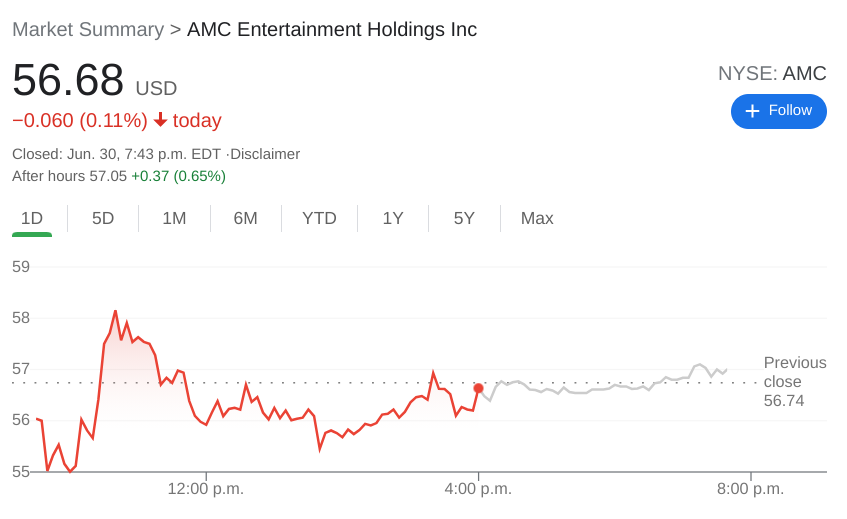
  • NYSE:AMC dipped by 0.11% on Wednesday during another choppy day of trading for the broader markets.
  • Robinhood to pay the largest FINRA penalty ever at $70 million USD.
  • Black Widow receives positive reviews ahead of its anticipated debut.

NYSE:AMC has been quiet as of late, and surprisingly the stock has maintained its over inflated valuation despite the momentum of the short squeeze dying down. On Wednesday, shares of AMC trimmed 0.11% to close the trading session at $56.68, during a relatively choppy yet uneventful session for the broader markets. GameStop (NYSE:GME) gained 1.62% and BlackBerry (NYSE:BB) trimmed off 0.20%, as the meme stocks had a flat day on much lower than average trading volume, another sign that the latest meme short squeeze could be fading.


Stay up to speed with hot stocks' news!


The fallout from the original meme stock short squeeze will see retail trading app Robinhood slapped with the largest FINRA fine in history. Robinhood will be forced to pay $70 million in fines with $13 million being paid back to its clients in restitution. FINRA cited that Robinhood was responsible for the system outages that disabled trading for its users and cost them millions of dollars over the span of a few days. Robinhood expected the fine to be closer to $26 million, so the $70 million in fines will be an unexpected cost to the company as it approaches an IPO with a $30 billion valuation. 

AMC stock forecast
AMC and its shareholders are anticipating a rapid return to theaters this summer as the American economy reopens following the COVID-19 pandemic. With summer blockbusters on the way, it is expected that Marvel’s Black Widow will be the biggest hit of the season. So far a week ahead of its debut, Black Widow has received rave reviews from critics, so AMC could be in for another big weekend after July 9th. 

Author

More from Stocks Reporter
Share:

Editor's Picks

AUD/USD turns south toward 0.6900 as USD firms up

AUD/USD sees fresh selling and drops toward 0.6900 in late Asian trading on Monday, as renewed US Dollar strength weighs on the pair amid lingering Middle East and Russia-Ukraine geopolitical tensions. Focus remains on Oil prices, Treasury bond yields, and RBA expectations for fresh trading impetus in the major.

USD/JPY retakes 158.00 amid hawkish BoJ bets, firmer USD

USD/JPY erases losses and retakes 158.00 in the Asian session on Monday, trading within a one-week-old range. Geopolitical uncertainty continues to underpin the US Dollar, despite fading Fed rate hike hopes, supporting the pair's rebound. However, further upside could be capped by hawkish BoJ expectations and looming intervention risks that could support the Japanese Yen.

Gold flirts with $4,100, four-day lows

Gold adds to Friday’s losses and comes closer to the key $4,100 mark per troy ounce at the beginning of the week. The yellow metal’s retracement comes in response to the persistent advance in the US Dollar in combination with the resurgence of the upside momentum in US Treasury yields across the curve.

Crypto Today: Bitcoin rally slows while Ethereum and XRP extend recovery amid slowing ETF inflows

Bitcoin is narrowly consolidating while trading above $86,000 at the time of writing on Monday. Altcoins, on the other hand, show a positive outlook, with Ethereum edging higher above $2,700 while Ripple steadies above $1.52.

Eurozone inflation just hit 3.8%, its highest in three years. This chart shows why the ECB can’t simply hike its way out

The ECB would normally have a relatively straightforward answer to inflation running almost twice its target: raise interest rates. But these are not normal circumstances. This time, the bond market is already doing part of the tightening for it, leaving the ECB facing an increasingly difficult dilemma.

Eurozone inflation just hit 3.8%, its highest in three years. This chart shows why the ECB can’t simply hike its way out

The ECB would normally have a relatively straightforward answer to inflation running almost twice its target: raise interest rates. But these are not normal circumstances. This time, the bond market is already doing part of the tightening for it, leaving the ECB facing an increasingly difficult dilemma.
















