Amazon Stock News and Forecast: The great 20-for-1 AMZN split arrives
- On Monday Amazon will give investors 20 shares for every one they owned on Friday, June 3.
- The new split-adjusted shares are trading at $123.33 in Monday's premarket.
- Typically, share splits cause a rally in price action.

Amazon (AMZN) is set to trade in the low $120s for the first time since 2010. That is because the king of ecommerce, starting Monday, June 6, will begin trading at its new price based on a 20-for-1 share split. After closing up at $2,447 on Friday, AMZN stock is already exchanging hands at $123.33, which is about 0.8% higher than Friday's split-adjusted closing price of $122.35. Data from Bank of America states that on average S&P 500 companies that have share splits gain 25% over the following 12 months as their share prices become more attractive to retail buyers scared about high share prices.
Amazon Stock News: Anti-trust bill worries big tech
Besides the impending stock split, an impending bill being discussed in US congress has most of big tech up in arms. The American Innovation & Choice Online Act (AICOA) would stop big tech from "self-preferencing." This means that Amazon could not use its dominance in ecommerce, persay, to push third-party sellers to use Amazon Web Services for their separate web hosting needs. Google could not use its search engine to favour its own Gmail service ahead of other email providers.
Amazon and Google parent Alphabet are the two biggest opponents to the bill, but observers say it also specifically targets business strategies used by Apple (AAPL) and Facebook parent Meta Platforms (FB). The bill was spearheaded by Senator Amy Klobuchar (D-Minnseota) and House Representative David Cicilline (D-RI) but is said to have ample Republican support as well. A story in The Financial Times on Monday claims that Congressional offices are being bombarded by lobbyists for Silicon Valley's largest corporations.
Yelp is an outlier and believes AICOA would make the tech landscape more competitive for smaller entrants. FT quoted Yelp's Senior Vice-President of Public Policy Luther Lowe as saying, “The internet giants are in Yolo [you only live once] mode — they are desperate and are doing whatever they can to change the trajectory."
Zoe Lofgren (D-CA) has come out against the bill as well, saying it targets certain big tech platforms implicitly, which is against prior precedent.
Amazon Stock Forecast: Daily and weekly charts in disagreement
Amazon's daily chart is showing optimistic signs for short-term gains. The 9-day moving average has overtaken the 21-day moving average on Friday. Meanwhile, the Moving Average Convergence Divergence (MACD) indicator has been turning higher with the MACD line crossing above the signal line. If these two lines reach the zero bound, then it becomes an even better signal of continued advancing price. $126 is the target for bulls at the moment, but $146 will come into view if retail investors decide to get in on the excitement.
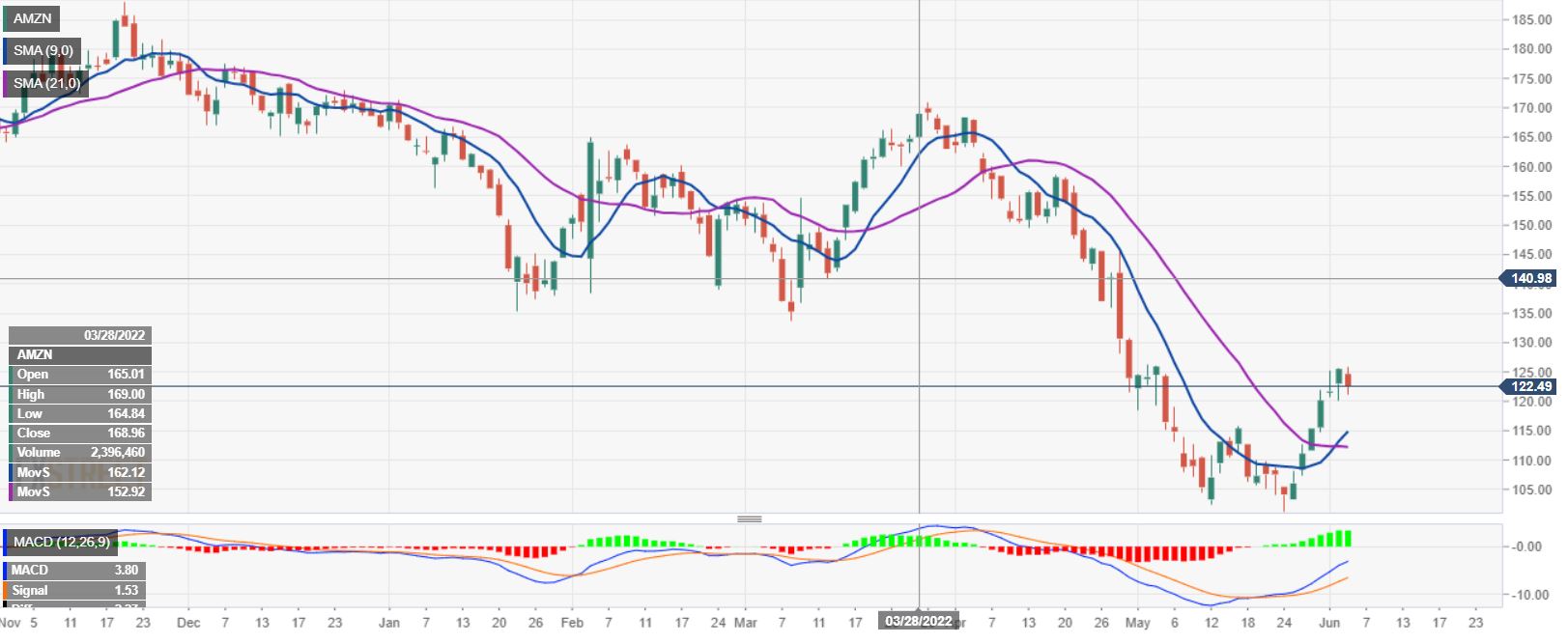
AMZN 1-day chart
The new support lines come from a consolidation area between April and June of 2020, as seen on the weekly chart below. Current price action near $122.50 is at the top of the consolidation zone, and Amazon stock might have support there. The bottom of the zone, at $112.95, should provide support as well. Falling support could also lead price action to drop to $101.95 in the event that inflation grows worse or prophecies of a recession are made real over the next several months. Notice how the MACD on the weekly chart remains bearish, unlike the daily.
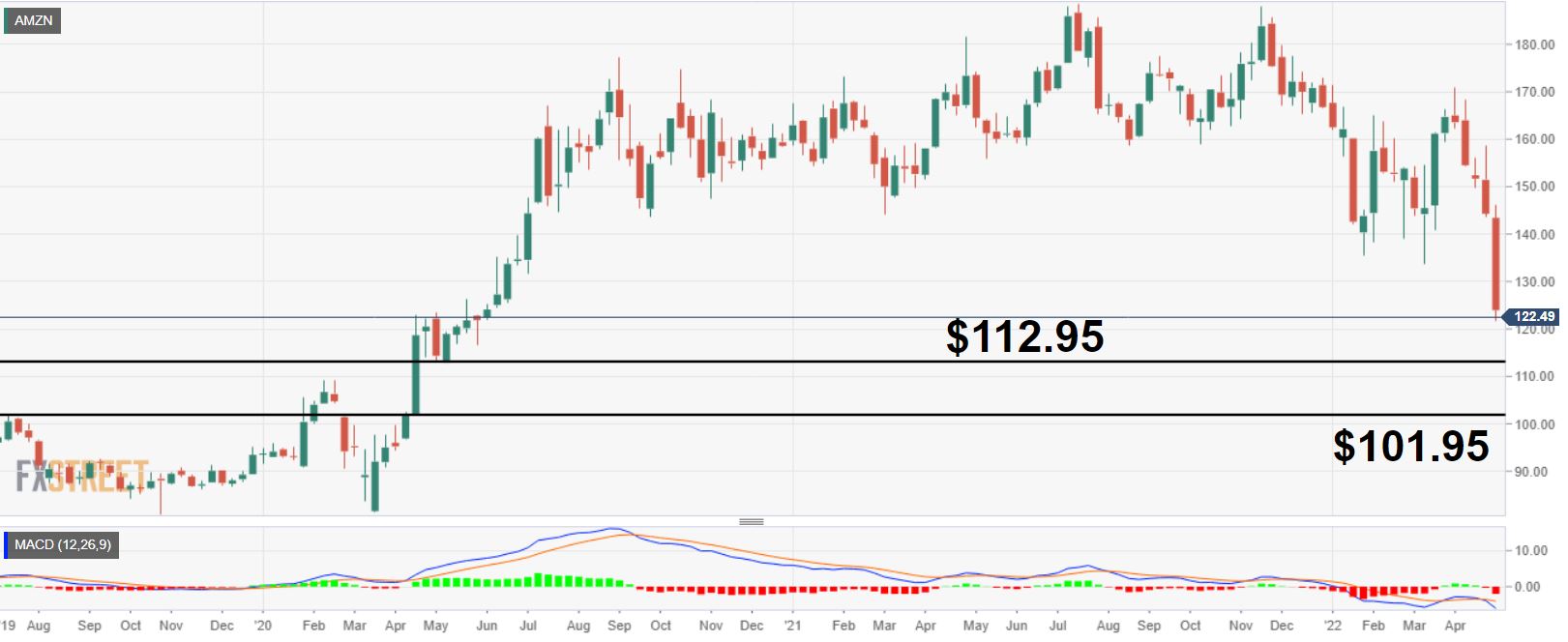
AMZN weekly chart
Like this article? Help us with some feedback by answering this survey:
Author

Clay Webster
FXStreet
Clay Webster grew up in the US outside Buffalo, New York and Lancaster, Pennsylvania. He began investing after college following the 2008 financial crisis.