Amazon handily beats Q2 earnings consensus, hikes Q3 guidance
- Amazon beats Wall Street earnings consensus for Q2 by 26%.
- Revenue arrives $5.6 billion ahead of estimates.
- AMZN stock sinks 3.7% despite earnings beat, guidance hike.


Amazon (AMZN) initially fell 2.6% afterhours following impressive second-quarter results. The largest US online retailer and largest cloud hyperscaler reported adjusted earnings per share (EPS) of $1.68, which was 26% or $0.35 ahead of the Wall Street consensus.
Revenue of $167.7 billion was also $5.6 billion above the Street's projection.
North America sales rose 11% YoY, international sales gained 16% YoY, aided by exchange rates, and AWS segment sales surged 17.5% from a year ago.
Looking ahead to the third quarter, Amazon predicted revenue will rise to a midpoint of $176.25 billion, well above the Street's estimate of $173.2 billion. Operating income guidance for Q3 was placed at $18 billion, slightly advancing from the $17.4 billion in Q3 2024.
One sore point was free cash flow, which is stuck at $18.2 billion over the trailing 12 months. This compares unfavorably to the $53 billion seen in the previous 12-month period.
“Our conviction that AI will change every customer experience is starting to play out as we’ve expanded Alexa+ to millions of customers, continue to see our shopping agent used by many millions of customers, launched AI models like DeepFleet that optimize productivity paths for our 1M+ robots, made it much easier for software developers to write code with Kiro (our new agentic IDE), launched Strands to make it easier to build AI agents, and released Bedrock AgentCore to enable agents to be operated securely and scalably,” said CEO Andy Jassy in a statement.
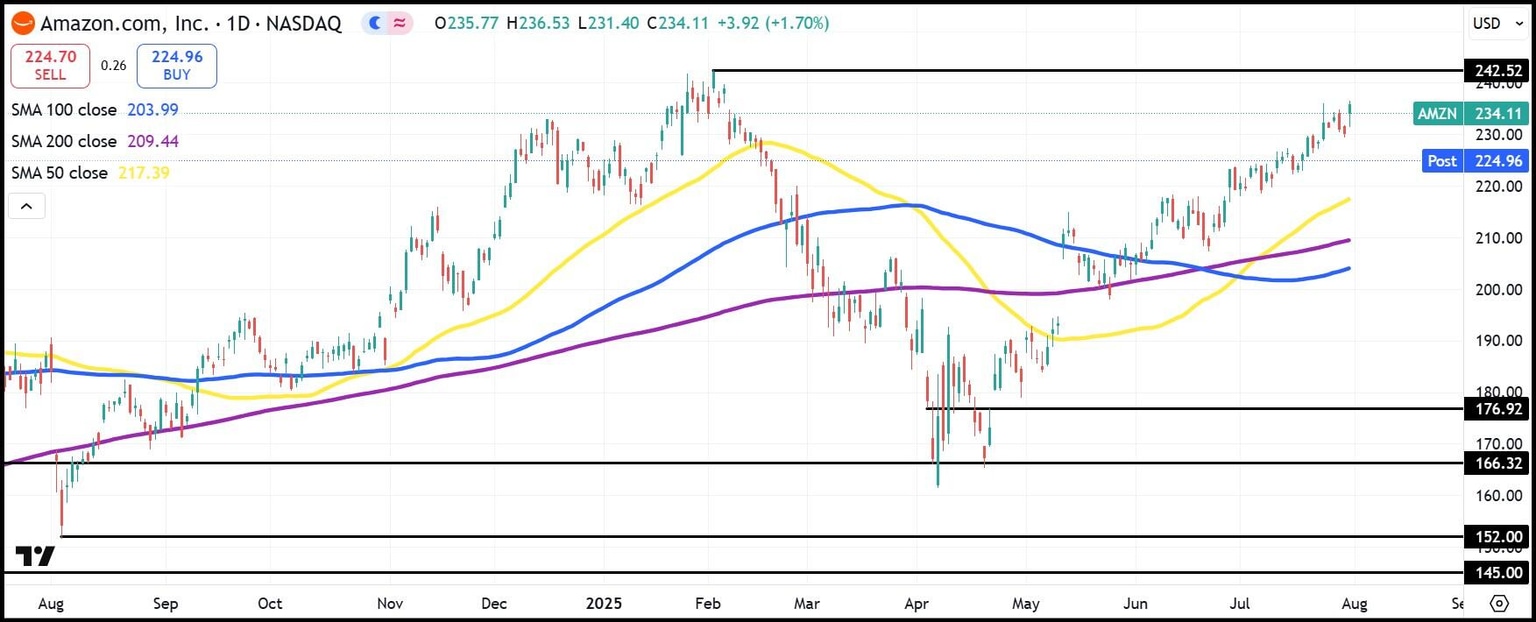
AMZN daily stock chart
Premium
You have reached your limit of 3 free articles for this month.
Start your subscription and get access to all our original articles.
Author
Clay Webster
FXStreet
Clay Webster grew up in the US outside Buffalo, New York and Lancaster, Pennsylvania. He began investing after college following the 2008 financial crisis.

















