Alibaba Stock Forecast: With 7% gain, BABA reaches six-month high
- Alibaba stock reaches highest level since November 15, 2023.
- BABA shares gain 7.1% as 13Fs get filed by institutions.
- David Tepper, Michael Burry have both been grabbing shares.
- JD.com saw ADS earnings rise 19% from a year earlier.


Alibaba (BABA) closed up 7.1% on Thursday as the ecommerce giant benefited more from JD.com’s earnings beat than its own. This gain, the best since January 23, puts Alibaba stock in striking distance of an important resistance band on the daily chart as it trades at a six-month high.
Additionally, 13F filings this week are showing that BABA continues to attract star investors to its fold.
Alibaba shares sold off earlier this week following its own earnings that replayed meager growth and management’s attempt to persuade shareholders by introducing a special dividend.
Alibaba stock news
One of Alibaba’s primary competitors, JD.com boasted a 7% annual revenue gain to $36 billion in the first quarter. Even better, earnings per ADS rose 19% from a year ago.
Rather than digging into Alibaba’s business, this was seen as a sign that the Chinese economy was more robust than many observers expected. JD.com stock did not fare as well as BABA though, rising just 1.9% in the session.
However, Alibaba stock is benefiting from the all-star investors who are taking a second look at the stock. On Thursday, 13F filings from hedge funds, family offices and other institutional investors were released for the first quarter.
In the quarter ending March 31, David Tepper’s Appaloosa Management hedge fund doubled its investment in Alibaba stock to more than $800 million. Additionally, Tepper bought more Baidu (BIDU) and PDD Holdings (PDD). Overall, it showed a strong sign of trust in the Chinese stock market, a market that has been ignored over the past two years by a large swath of Wall Street big-wigs.
Besides Tepper, Michael Burry of Scion Asset Management, his family office, added to his BABA stash, increasing it by 67% in the first quarter to $9 million. Burry has been adding to his Alibaba stake since the third quarter of 2023, and it appears he will continue doing so until there is a major reversal higher for the famed company.
AsianStocks FAQs
Asia contributes around 70% of global economic growth and hosts several key stock market indices. Among the region’s developed economies, the Japanese Nikkei – which represents 225 companies on the Tokyo stock exchange – and the South Korean Kospi stand out. China has three important indices: the Hong Kong Hang Seng, the Shanghai Composite and the Shenzhen Composite. As a big emerging economy, Indian equities are also catching the attention of investors, who increasingly invest in companies in the Sensex and Nifty indices.
Asia’s main economies are different, and each has specific sectors to pay attention to. Technology companies dominate in indices in Japan, South Korea, and increasingly, China. Financial services are leading stock markets such as Hong Kong or Singapore, considered key hubs for the sector. Manufacturing is also big in China and Japan, with a strong focus on automobile production or electronics. The growing middle class in countries like China and India is also giving more and more prominence to companies focused on retail and e-commerce.
Many different factors drive Asian stock market indices, but the main factor behind their performance is the aggregate results of the component companies revealed in their quarterly and annual earnings reports. The economic fundamentals of each country, as well as their central bank decisions or their government’s fiscal policies, are also important factors. More broadly, political stability, technological progress or the rule of law can also impact equity markets. The performance of US equity indices is also a factor as, more often than not, Asian markets take the lead from Wall Street stocks overnight. Finally, the broader risk sentiment in markets also plays a role as equities are considered a risky investment compared to other investment options such as fixed-income securities.
Investing in equities is risky by itself, but investing in Asian stocks comes along with region-specific risks to be taken into account. Asian countries have a wide range of political systems, from full democracies to dictatorships, so their political stability, transparency, rule of law or corporate governance requirements may diverge considerably. Geopolitical events such as trade disputes or territorial conflicts can lead to volatility in stock markets, as can natural disasters. Moreover, currency fluctuations can also have an impact on the valuation of Asian stock markets. This is particularly true in export-oriented economies, which tend to suffer from a stronger currency and benefit from a weaker one as their products become cheaper abroad.
Alibaba stock forecast
Alibaba stock traded up to its highest level since November 15, 2023. Interestingly, the stock yielded before hitting the resistance band or supply zone between $87.80 and $88.80. That level has held significance since at least September of last year.
A break through that thicket would allow bulls to retest the $95.00 level, although that price tag largely worked as a support floor last summer.
The $80.00 level should now work as support over the near term as the 200-day Simple Moving Average (SMA) is traveling just below it. The 50-day SMA has only just moved above the 100-day SMA, a bullish sign that needs to be confirmed by the 50-day overtaking the 200-day soo enough.
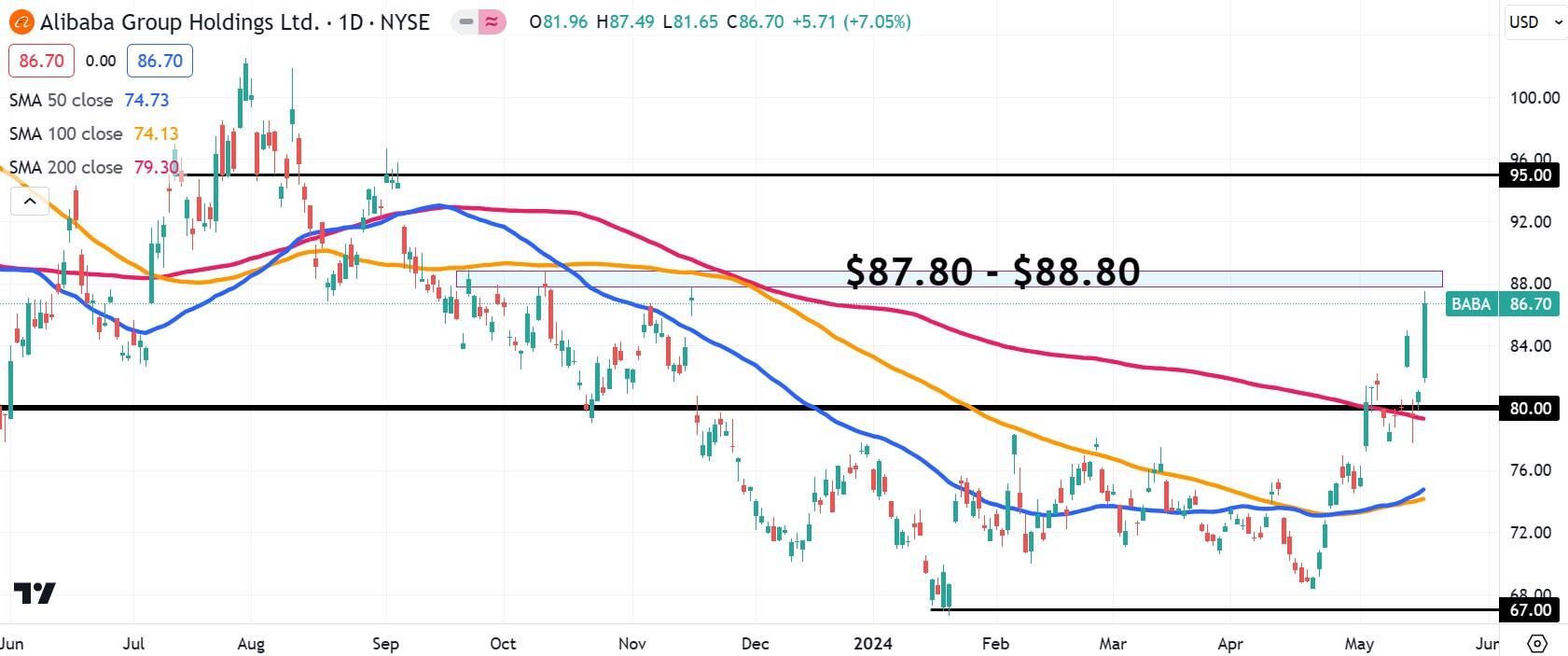
BABA daily stock chart
Premium
You have reached your limit of 3 free articles for this month.
Start your subscription and get access to all our original articles.
Author
Clay Webster
FXStreet
Clay Webster grew up in the US outside Buffalo, New York and Lancaster, Pennsylvania. He began investing after college following the 2008 financial crisis.