AEM's Q4 earnings surpass on higher realized Gold prices

Agnico Eagle Mines Limited (AEM) reported adjusted earnings of $2.69 per share for the fourth quarter of 2025, up from $1.26 in the year-ago quarter. The bottom line topped the Zacks Consensus Estimate of $2.56.
The company generated revenues of $3,564 million, up roughly 60.3% year over year. The top line surpassed the Zacks Consensus Estimate of $3,240.7 million.
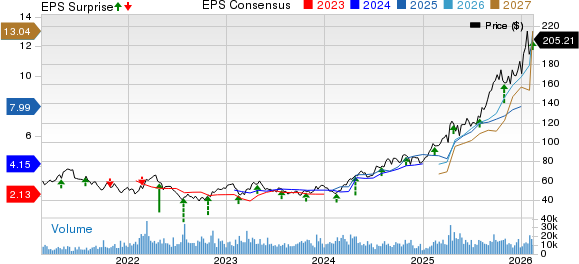
Agnico Eagle Mines Limited price, consensus and EPS surprise
AEM’s operational highlights
Payable gold production was 840,608 ounces in the reported quarter, down from 847,401 ounces in the prior-year quarter. The figure surpassed our estimate of 839,674 ounces.
Total cash costs per ounce for gold were $1,089, up from $923 a year ago. It was higher than our estimate of $945.
Realized gold prices were $4,163 per ounce in the quarter, up from $2,660 a year ago. It outpaced our estimate of $3,593.
All-in-sustaining costs (AISC) were $1,517 per ounce in the quarter, higher than $1,316 per ounce a year ago. It was higher than our estimate of $1,315.
AEM’s financial position
AEM ended the quarter with cash and cash equivalents of $2,866 million, up 21.7% sequentially. Long-term debt was around $196.3 million.
Total cash from operating activities amounted to $2,112 million in the fourth quarter, up from $1,132 million a year ago.
AEM’s outlook
For 2026, the company expects gold production to be between 3.3 million and 3.5 million ounces. Total cash costs per ounce are projected between $1,020 and $1,120, while AISC is forecasted in the range of $1,400 to $1,550 per ounce.
Exploration and corporate development expenses are expected to be between $275 million and $305 million, with a midpoint of $290 million. Depreciation and amortization expenses are forecasted to be $1.55-$1.75 billion, averaging $1.65 billion. The company anticipates general and administrative expenses to be in the $230 million to $260 million range, with other costs projected between $75 million and $95 million.
The effective tax rate for 2026 is expected to be between 34% and 36%, with cash taxes estimated in the range of $3.4 billion to $3.6 billion. The company also plans capital expenditures (excluding capitalized exploration) of roughly $2.2-$2.4 billion, and capitalized exploration spending is forecasted be in the band of $290-330 million.
AEM’s price performance
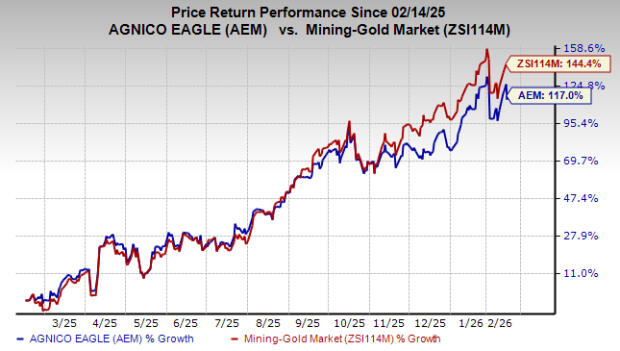
Agnico Eagle’s shares have gained 117% in the past year compared with the 144.4% rise of the industry.
AEM’s Zacks rank and other key picks
AEM currently carries a Zacks Rank #2 (Buy).
Some other top-ranked stocks in the basic materials space are Coeur Mining, Inc. (CDE), Valmont Industries Inc. (VMI) and Avino Silver & Gold Mines Ltd. (ASM).
Coeur is scheduled to report fourth-quarter results on Feb. 18. The Zacks Consensus Estimate for CDE’s fourth-quarter earnings is pegged at 42 cents. CDE beat the Zacks Consensus Estimate in three of the last two quarters and missed once, the average earnings surprise being 106.61%. CDE currently flaunts a Zacks Rank #1 (Strong Buy) at present.
Valmon is slated to report fourth-quarter results on Feb. 17. The Zacks Consensus Estimate for earnings is pegged at $4.95 per share. VMI beat the Zacks Consensus Estimate in each of the last four quarters, the average earnings surprise being 4.38%. VMI carries a Zacks Rank #2.
Avino Silver is slated to report fourth-quarter results on March 11. The consensus estimate for ASM’s earnings is pegged at 6 cents. ASM, presently carrying a Zacks Rank #2, beat the consensus estimate in the last four quarters, the average earnings surprise being 150%.
Want the latest recommendations from Zacks Investment Research? Download 7 Best Stocks for the Next 30 Days. Click to get this free report
Author

Zacks
Zacks Investment Research
Zacks Investment Research provides unbiased investment research and tools to help individuals and institutional investors make confident investing decisions.
















