Advanced Micro Devices Stock News and Forecast: AMD set to continue slide lower on Friday
- AMD stock closed down 5.3% on Thursday.
- Russia-Ukraine conflict continues to push stock markets lower.
- Micron has been given a investment grade rating by Fitch.

Advanced Micro Devices (AMD) is set to open much lower on Friday, one day after dropping more than 5%. Friday's premarket sees AMD shares trading hands at $109.72, down 2%. Shares opened lower and then preceded to continue diving throughout Thursday's session, closing the session down 5.3% at $11.98. The ongoing conflict in Ukraine is a primary reason for the end of the week's risk-off stance. Over the past 24 hours, Russia shelled and then took over Europe's largest nuclear power plant, Zaporizhzhia, in Ukraine. Now there are reports of a second power plant being overrun.
Advanced Micro Devices Stock News: Russia-Ukraine has entire market down
Asian and European markets also dropped on Friday on news of the power plant attack. The Nikkei 225 dropped 2.2%, and at the time of writing the FTSE 100 is down 3.3%.
News on the semiconductor front has been scarce. At first, some observers were worried about the Russia-Ukraine conflict affecting the industry, since Neon gas and Palladium are exported from both Ukraine and Russia, respectively. The market, however, seems to be taking this fact and flipping it on its head. Supply shortages will only increase prices in the already constrained semiconductor business, so the war may not prove too worrying for chip designers like AMD. Russia and Ukraine together only combine for 3% or less of global chip demand, according to some estimates.
Competitor Micron Technology (MU) has been upgraded by Fitch to a BBB debt rating. This rating puts it in the "investment grade" category and means it will now have access to cheaper debt. In its note, Fitch said chip component shortages were giving semiconductor companies heavier demand and thus making them safer investments in the near term. This probably applies to AMD as well.
Advanced Micro Devices announced a new $8 billion share repurchase program in late February. The program comes before the prior $4 billion repurchase policy announced in May 2021 has finished. $1 billion worth of AMD stock remains to be purchased from that program. Investors can look forward to a total of $9 billion worth of buybacks ahead, which may be utilized currently with the share price dropping below $110.
Analysts at Bank of America said last week that Advanced Micro Devices should benefit from the GPU upgrade cycle, arguing it will be longer due to constrained supply and that AMD can expect healthy growth in the second half of the year. AllianceBernstein gave AMD its first outperform rating in a decade and a price target of $150 recently.
AMD key statistics
| Market Cap | $185 billion |
| Price/Earnings | 35 |
| Price/Sales | 8 |
| Price/Book | 18 |
| Enterprise Value | $182 billion |
| Operating Margin | 22% |
| Profit Margin |
19% |
| 52-week high | $164.46 |
| 52-week low | $72.50 |
| Short Interest | 6% |
| Average Wall Street Rating and Price Target | Buy, $153.59 |
Advanced Micro Devices Stock Forecast: AMD close to breaking out of wedge pattern
The wedge that formed on the daily chart due to February 24's $103 low and the top descending trendline that began on November 30 converge at a $109 apex. AMD stock needs to close above approximately $122 to break out of this wedge.
At this point it seems as if AMD is trying to retouch the bottom trendline near $105 before making another run at the top line.
On February 18, the 50-day moving average dropped below the 100-day, always a bad sign for bulls. This may be a reason to wait out the current downturn.
February 9's range high at $132.96 is still the upside target. The 50-day moving average cut below the 100-day moving average just above here. Breaking through the bottom trendline would send AMD stock down to $100 for support.
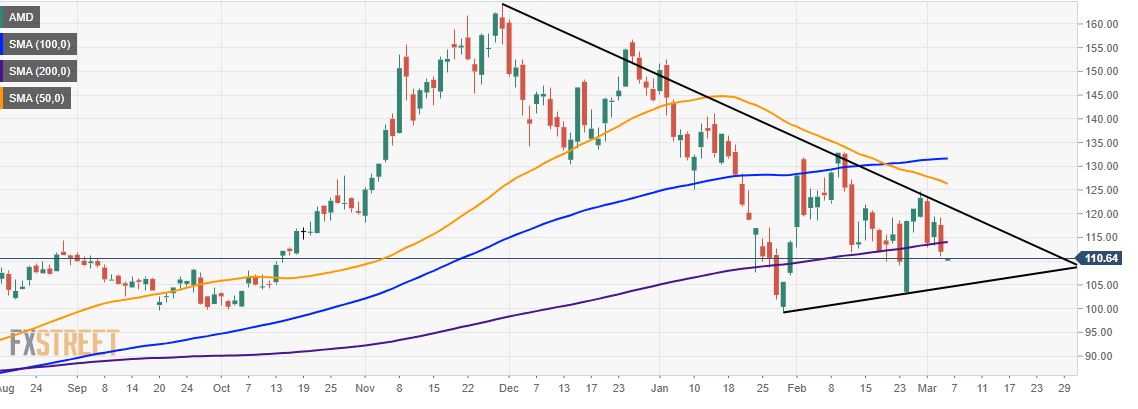
AMD 1-day chart
Premium
You have reached your limit of 3 free articles for this month.
Start your subscription and get access to all our original articles.
Author

Clay Webster
FXStreet
Clay Webster grew up in the US outside Buffalo, New York and Lancaster, Pennsylvania. He began investing after college following the 2008 financial crisis.