XRP bears tighten grip as retail activity slows
- XRP extends its correction below $2.18 support amid a sell-off gripping crypto majors.
- XRP faces increasing downside risks amid neutral retail activity.
- Whale-to-exchange transactions cool down in November after a significant spike in October.

Ripple (XRP) edges lower, trading below $2.18 at the time of writing on Friday. The sell-off has affected most major cryptocurrencies, including Bitcoin (BTC), which hovers above $100,000 and Ethereum (ETH), trading below $3,250.
Several attempts to sustain price recovery have failed, resulting in losses. The sticky risk-off sentiment can be attributed to macroeconomic uncertainty amid the extended United States (US) government shutdown, low retail activity and a lack of significant price catalysts within the ecosystem, among other factors.
XRP retail activity slows as sellers tighten grip
XRP retail activity remains in the neutral zone following the October 10 aggressive sell-off, which resulted in the largest single-day liquidation event in the crypto market. At least $19 billion was wiped out, leaving traders counting losses and investors demoralised.
The Neutral zone, as observed in CryptoQuant’s chart below, indicates that retail investors have retreated to the sidelines until sentiment in the broader cryptocurrency market improves. Conversely, neutral conditions also suggest that XRP is approaching a potential bottom, with buy-the-dip opportunities emerging.
-1762528075569-1762528075570.png)
Meanwhile, whale-to-exchange (Binance) transactions have significantly declined over the past week, following several spikes in October. Roughly 800 transactions of this nature have been recorded on Friday, down from approximately 49,000 on October 25 and 44,000 on October 11.
Investors transfer their assets to exchanges intending to trade or sell. Hence, spikes in whale-to-exchange transactions often precede heightened volatility. Fewer whales sending XRP to exchanges decreases potential selling pressure, which could pave the way for a steady recovery.
-1762528103887-1762528103887.png)
Technical outlook: XRP bears tighten their grip
XRP has given back intraday gains after topping out at $2.23 on Friday, resulting in an extended drawdown below $2.18. The daily chart shows that sellers have the upper hand, particularly with the Relative Strength Index (RSI) falling to 35, from 42 on Wednesday.
Investors will likely remain bearish heading into the weekend, citing a sell signal from the Moving Average Convergence Divergence (MACD) indicator since Tuesday. Sentiment may remain bearish as long as the blue line holds below the red signal line and the indicator continues to edge lower.
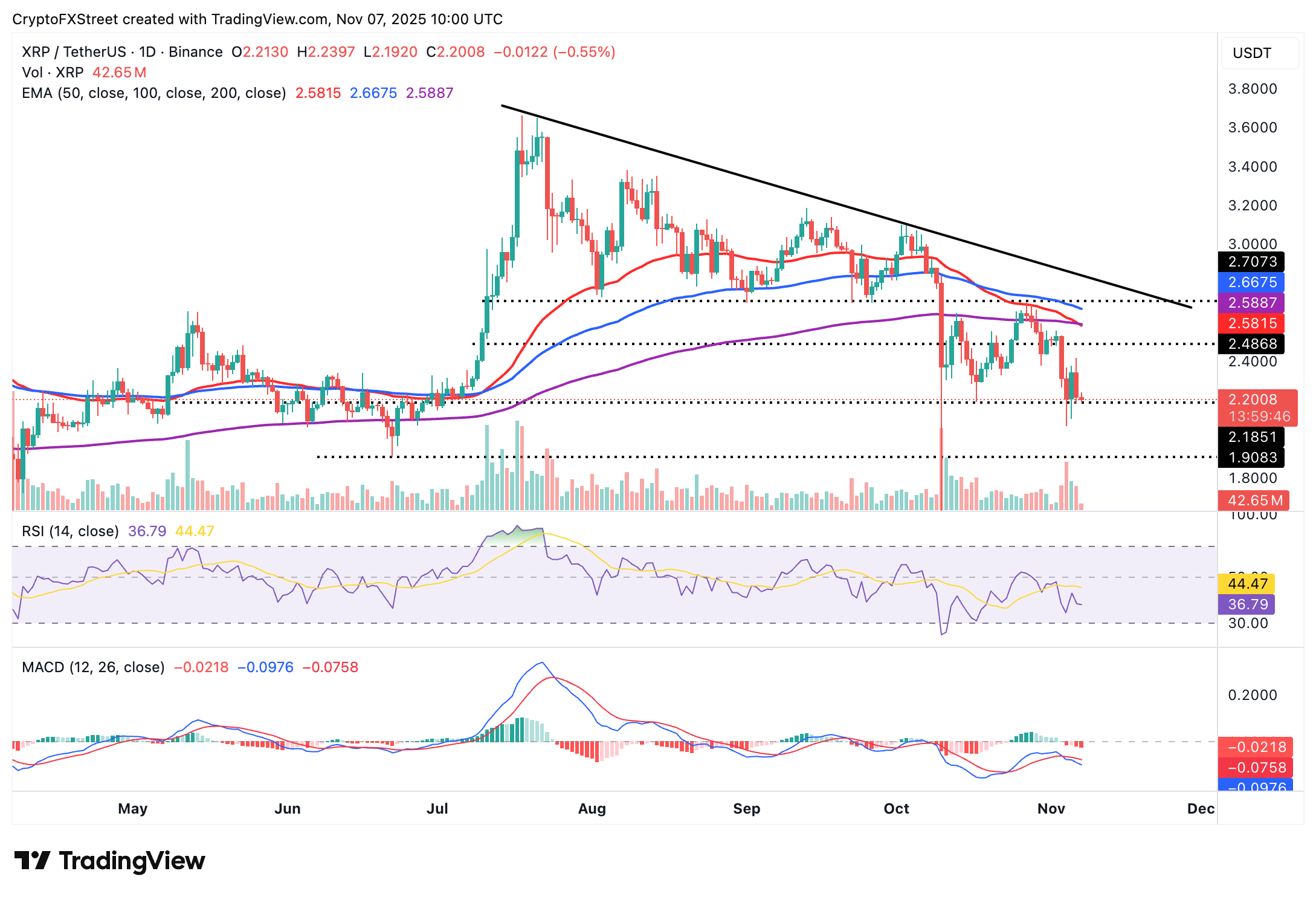
A Death Cross is a bearish pattern, which occurs when a shorter-term moving average crosses below a longer-term one. From the daily chart above, the 50-day EMA at $2.58 is on the verge of crossing below the 200-day EMA, bolstering the bearish outlook.
Still, if bulls seek exposure by buying the dip, XRP could resume its uptrend, targeting highs above the confluence of the 200-day and 50-day EMAs at $2.58.
Cryptocurrency prices FAQs
Token launches influence demand and adoption among market participants. Listings on crypto exchanges deepen the liquidity for an asset and add new participants to an asset’s network. This is typically bullish for a digital asset.
A hack is an event in which an attacker captures a large volume of the asset from a DeFi bridge or hot wallet of an exchange or any other crypto platform via exploits, bugs or other methods. The exploiter then transfers these tokens out of the exchange platforms to ultimately sell or swap the assets for other cryptocurrencies or stablecoins. Such events often involve an en masse panic triggering a sell-off in the affected assets.
Macroeconomic events like the US Federal Reserve’s decision on interest rates influence crypto assets mainly through the direct impact they have on the US Dollar. An increase in interest rate typically negatively influences Bitcoin and altcoin prices, and vice versa. If the US Dollar index declines, risk assets and associated leverage for trading gets cheaper, in turn driving crypto prices higher.
Halvings are typically considered bullish events as they slash the block reward in half for miners, constricting the supply of the asset. At consistent demand if the supply reduces, the asset’s price climbs.
Author

John Isige
FXStreet
John Isige is a seasoned cryptocurrency journalist and markets analyst committed to delivering high-quality, actionable insights tailored to traders, investors, and crypto enthusiasts. He enjoys deep dives into emerging Web3 tren