Whales drop stablecoins like hotcakes, analysts wait for turnaround in Bitcoin demand
- Whale stablecoin holdings have dropped consistently since June.
- Stablecoin holdings of whales are at their lowest level in six months.
- On-chain analysts suggest that once whale wallets larger than $5 million begin adding stablecoins, a Bitcoin recovery can emerge.

Large wallet investors’ stablecoin holdings have typically been considered an indicator for determining whether there is demand or buying power in the crypto market. A rise in stablecoin balances of the wallets could indicate a recovery in Bitcoin, according to on-chain analysts on crypto intelligence tracker Santiment.
Also read: Optimism airdrop distributes 19 million OP tokens to more than 31,000 addresses
Whale buying power should fuel Bitcoin price demand
Whale wallets holding more than $5 million worth of stablecoins own over 51.14% of stablecoin supply, the lowest level since March 18. Analysts at Santiment note that a spike in whale holdings increases buying pressure on Bitcoin and acts as a catalyst for BTC price rallies.
In June 2023, Bitcoin price crossed $30,000. Analysts identified this by observing the change in stablecoin holdings of whales holding $5 million or more in stablecoins.
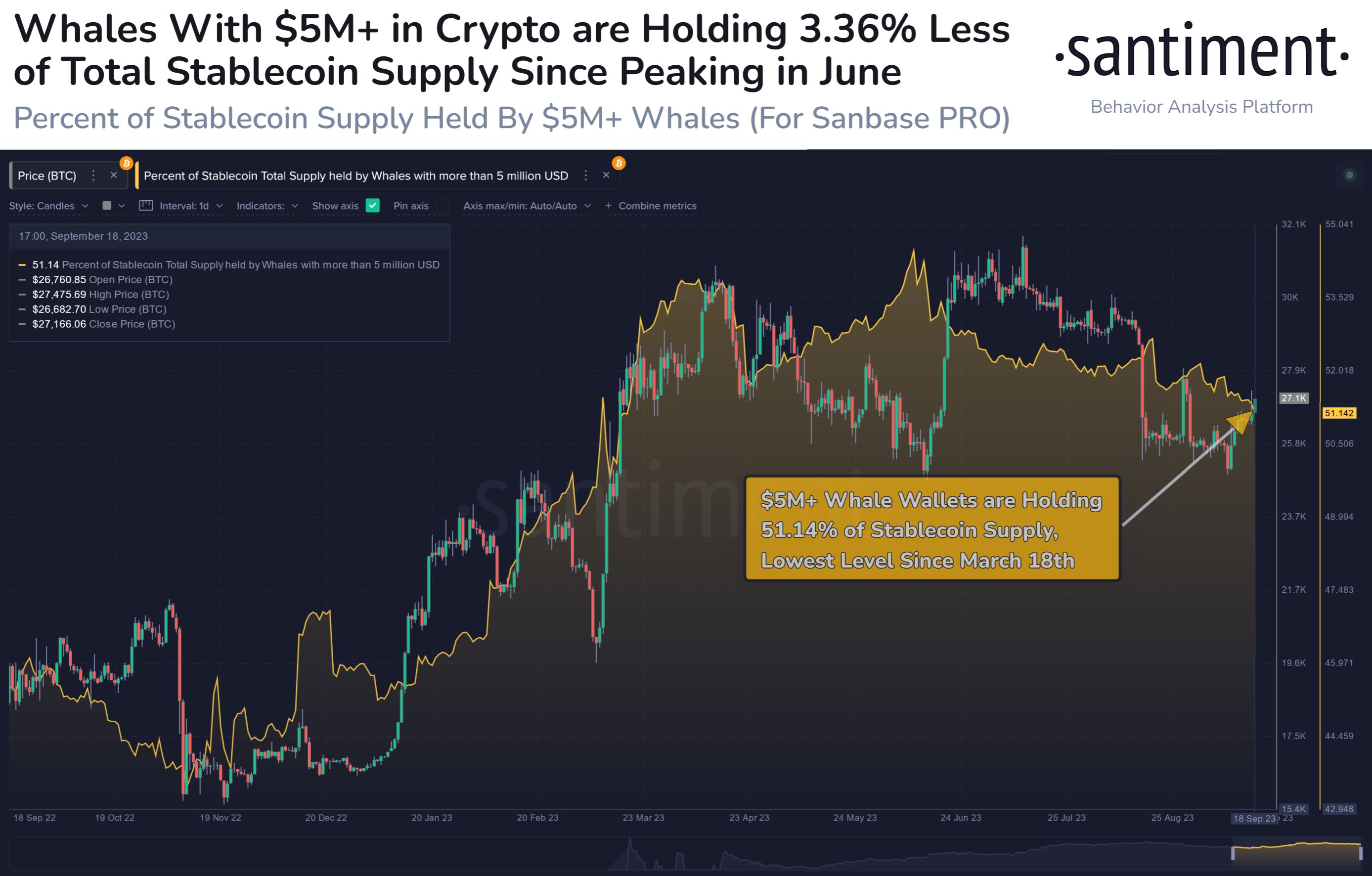
Whales with $5 million in crypto
As of September 20, the stablecoin holdings of these whales have hit the lowest point in six months. Market participants can typically predict a recovery in BTC price as large wallets in this segment begin accumulating stablecoins. This could increase demand for the largest asset by market capitalization across centralized exchanges, and in turn, drive prices higher.
Bitcoin price is above the $27,000 level on Binance at the time of writing. BTC price is above three long-term Exponential Moving Averages (EMAs) at $26,615, $27,037 and $25,883, respectively. A recovery in stablecoin demand from whales could catalyze BTC price recovery, driving it toward its August 29 intraday high of $28,000.
Bitcoin, altcoins, stablecoins FAQs
What is Bitcoin?
Bitcoin is the largest cryptocurrency by market capitalization, a virtual currency designed to serve as money. This form of payment cannot be controlled by any one person, group, or entity, which eliminates the need for third-party participation during financial transactions.
What are altcoins?
Altcoins are any cryptocurrency apart from Bitcoin, but some also regard Ethereum as a non-altcoin because it is from these two cryptocurrencies that forking happens. If this is true, then Litecoin is the first altcoin, forked from the Bitcoin protocol and, therefore, an “improved” version of it.
What are stablecoins?
Stablecoins are cryptocurrencies designed to have a stable price, with their value backed by a reserve of the asset it represents. To achieve this, the value of any one stablecoin is pegged to a commodity or financial instrument, such as the US Dollar (USD), with its supply regulated by an algorithm or demand. The main goal of stablecoins is to provide an on/off-ramp for investors willing to trade and invest in cryptocurrencies. Stablecoins also allow investors to store value since cryptocurrencies, in general, are subject to volatility.
What is Bitcoin Dominance?
Bitcoin dominance is the ratio of Bitcoin's market capitalization to the total market capitalization of all cryptocurrencies combined. It provides a clear picture of Bitcoin’s interest among investors. A high BTC dominance typically happens before and during a bull run, in which investors resort to investing in relatively stable and high market capitalization cryptocurrency like Bitcoin. A drop in BTC dominance usually means that investors are moving their capital and/or profits to altcoins in a quest for higher returns, which usually triggers an explosion of altcoin rallies.
Like this article? Help us with some feedback by answering this survey:
Author

Ekta Mourya
FXStreet
Ekta Mourya has extensive experience in fundamental and on-chain analysis, particularly focused on impact of macroeconomics and central bank policies on cryptocurrencies.