Wen moon? Data shows pro traders becoming more bullish on Bitcoin price

MicroStrategy’s purchase of 7,002 BTC might have helped boost Bitcoin price today, but derivatives data also shows that pro traders are becoming more bullish.
The $4,700 Bitcoin (BTC) price spike on Nov. 29 was likely a great relief for holders, but it seems premature to call the bottom according to derivative metrics.
This should not come as a surprise because Bitcoin price is still 15% below the $69,000 all-time high set on Nov. 10. Just 15 days later, the cryptocurrency was testing the $53,500 support after an abrupt 22% correction.
Today’s trend reversal was possibly encouraged by MicroStrategy’s announcement that it had acquired 7,002 Bitcoin on Monday at an average price of $59,187 per coin. The listed company raised money by selling 571,001 shares between Oct. 1 and Nov. 29, raising a total of $414.4 million in cash.
More bullish news came after German stock market operator Deutsche Boerse announced the listing of the Invesco Physical Bitcoin exchange-traded note or ETN. The new product will trade under the ticker BTIC on Deutsche Boerse's Xetra digital stock exchange.
Data shows pro traders are still neutral-to-bullish
To understand how bullish or bearish professional traders are positioned, one should analyze the futures basis rate. That indicator is also known as the futures premium, and it measures the difference between futures contracts and the current spot market at regular exchanges.
Bitcoin’s quarterly futures are the preferred instruments of whales and arbitrage desks. Even though derivatives might seem complicated for retail traders due to their settlement date and price difference from spot markets, the most notorious benefit is the lack of a fluctuating funding rate.
Bitcoin 3-month futures basis rate. Source: Laevitas.ch
The three-month futures typically trade with a 5%–15% annualized premium, which is deemed an opportunity cost for arbitrage trading. By postponing settlement, sellers demand a higher price and this causes the price difference.
Notice the 9% bottom on Nov. 27, as Bitcoin tested the $56,500 support. Then, after Monday’s rally above $58,000, the indicator shifted back to a healthy 12%. Even with this movement, there is no sign of excitement, but none of the past few weeks could be described as a bearish period.
Lending markets provide additional insight
Margin trading allows investors to borrow cryptocurrency to leverage their trading position, therefore increasing the returns. For example, one can buy Bitcoin by borrowing Tether (USDT), thus increasing the exposure. On the other hand, borrowing Bitcoin can only be used to short it or bet on the price decrease.
Unlike futures contracts, the balance between margin longs and shorts isn’t necessarily matched.
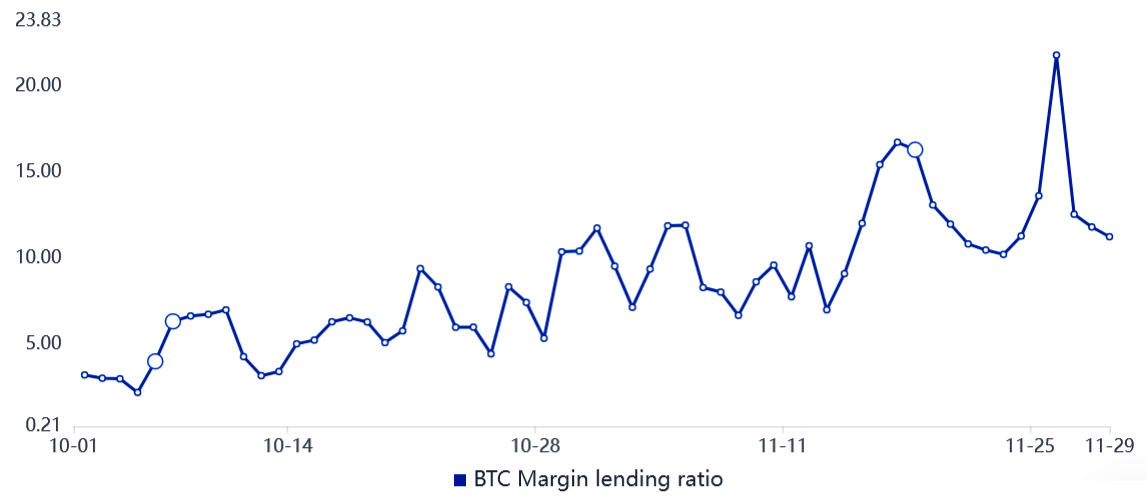
OKEx USDT/BTC margin lending ratio. Source: OKEx
When the margin lending ratio is high, it indicates that the market is bullish—the opposite, a low lending ratio signals that the market is bearish.
The chart above shows that traders have been borrowing more Bitcoin recently, because the ratio decreased from 21.9 on Nov. 26 to the current 11.3. However, the data leans bullish in absolute terms because the indicator favors stablecoin borrowing by a wide margin.
Derivatives data shows zero excitement from pro traders even as Bitcoin gained 9% from the $53,400 low on Nov. 28. Unlike retail traders, these experienced whales avoid FOMO, although the margin lending indicator shows signs of excessive optimism.
Author

Cointelegraph Team
Cointelegraph
We are privileged enough to work with the best and brightest in Bitcoin.