Vitalik Buterin wants rollups to hit stage one decentralization by year-end

Ethereum co-founder Vitalik Buterin is proposing to raise the bar on what’s considered a rollup in the Ethereum ecosystem — and suggests developers should aim to get their decentralization efforts in order by the end of the year.
The comments came in his latest blog post on March 28, reflecting on the year ahead following Ethereum’s latest Dencun upgrade, which significantly reduced transaction fees for rollups on layer 2.
Buterin noted that Ethereum was in the “process of a decisive shift” from a “very rapid L1 progress era” to an era where L1 progress will still be very significant.
He also said that Ethereum’s scaling efforts have shifted from a “zero-to-one” problem to an incremental problem, as further scaling work will focus on increasing blob capacity and improving rollup efficiency, he said.
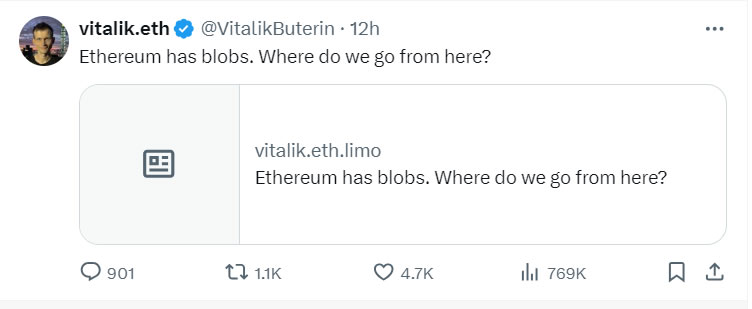
Source: Vitalik Buterin
He continued to state that the ecosystem’s standards will need to become stricter, adding:
By the end of the year, I think our standards should increase and we should only treat a project as a rollup if it has actually reached at least stage 1.
Stage 1 is Buterin’s classification of layer-2’s decentralization progress, whereby a network has advanced enough in terms of security and scaling but is not yet fully decentralized (which would be stage 2).
He observed that only five of the layer-2 projects listed on L2beat are at either stage 1 or 2, and only Arbitrum is fully EVM (Ethereum Virtual Machine) compatible.
The next steps on the roadmap include implementing data availability sampling to increase blob capacity to 16MB per slot, optimizing layer 2 solutions through techniques like data compression, optimistic execution, and improved security.
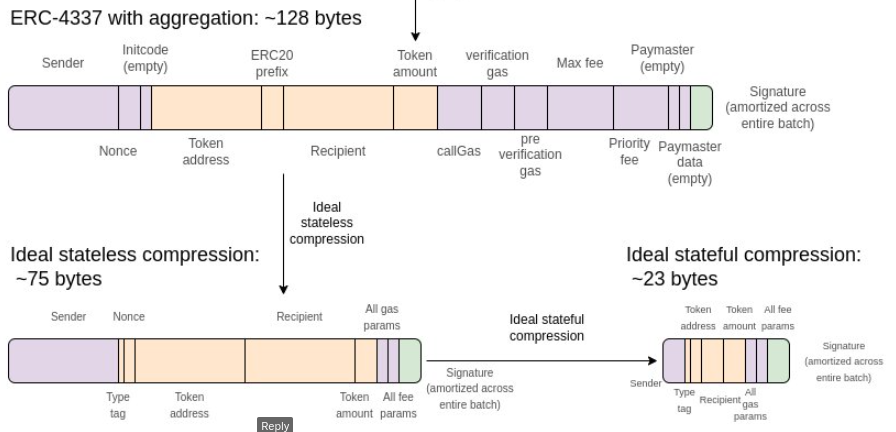
L2 data compression. Source: Vitalik Buterin
“After this, we can cautiously move toward stage 2: a world where rollups truly are backed by code, and a security council can only intervene if the code “provably disagrees with itself,” he added.
Related: Vitalik Buterin is cooking up a new way to decentralize Ethereum staking
Buterin said that further changes such as Verkle trees, single-slot finality, and account abstraction are still significant, “but they are not drastic to the same extent that proof of stake and sharding are.”
In 2022, Ethereum was like a plane replacing its engines mid-flight. In 2023, it was replacing its wings.
Ethereum is currently at “The Surge” phase of its upgrade roadmap with upgrades related to scalability by rollups and data sharding. The next phase, “The Scourge,” will have upgrades related to censorship resistance, decentralization, and protocol risks from MEV.
Developers should design applications with a “2020s Ethereum” mindset, embracing layer-2 scaling, privacy, account abstraction, and new forms of community membership proofs, he said before concluding:
Ethereum has upgraded from being ‘just’ a financial ecosystem into a much more thorough independent decentralized tech stack.
Author

Cointelegraph Team
Cointelegraph
We are privileged enough to work with the best and brightest in Bitcoin.