Vitalik Buterin: Ethereum ‘fails’ without these three important ‘transitions’

Ethereum co-founder Vitalik Buterin believes the success of Ethereum will come down to three major technical “transitions” that need to happen almost simultaneously — layer-2 scaling, wallet security and privacy-preserving features.
In a June 9 post via his personal blog, Buterin explained that the Ethereum blockchain outright “fails” without sufficient scaling infrastructure to make transactions cheap.
“Ethereum fails because each transaction costs $3.75 ($82.48 if we have another bull run), and every product aiming for the mass market inevitably forgets about the chain and adopts centralized workarounds for everything,” he said.
The Three Transitions:https://t.co/rtewRnm2wK
— vitalik.eth (@VitalikButerin) June 9, 2023
Another point of failure, according to Buterin, relates to smart contract wallets.
He explained that a move to smart contract wallets has caused some issues, because of complexities from the user experience side of things when users take control of multiple addresses at once.
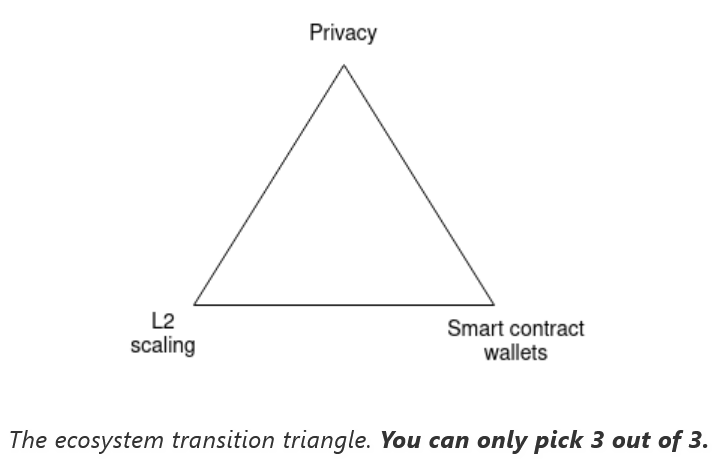
Ethereum needs to improve its layer-2 scalability, wallet security and privacy features, according to Buterin. Source: Vitalik Buterin’s website
In addition to wallets securing crypto assets, Buterin explained that wallets would need to secure data in order to truly transition into an on-chain world with zero-knowledge rollups:
In a ZK world, however, this is no longer true: the wallet is not just protecting authentication credentials, it's also holding your data.
The last of Buterin’s three transitions — privacy — will need to come in the form of improved identity, reputation and social recovery systems.
“Without the third, Ethereum fails because having all transactions (and POAPs, etc) available publicly for literally anyone to see is far too high a privacy sacrifice for many users, and everyone moves onto centralized solutions that at least somewhat hide your data,” he said.
The Ethereum co-founder suggested that stealth addresses could be implemented to resolve this issue.
Buterin said that achieving all three will be “challenging” because of the “intense coordination” involved between them.
He admitted that each of the three transitions “weaken” the “one user — one address” model, which, in turn, may complicate the way transactions are executed.
“If you want to pay someone, how will you get the information on how to pay them?”
“If users have many assets stored in different places across different chains, how do they do key changes and social recovery?" he added.
Buterin concluded by stressing the need to build infrastructure that ultimately improvers user experience:
Despite the challenges, achieving scalability, wallet security, and privacy for regular users is crucial for Ethereum's future. It is not just about technical feasibility but about actual accessibility for regular users. We need to rise to meet this challenge.
Author

Cointelegraph Team
Cointelegraph
We are privileged enough to work with the best and brightest in Bitcoin.