VeChain mainnet upgrade shifts consensus mechanism from PoA to DPoS as VET extends decline
- VeChain holds above $0.0150 as overhead pressure signals a 15% downside risk.
- VeChain migrates from Proof of Authority to Delegated Proof of Stake to power the network’s next growth phase.
- Delegated Proof of Stake transforms VET holders into active participants with shared value creation.

VeChain (VET) is trading at $0.0156 at the time of writing on Friday amid high volatility across the cryptocurrency market. Risk-off sentiment has pushed investors to the sidelines over the last few weeks, citing macroeconomic uncertainty and a lack of strong price catalysts.
VeChain to migrate mainnet from PoA to DPoS
VeChain has announced the migration of its mainnet from Proof of Authority (PoA) to Delegated Proof of Stake (DPoS), ushering in a new era of growth for the network.
The network overhaul will take place during the upcoming Hayabusa upgrade. With the PoA mechanism, VeChain expects to return power to VET token holders.
VeChain stated that, “This major update will fuel the network’s next phase of growth without compromising the predictable costs and features that real world users rely on.”
The upgrade paves the way for every VET holder to participate by staking and delegating to network validators. It also improves security and centralisation without affecting the vital feature of predictable fees.
VeChain said the key reason behind the shift is that DPoS delivers enterprise-grade utility with 100% uptime. Moreover, ensure that every VET holder participates in the network without adding complexity.
“Token holders gain a direct role in security and rewards, Node operators compete on performance and trust, while businesses and builders keep the predictable costs that make consumer-grade experiences possible,” VeChain explained in an X post.
Technical outlook: VeChain risks 15% drop
VeChain is trading above $0.0150 at the time of writing on Friday, reflecting negative sentiment in the broader cryptocurrency market. The token sits below key moving averages, including the 50-day Exponential Moving Average (EMA) at $0.0182, the 100-day EMA at $0.0203 and the 200-day EMA at $0.02289, emphasising a strong bearish grip.
The Relative Strength Index (RSI) is at 41 on the daily chart, and falling toward the oversold region. Lower RSI readings indicate that bearish momentum is increasing.
Traders should watch for a potential sell signal from the Moving Average Convergence Divergence (MACD) indicator. If the blue MACD line crosses below the red signal line, investors will be encouraged to reduce their exposure, which can drive selling pressure.
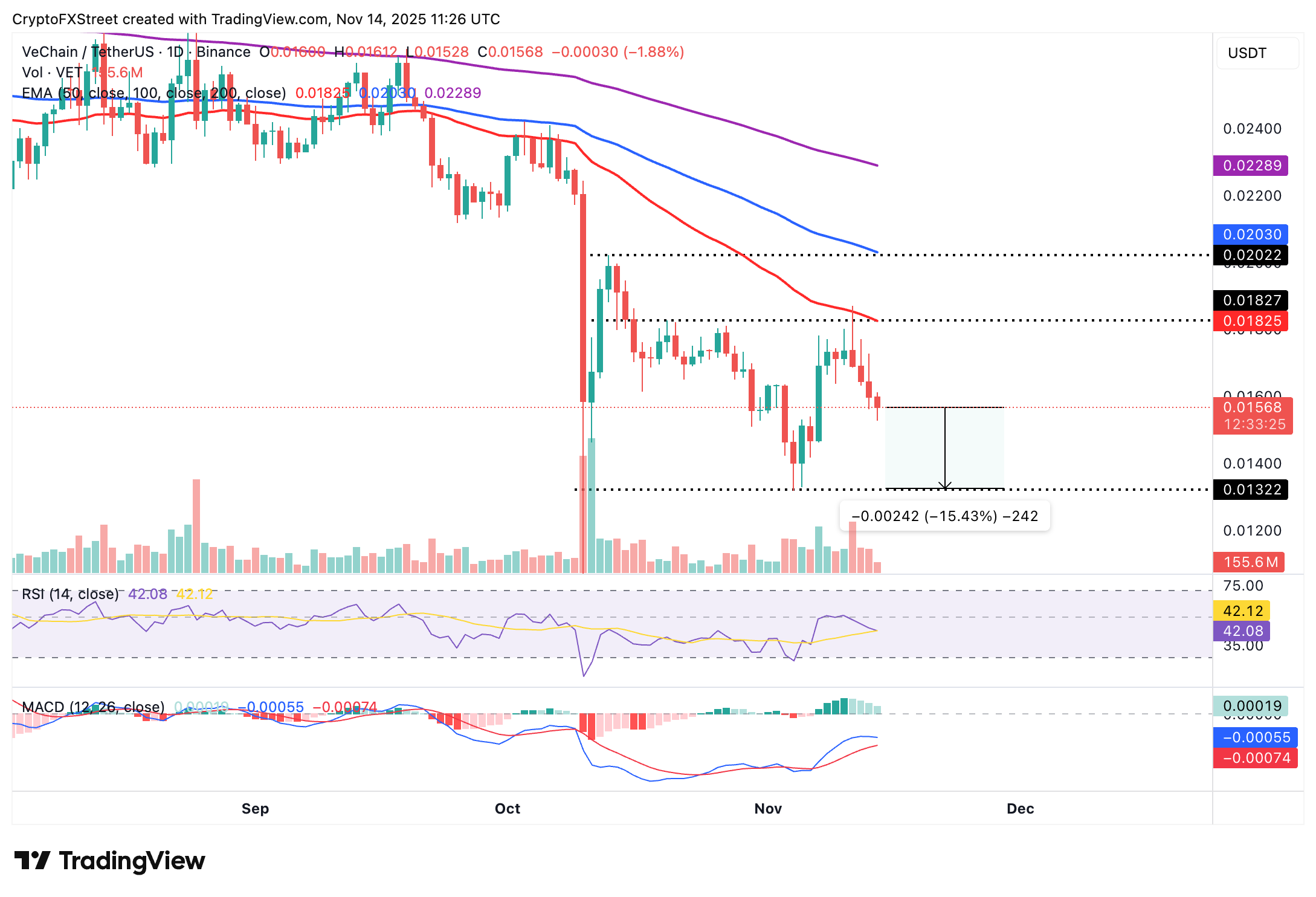
A 15% decline to $0.0132 is estimated if VET’s downtrend persists. However, an immediate recovery may follow if bulls defend the short-term support at $0.0150.
Cryptocurrency prices FAQs
Token launches influence demand and adoption among market participants. Listings on crypto exchanges deepen the liquidity for an asset and add new participants to an asset’s network. This is typically bullish for a digital asset.
A hack is an event in which an attacker captures a large volume of the asset from a DeFi bridge or hot wallet of an exchange or any other crypto platform via exploits, bugs or other methods. The exploiter then transfers these tokens out of the exchange platforms to ultimately sell or swap the assets for other cryptocurrencies or stablecoins. Such events often involve an en masse panic triggering a sell-off in the affected assets.
Macroeconomic events like the US Federal Reserve’s decision on interest rates influence crypto assets mainly through the direct impact they have on the US Dollar. An increase in interest rate typically negatively influences Bitcoin and altcoin prices, and vice versa. If the US Dollar index declines, risk assets and associated leverage for trading gets cheaper, in turn driving crypto prices higher.
Halvings are typically considered bullish events as they slash the block reward in half for miners, constricting the supply of the asset. At consistent demand if the supply reduces, the asset’s price climbs.
Author

John Isige
FXStreet
John Isige is a seasoned cryptocurrency journalist and markets analyst committed to delivering high-quality, actionable insights tailored to traders, investors, and crypto enthusiasts. He enjoys deep dives into emerging Web3 tren