United Kingdom lawmakers disagree with Binance’s evidence on FTX collapse, crypto market stays calm
- The UK parliamentary committee probing the crisis that led to FTX’s demise says evidence from Binance is unacceptable.
- Canadian exchange Bitvo pulls out of a deal to acquire FTX, citing a long regulatory approval process.
- Bitcoin price consolidates losses below $16,600 as the crypto market faces a liquidity crisis.

The UK parliamentary committee investigating the events that led to the FTX crisis and the exchange’s ultimate collapse appears to disagree with news articles sent by Binance to back up its case that it did not liquidate its holdings of FTT – a native token to FTX – out of malicious intent to harm a competitor.
Yet the evidence sent by the largest exchange by daily traded volume is unsatisfactory, according to Alison Thewliss, a Treasury Committee member.
UK parliamentary committee plans to extend probe
Alison Thewliss, while speaking on Bloomberg radio on Thursday, reckoned that the information provided by Binance does not give them “the real background detail.” She added that the “committee will be asking more questions to get to the details of what happened.”
"The collapse of FTX has had wider implications on the cryptocurrency industry and cannot be taken lightly," added Thewliss, the Member of Parliament for Glasgow Central. According to Bloomberg, the committee is awaiting internal records touching on the impact of Binance’s publicized divestment of FTT.
Appearing at the hearing on Wednesday was Daniel Trinder, Binance’s vice president of government affairs in Europe. The committee also made public a document from Binance containing a list of new articles giving the chronology of events leading to FTX’s collapse.
Is limited power a concern?
Alison Thewliss agreed that a lack of transparency from Binance could limit the extent of the inquiry and the committee’s recommendation. Moreover, the Treasury Committee’s chair, Harriett Baldwin, said in a recent interview that they lack the mandate “to push for more than we’ve received,” because the issues that led to the fall of FTX mainly occurred outside the United Kingdom.
Binance initially offered to acquire the embattled exchange when liquidity problems first arose. However, the company backed out of the deal, saying that the issues at FTX were beyond its control.
Canadian exchange Bitvo pulls out of deal to acquire FTX
Canadian cryptocurrency exchange Bitvo, in a statement released on Thursday, said it would no longer continue with an earlier deal to acquire FTX due to a lengthy approval process by local regulators. The exchange has assured its users and stakeholders that it had no exposure to FTX Canada and FTX Trading and that its operations continue as usual.
“Bitvo operates on a full reserve basis, meaning it does not lend customer funds. Bitvo has always chosen to operate in this fashion, and it is a requirement of Bitvo’s regulatory status as a Restricted Dealer registered with the Canadian Securities Administrators,” a statement from the company states.
Bitcoin price flaunts a buy signal
The cryptocurrency market has remained relatively mum this week, apart from the events surrounding the fall of FTX. Bitcoin price climbed to $18,155 after Binance announced the creation of an “Industry Recovery Fund” on Monday, November 14.
A report released by analysts from Coinbase on Wednesday said that a crypto liquidity crisis caused by the fall of Alameda Research, one of the largest crypto investment funds in the sector, threatens a potential recovery. The analysts predicted crypto winter to last until the end of 2023.
Bitcoin price is trading at $16,489 at the time of writing. With support at $16,600 broken, the largest cryptocurrency might drop to $15,800, where a huge buyer congestion zone may push for a trend reversal.
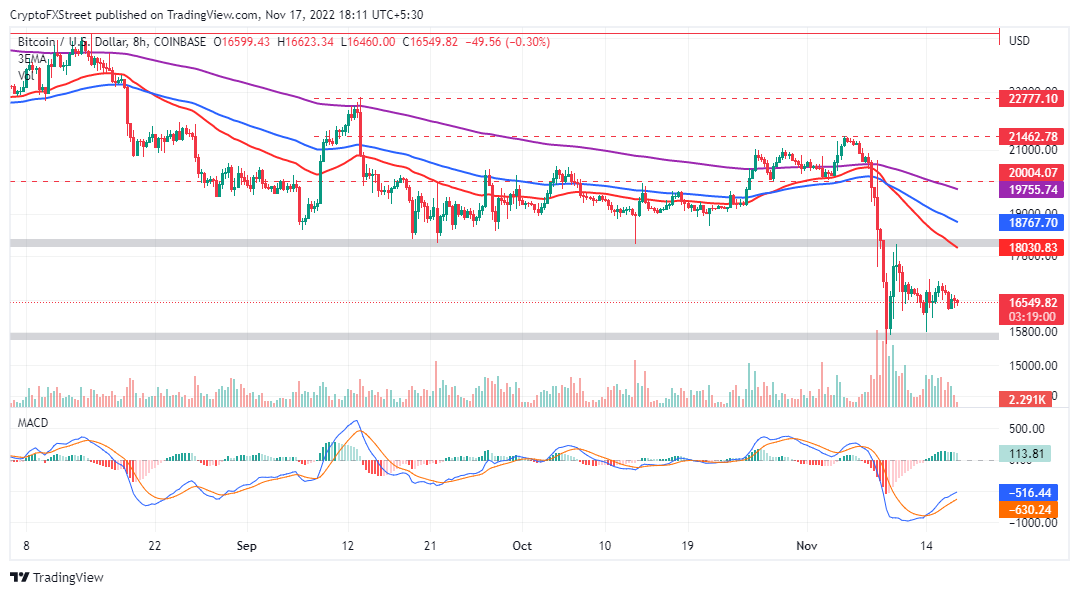
BTCUSD daily chart
The Moving Average Convergence Divergence (MACD) indicator on the BTCUSD chart has a bullish outlook following the release of a buy signal when the 12-day Exponential Moving Average (EMA) (in blue) crossed above the 26-day EMA (in brown). Despite BTC’s correction below $16,600, recovery to $18,000 and $20,000 is still possible, especially if buyers heed the call to buy more coins.
Author

John Isige
FXStreet
John Isige is a seasoned cryptocurrency journalist and markets analyst committed to delivering high-quality, actionable insights tailored to traders, investors, and crypto enthusiasts. He enjoys deep dives into emerging Web3 tren