Traders flinch after Ethereum price rejects at $2,000

Data shows pro traders are slightly skeptical of the strength of Ethereum’s rally after ETH price sold off at the $2,000 resistance.
Ether (ETH) rejected the $2,000 resistance on Aug. 14, but the solid 82.8% gain since the rising wedge formation started on July 13 certainly seems like a victory for bulls. Undoubtedly, the "ultrasound money" dream gets closer as the network expects the Merge transaction to a proof-of-stake (PoS) consensus network on Sept. 16.
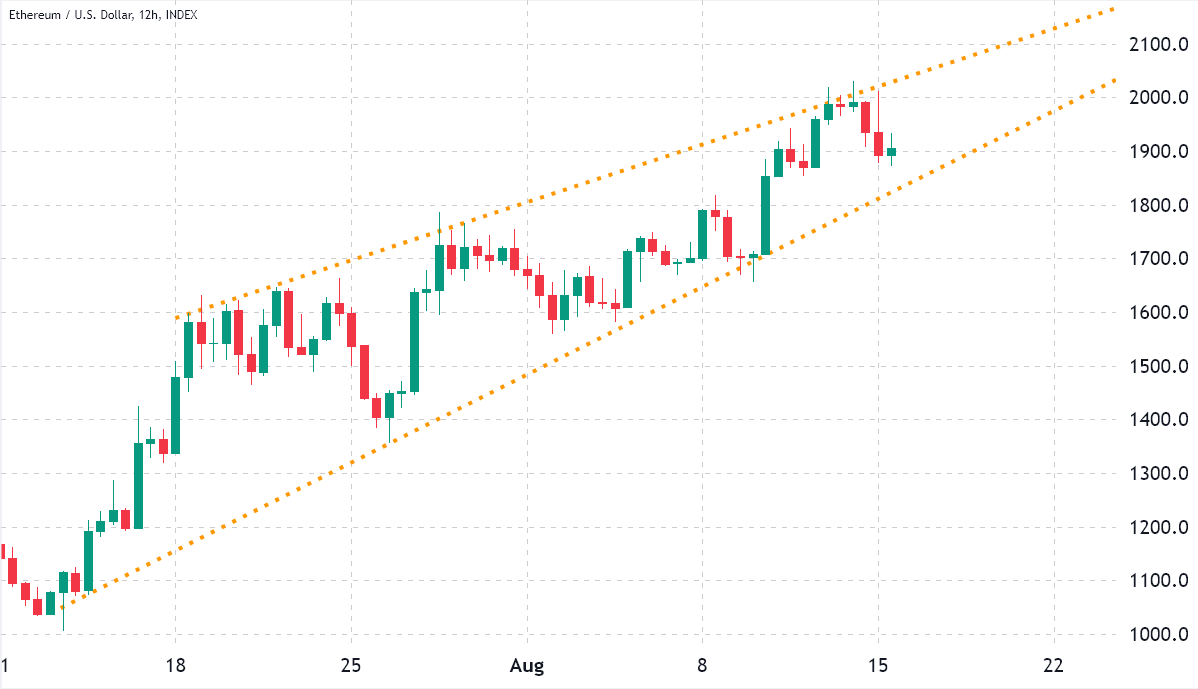
Ether price index in USD, 12-hour chart. Source: TradingView
Some critics point out that the transition out of proof-of-work (PoW) mining has been delayed for years and that the Merge itself does not address the scalability issue. The network’s migration to parallel processing (sharding) is expected to happen later in 2023 or early 2024.
As for the Ether bulls, the EIP-1559 burn mechanism introduced in August 2021 was essential to drive ETH to scarcity, as crypto analyst and influencer Kris Kay illustrates:
~ 11% of all $ETH supply now staked.
— Kris Kay | DeFi Donut (@thekriskay) August 15, 2022
~ 2% of all $ETH supply now burned
~ 100% of $ETH is ultra-sound money
+=
few
The highly anticipated move to the Ethereum beacon chain enjoyed a lot of criticism, despite eliminating the need to support the expensive energy-intensive mining activities. Below, “DrBitcoinMD” highlights the impossibility for ETH stakers to withdraw their coins, creating an unsustainable temporary offer-side reduction.
Anyone still putting their faith behind the gangly Russian pseudointellectual and the Ethereum ponzi deserves what's coming to them. pic.twitter.com/gjxHXdzuSK
— Doc (@DrBitcoinMD) August 11, 2022
Undoubtedly, the decreased amount of coins available for sale caused a supply shock, especially after the 82.8% rally as Ether has recently undergone. Still, these investors knew the risks of ETH 2.0 staking and no promises were made for instant transfers post-Merge.
Option markets reflect dubious sentiment
Investors should look at Ether's derivatives markets data to understand how whales and arbitrage desks are positioned. The 25% delta skew is a telling sign whenever traders overcharge for upside or downside protection.
If those market participants feared an Ether price crash, the skew indicator would move above 12%. On the other hand, generalized excitement reflects a negative 12% skew.
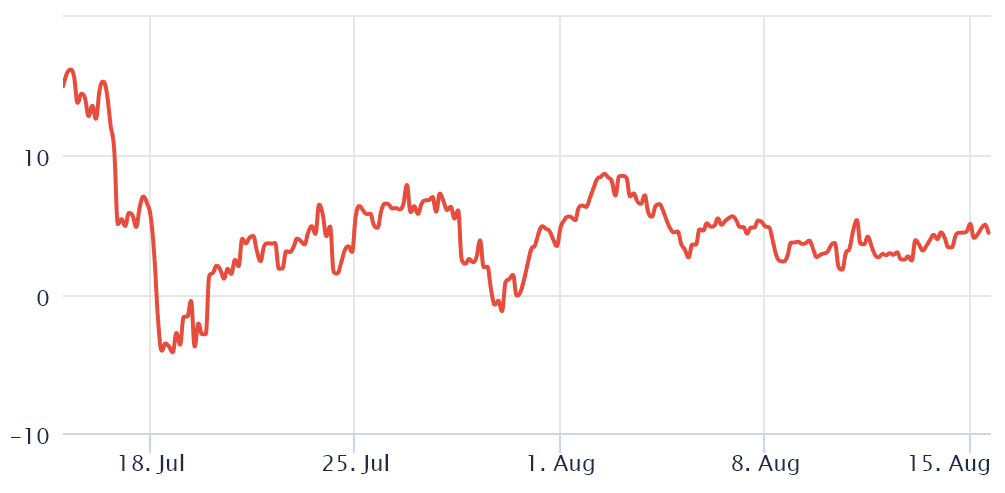
Ether 30-day options 25% delta skew: Source: Laevitas.ch
The skew indicator remained neutral since Ether initiated the rally, even as it tested the $2,000 resistance on Aug. 14. The absence of improvement in the market sentiment is slightly concerning because ETH option traders are currently assessing similar upside and downside price movement risks.
Meanwhile, the long-to-short data shows low confidence at the $2,000 level. This metric excludes externalities that might have solely impacted the options markets. It also gathers data from exchange clients' positions on the spot, perpetual and quarterly futures contracts, thus better informing on how professional traders are positioned.
There are occasional methodological discrepancies between different exchanges, so readers should monitor changes instead of absolute figures.
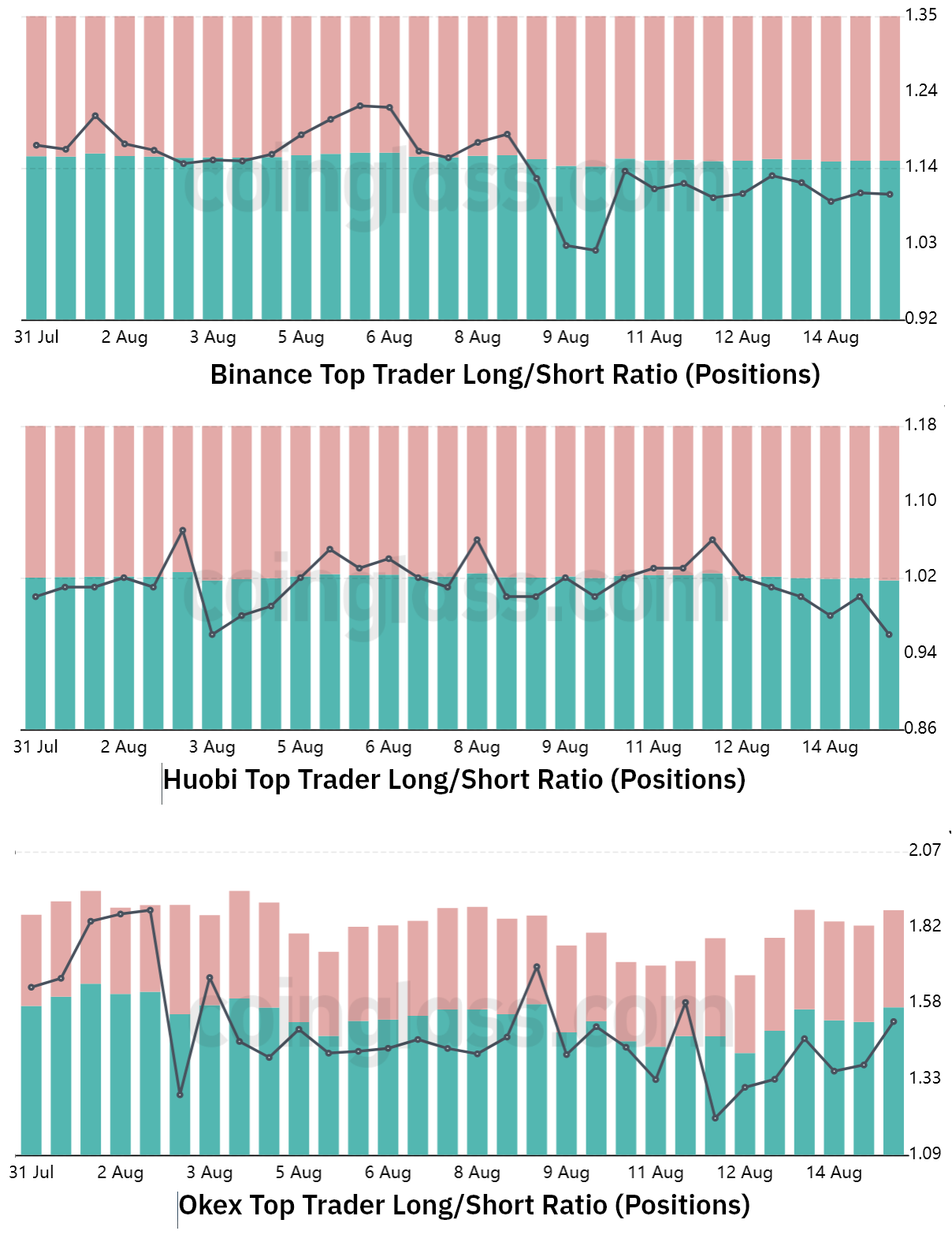
Exchanges' top traders Ether long-to-short ratio. Source: Coinglass
Even though Ether has rallied 18% from Aug. 4 to Aug. 15, professional traders slightly reduced their leverage long positions, according to the long-to-short indicator. For instance, the Binance traders' ratio improved somewhat from the 1.16 start but finished the period below its starting level near 1.12.
Meanwhile, Huobi displayed a modest decrease in its long-to-short ratio, as the indicator moved from 0.98 to the current 0.96 in eleven days. Lastly, the metric peaked at 1.70 at the OKX exchange but only slightly increased from 1.46 on Aug. 4 to 1.52 on Aug. 15. Thus, on average, traders were not confident enough to keep their leverage bullish positions.
There hasn't been a significant change in whales' and market makers' leverage positions despite Ether's 18% gains since Aug. 4. If options traders are pricing similar risks for Ether's upside and downside moves, there is likely a reason for this. For instance, strong backing of the proof-of-work fork would pressure ETH.
One thing is for sure, at the moment professional traders aren't confident that the $2,000 resistance will be easily broken.
Author

Cointelegraph Team
Cointelegraph
We are privileged enough to work with the best and brightest in Bitcoin.