Solana price jumps 7% as Visa outlines plan to use SOL blockchain for USDC payments
- Solana price is up almost 7% in the last 24 hours, with the mean threshold of $19.15 providing support.
- The surge follows a recent announcement indicating Visa's move to pilot stablecoin-transaction merchants via Solana blockchain.
- SOL could rise 10% to confront the $22.09 resistance level, with TVL rising over $2 million, hours following the news.
- Invalidation of this bullish outlook would occur upon a decisive daily candlestick close below the $18.41 level.
Solana (SOL) price has stayed glued to monthly lows over the past week despite an influx of funds from institutional players reaching up to $700,000. This capital inflow and a steady rise in Total Value Locked (TVL) failed to catalyze an uptrend for SOL, but things seem to have changed following a recent announcement.
Also Read: Solana price fails to gather momentum despite rising institutional flows, MakerDAO likely adoption.
Solana price rises on Visa announcement
Solana (SOL) price is up 7%, with indications of a continued rally, coming on the back of a recent announcement from digital payments company Visa. Based on the announcement, Visa has outlined a plan to leverage the Solana blockchain for its payments services. Specifically, it will scale its USDC stablecoin settlement capabilities to merchant acquirers launching pilots with select firms.
1/Breaking: Visa Expands Stablecoin Settlement Pilot to Solana@Visa is scaling their USDC settlement pilot to include the Solana blockchain, enabling enterprise-grade throughput at virtually no cost for Visa issuers and merchant acquirers on Solana. https://t.co/rF5ouZaISM
— Solana (@solana) September 5, 2023
Visa to leverage Solana blockchain for stablecoin settlement on its cross-border payments
Two weeks after Shopify integrated Solana to its platform for crypto payments, Visa has also joined in, expanding its "stablecoin settlement capabilities to merchant acquirers launching pilots with Worldpay Global and Nuvei. Citing Head of Crypto Visa Cuy Sheffield on Businesswire:
By leveraging stablecoins like USDC and global blockchain networks like Solana and Ethereum, we're helping to improve the speed of cross-border settlement and providing a modern option for our clients to send or receive funds from Visa's treasury easily.
The move is part of Visa's commitment to "being on the forefront of digital currency and blockchain innovation," which explains the payments company's decision to leverage new technologies to help improve the way money moves.
Noteworthy, Visa is building atop a 2021 vision where they tested Circle's USDC stablecoin could serve within its treasury operations, leading to a pilot with Crypto.com. Citing Circle CEO Jeremy Allaire on the latest development:
We are excited about the USDC use cases Visa and its partners are driving to create fundamental blockchain innovation… Circle built USDC to provide a functional digital dollar that could move at the speed of the internet to facilitate secure, reliable payments. Expanding the pilot exemplifies how pairing USDC with Visa's innovation opens up the future of payments, commerce, and financial applications.
On September 4, Ripple Attorney John E. Deaton joined crypto enthusiast Faisal Khan to hint at a possible announcement from Circle's Allaire. Read the full story here and its impact on USDC stablecoin.
Pay attention folks. Could be big. https://t.co/NF9dDCHeUP
— John E Deaton (@JohnEDeaton1) September 4, 2023
Visa's decision to leverage Solana as a high-performance blockchain qualifies the payments company among pioneers leveraging Solana for live settlement payments between its clients.
Impact of integration on SOL token
The Solana-Visa partnership has boded well for the SOL token, with DeFiLlama indicating a $2 million surge in Total Value Locked (TVL) on the blockchain within a matter of hours. More accurately, Solana TVL moved from $305.75 million, as seasoned crypto analyst and reporter at FXStreet Ekta Mourya indicated earlier, to the current $307.74 million.
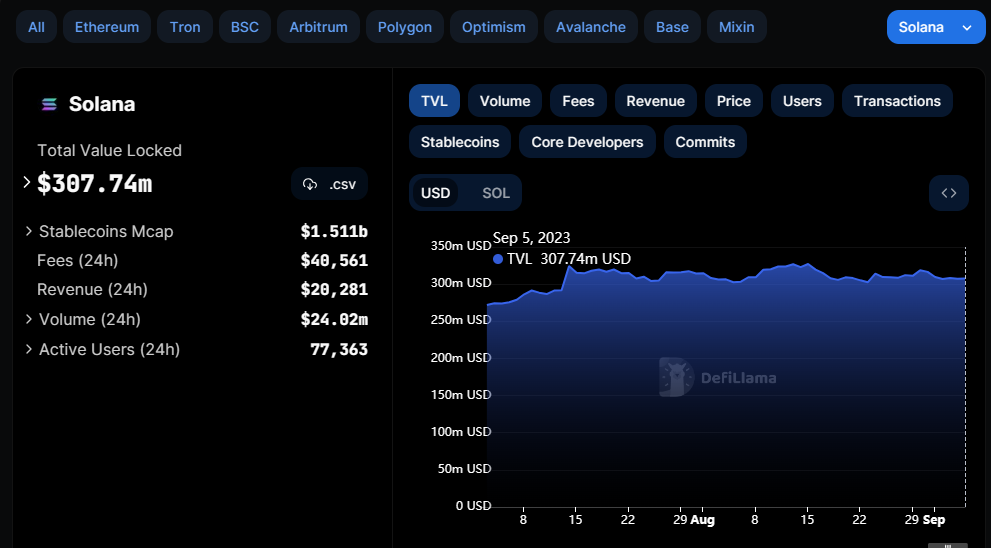
Solana TVL
For the layperson, a rise in TVL indicates that user deposits are rising, which, in this case, points to user interest in the Solana blockchain.
Furthermore, the announcement seems to have ignited a renaissance for Solana price, which is up almost 7% in the last 24 hours, breaking from consolidation around the monthly lows of $19.15 to the current $20.36.
Increased buying pressure could send Solana price above the $22.09 resistance level, a formidable hurdle that suppressed SOL for the better part of August. In a highly bullish case, the altcoin could break above to confront the optimistic target of $25.23. A move to the range high of $28.98 could occur in overly ambitious cases.
The Relative Strength Index (RSI) and the Awesome Oscillator (AO) histogram bars point to rising momentum, adding credence to the upside.
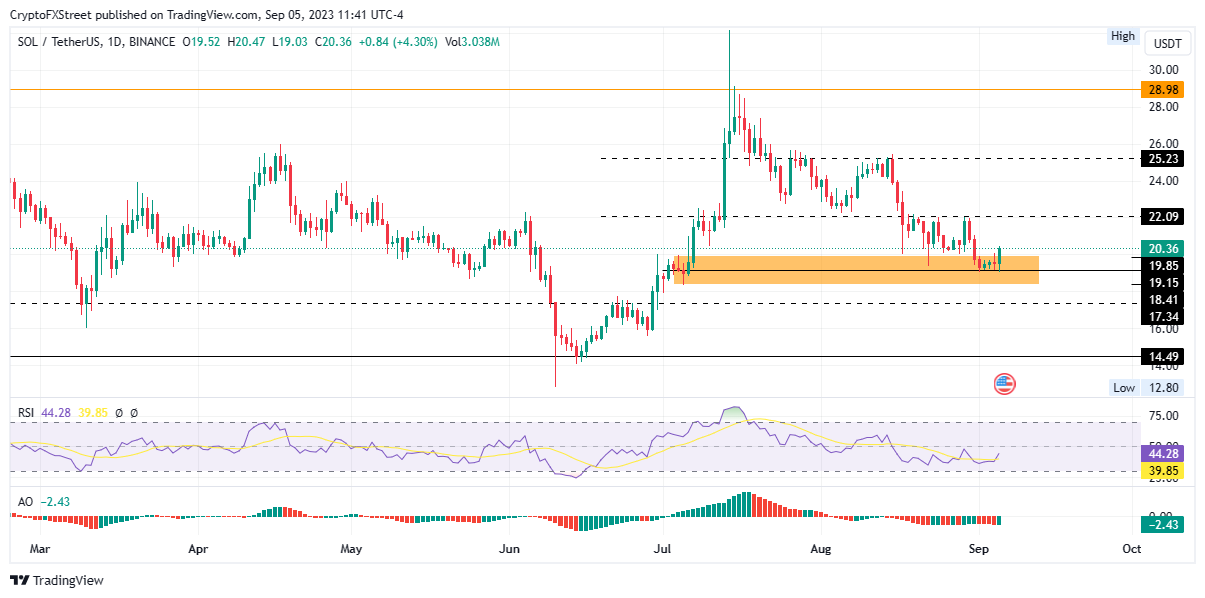
SOL/USDT 1-day chart
Conversely, a rejection from the overhead pressure could see Solana price retrace, possibly dipping into the demand zone and losing the support offered by the mean threshold at $19.15 and, worse, break below the $18.41 support level, thereby invalidating the bullish outlook.
Also Read: USDC ecosystem likely to find a boost soon, expert says, as stablecoin market cap rises $663 million
Cryptocurrency metrics FAQs
What is circulating supply?
The developer or creator of each cryptocurrency decides on the total number of tokens that can be minted or issued. Only a certain number of these assets can be minted by mining, staking or other mechanisms. This is defined by the algorithm of the underlying blockchain technology. Since its inception, a total of 19,445,656 BTCs have been mined, which is the circulating supply of Bitcoin. On the other hand, circulating supply can also be decreased via actions such as burning tokens, or mistakenly sending assets to addresses of other incompatible blockchains.
What is market capitalization?
Market capitalization is the result of multiplying the circulating supply of a certain asset by the asset’s current market value. For Bitcoin, the market capitalization at the beginning of August 2023 is above $570 billion, which is the result of the more than 19 million BTC in circulation multiplied by the Bitcoin price around $29,600.
What is trading volume?
Trading volume refers to the total number of tokens for a specific asset that has been transacted or exchanged between buyers and sellers within set trading hours, for example, 24 hours. It is used to gauge market sentiment, this metric combines all volumes on centralized exchanges and decentralized exchanges. Increasing trading volume often denotes the demand for a certain asset as more people are buying and selling the cryptocurrency.
What is funding rate?
Funding rates are a concept designed to encourage traders to take positions and ensure perpetual contract prices match spot markets. It defines a mechanism by exchanges to ensure that future prices and index prices periodic payments regularly converge. When the funding rate is positive, the price of the perpetual contract is higher than the mark price. This means traders who are bullish and have opened long positions pay traders who are in short positions. On the other hand, a negative funding rate means perpetual prices are below the mark price, and hence traders with short positions pay traders who have opened long positions.
Author

Lockridge Okoth
FXStreet
Lockridge is a believer in the transformative power of crypto and the blockchain industry.