Sam Altman’s Worldcoin launches in the US with Visa card, Stripe and Tinder integration
- Worldcoin launches in the US with integrations across Visa, Stripe and Tinder, aiming to deploy 7,500 biometric "orbs" in major cities by year-end.
- World App expands functionality with USDC, Stripe, Kalshi, and a newly unveiled Visa card, enhancing utility for verified digital identity holders.
- WLD price dips 3.1% to $1.03, showing a muted short-term reaction but signaling strong long-term potential as a protocol fee token.

Worldcoin (WLD) price outlook remains cautiously optimistic as its launch in the United States (US) with Visa, Stripe and Tinder integration may boost the long-term digital ID adoption prospects.
Worldcoin expands to the US with Orb rollout and Texas manufacturing hub
Worldcoin, now rebranded simply as World, officially launched in the US this week, marking a major milestone for Sam Altman and co-founder Alex Blania’s digital identity project.
The announcement was made at the company’s “At Last” event, where executives detailed plans to expand World’s global proof-of-humanity network in response to surging AI-generated content.
The rollout will begin in six major cities: Atlanta, Austin, Los Angeles, Miami, Nashville and San Francisco. By the end of 2025, World plans to quadruple its global hardware footprint, with 7,500 biometric orbs deployed worldwide. To support this scale, a new manufacturing line has opened in Texas to assemble Orbs locally and for global distribution.
Orbs are chrome, spherical devices that scan users’ irises to verify identity and offer access to the World app and an airdrop of its native WLD token.
The company also introduced Orb Mini, a portable verification device set to begin shipping in 2026. Orb Mini enables a peer-to-peer verification model, letting verified users help others confirm their humanity—a move aimed at decentralizing trust and scaling identity authentication, particularly in the Global South.
Blania cited growing political clarity and regulatory progress in the US as key drivers of the launch, saying World’s conservative approach to regulation had finally found an encouraging environment.
Tinder, Razer, Stripe and Visa integrate World ID in next-gen Web3 partnerships
World’s expansion into the US is supported by major partnerships aimed at bringing decentralized identity into everyday applications. In gaming, Razer is embedding World ID across its ecosystem, enabling bot-resistant experiences and human-exclusive tournaments. Verified users will be eligible to join the upcoming League of Humans, a gaming series exclusive to humans authenticated by World Orbs.
In dating, Tinder’s parent company Match Group is piloting World ID in Japan to enhance age and identity verification. The integration is expected to expand to more Match platforms and international markets in 2026.
The World App and World’s flagship mobile wallet have also undergone major upgrades. New integrations include:
- Circle, for USDC-based payments and digital dollar access;
- Stripe, for seamless fiat ramps;
- Kalshi, enabling in-app access to prediction markets.
Most notably, World is preparing to launch a World Visa Card, starting with merchant integrations and rolling out to users in stages. The World ID initiative could integrate blockchain verification with mainstream commercial payments.
WLD token gains as traders eye long-term role in World ecosystem
Despite the high-profile US launch, WLD has seen muted short-term price action, trading down 3% over 24 hours to $1.03.
As seen below, WLD traded within a $1.02–$1.07 range while volumes also flattened, suggesting a wait-and-see stance among investors after the 24-hour announcement.
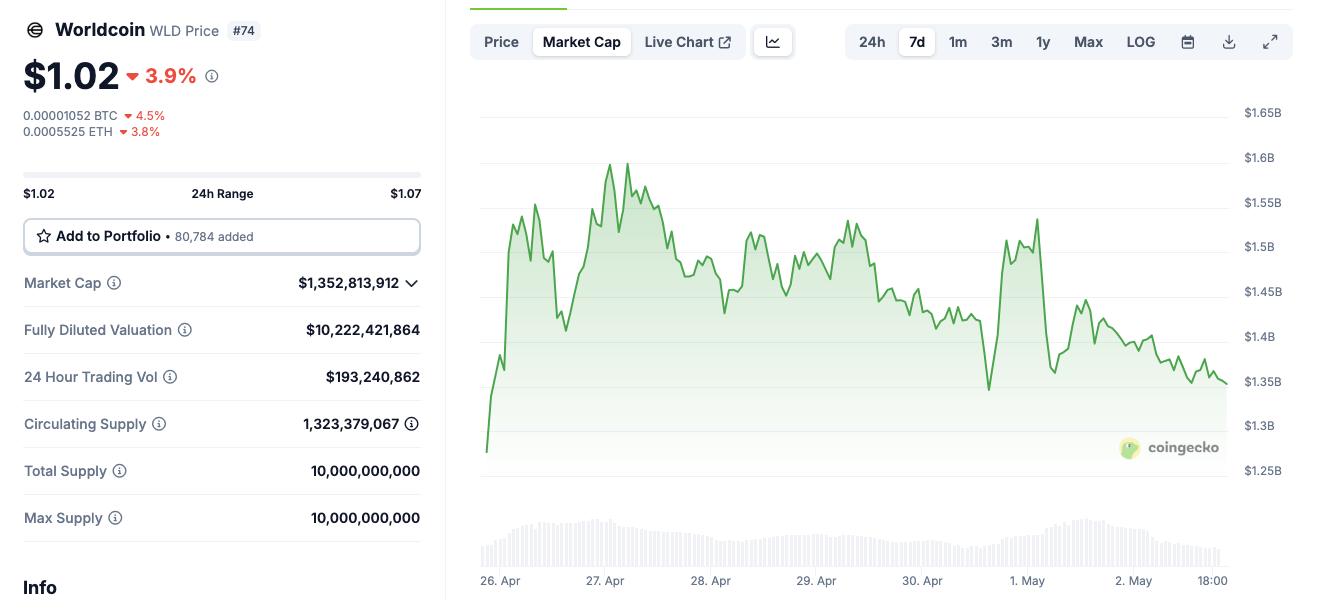
Worldcoin price action, Friday, May 2, 2025 | Coingecko
At press time, Worldcoin’s current market cap is approximately $195 million, placing it at 74th among global crypto assets, according to Coingecko data.
The WLD token is designed to function as the fee token for World Chain, the project's custom blockchain.
Applications using World ID will pay fees in WLD. Those fees may be burned, redistributed, or allocated based on community governance, creating a closed economic loop.
Zooming out, WLD has returned 30.0% over the past month and an impressive 77.4% over the past year, reflecting growing interest in its long-term utility.
While initial WLD price action is subdued for now, the Sam Altman-led firm’s foray into the US establishes long-term growth factors tied to real-world integrations in identity, payments, and compliance.
WLD could emerge as a core asset in the Web3 identity stack, with long-term upside driven by mainstream and institutional integrations.
Author

Ibrahim Ajibade
FXStreet
Ibrahim Ajibade is an accomplished Crypto markets Reporter who began his career in commercial banking. He holds a BSc, Economics, from University of Ibadan.