XRP extends losses as ETF inflows fail to lift market sentiment
- XRP declines for the second consecutive day, as the crypto market struggles to sustain recovery.
- XRP ETFs record steady inflows, but sentiment remains lagging.
- A weak derivatives market, as reflected by Open Interest remaining below $4 billion, underlines risk-off sentiment.

Ripple (XRP) is extending its decline, trading at $2.17 at the time of writing on Wednesday. The cross-border remittance token was rejected at $2.30 on Monday, reflecting a sticky bearish sentiment in the broader cryptocurrency market despite steady inflows into Exchange Traded Funds (ETFs).
XRP ETF inflows extend as institutional demand steadies
Interest in US-listed XRP ETFs has continued to improve since their initial launch in mid-November. There are currently four XRP ETFs operating in the US, including Canary Capital’s XRPC, Bitwise’s XRP, Grayscale’s GXRP and Franklin Templeton’s XRPZ.
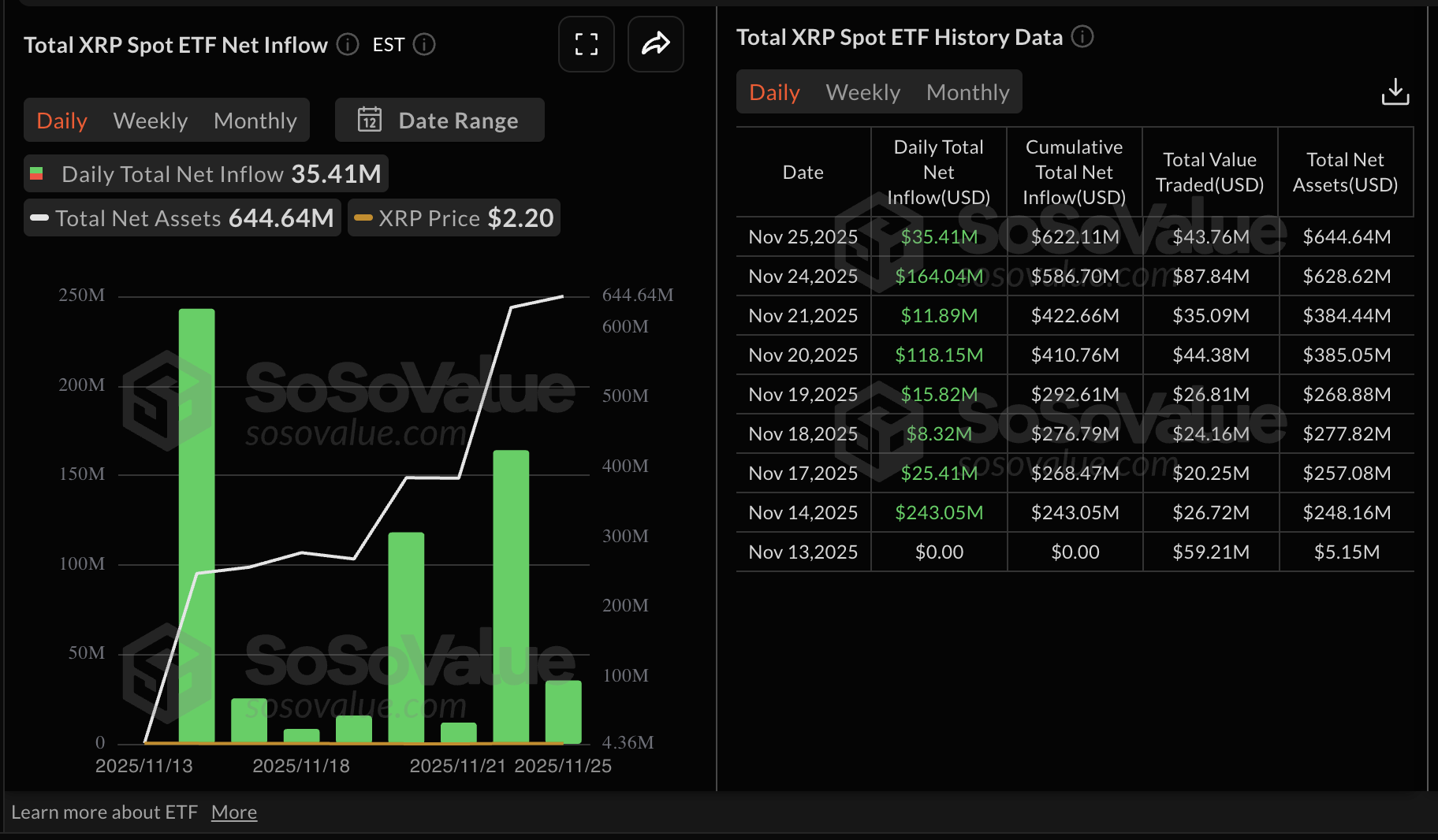
In total, XRP ETFs recorded approximately $35 million in inflows on Tuesday, bringing the cumulative volume to $622 million and net assets to $645 million.
ETF flows help gauge market sentiment, whereby inflows underpin a bullish market, while outflows signal a bearish outlook.
Retail demand, on the other hand, has remained relatively low, with futures Open Interest (OI) unable to steady above $4 billion since November 11. According to CoinGlass data, OI, which tracks the notional value of outstanding futures contracts, averaged $3.96 billion on Wednesday, down from $4 billion the previous day.
XRP futures OI hit a record high of $10.94 billion on July 22, days before the token achieved a record high of $3.66. This highlighted growing risk appetite for XRP derivatives and backed risk-on sentiment.
However, a steady decline in the OI has coincided with the price falling to $1.82 on Friday. If retail demand remains suppressed, it would be difficult to sustain recovery, with XRP likely to trade under pressure.
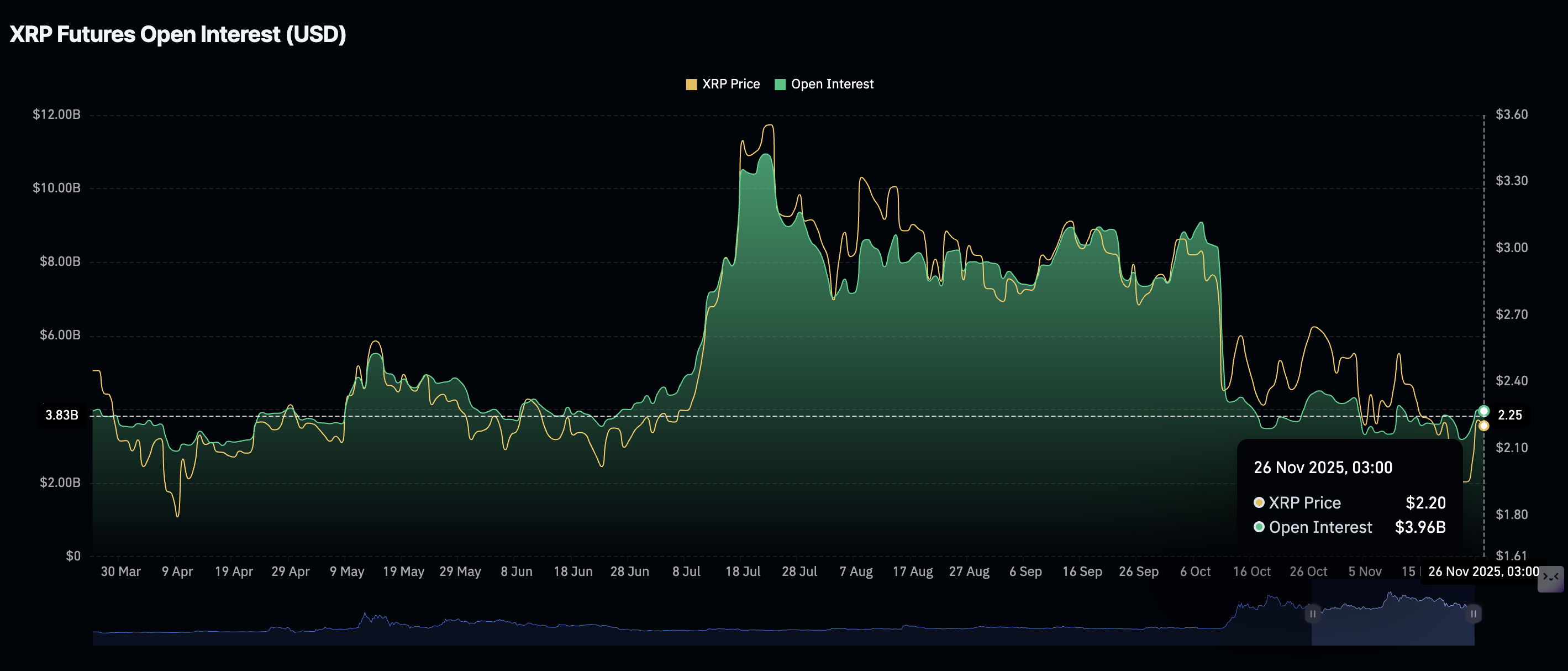
Chart of the day: XRP offers mixed signals
XRP remains capped below the 50-day Exponential Moving Average (EMA) EMA at $2.37, underscoring a continuous downward slope. The descending trend line from the record high of $3.66 limits rebounds on the daily chart, with resistance seen at $2.68.
The Moving Average Convergence Divergence (MACD) histogram has turned positive and is expanding, suggesting the MACD line has crossed above the signal line. This outlook could sustain a bullish tone in the short to medium term.
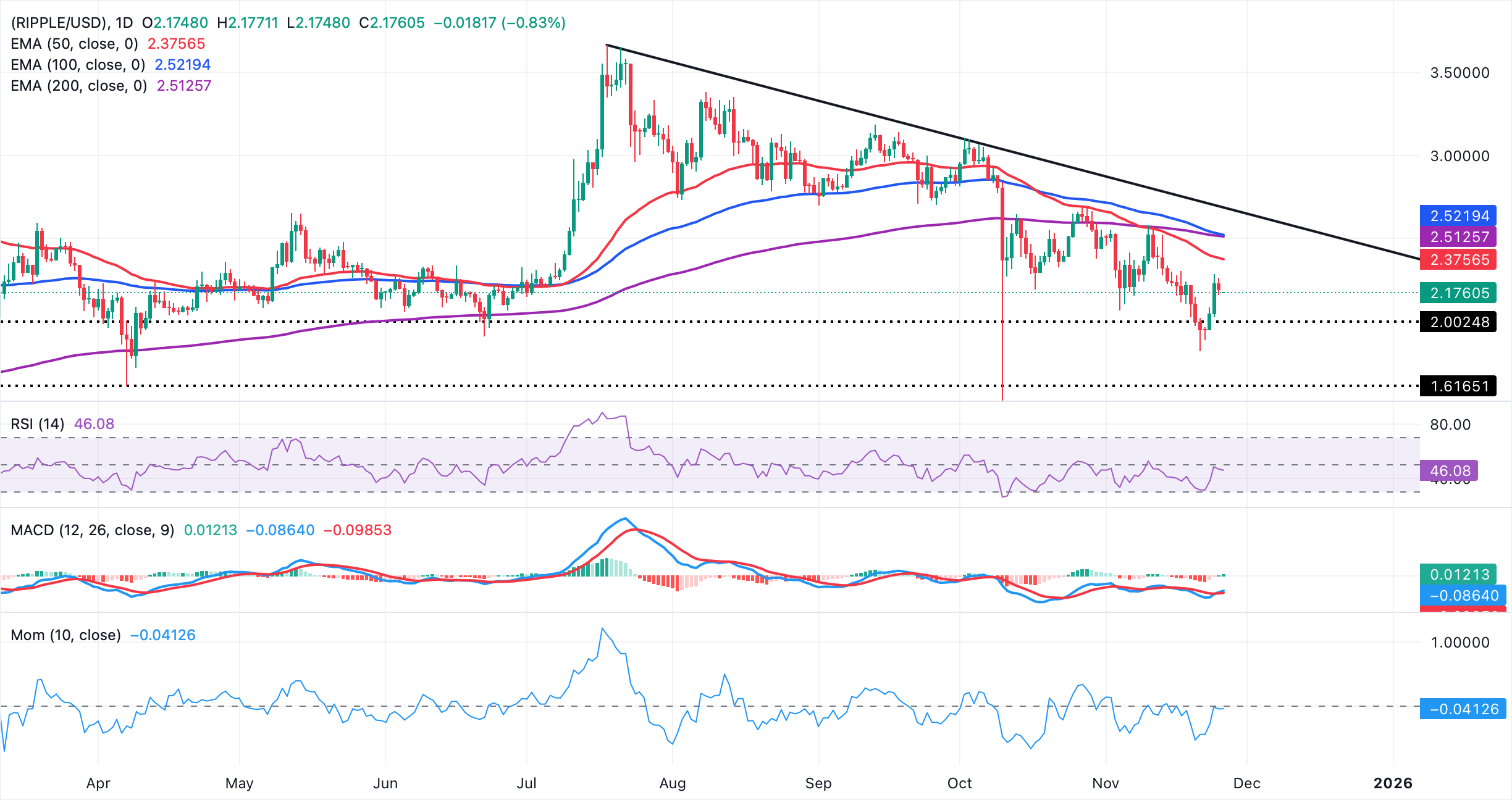
Still, the Relative Strength Index (RSI) at 46 leans neutral-to-soft, keeping upside efforts in check. The broader setup stays heavy while price trades beneath the 200-day EMA at $2.51 and the 100-day EMA at $2.52. Momentum holds below the zero line and flattens, indicating fading bearish pressure rather than a directional turn. A bounce would encounter supply into the 50-day EMA, while a daily close above the same level would open a recovery phase.
Cryptocurrency metrics FAQs
The developer or creator of each cryptocurrency decides on the total number of tokens that can be minted or issued. Only a certain number of these assets can be minted by mining, staking or other mechanisms. This is defined by the algorithm of the underlying blockchain technology. On the other hand, circulating supply can also be decreased via actions such as burning tokens, or mistakenly sending assets to addresses of other incompatible blockchains.
Market capitalization is the result of multiplying the circulating supply of a certain asset by the asset’s current market value.
Trading volume refers to the total number of tokens for a specific asset that has been transacted or exchanged between buyers and sellers within set trading hours, for example, 24 hours. It is used to gauge market sentiment, this metric combines all volumes on centralized exchanges and decentralized exchanges. Increasing trading volume often denotes the demand for a certain asset as more people are buying and selling the cryptocurrency.
Funding rates are a concept designed to encourage traders to take positions and ensure perpetual contract prices match spot markets. It defines a mechanism by exchanges to ensure that future prices and index prices periodic payments regularly converge. When the funding rate is positive, the price of the perpetual contract is higher than the mark price. This means traders who are bullish and have opened long positions pay traders who are in short positions. On the other hand, a negative funding rate means perpetual prices are below the mark price, and hence traders with short positions pay traders who have opened long positions.
(The technical analysis of this story was written with the help of an AI tool)
Author

John Isige
FXStreet
John Isige is a seasoned cryptocurrency journalist and markets analyst committed to delivering high-quality, actionable insights tailored to traders, investors, and crypto enthusiasts. He enjoys deep dives into emerging Web3 tren