Ripple Price Prediction: XRP price risks extending losses below $2.00 ahead of the weekend
- XRP’s downtrend persists, hinting at a drop below $2.00 following a botched recovery attempt.
- Ripple and Wormhole partner to expand XRL Ledger’s multi-chain interoperability.
- The integration could spearhead the adoption of stablecoins and tokenized assets by enhancing cross-chain messaging, transfers, and issuances.

Ripple (XRP) extends losses on the third day in a row after its bullish momentum snapped under the resistance level at $2.23. Key technical indicators cement the bearish grip, while the XRP price exchanges hands at around $2.08 on Friday. This bearish picture reflects subdued sentiment in the broader cryptocurrency market, with most altcoins clawing back gains accrued early this week.
Ripple eyes multi-chain interoperability with Wormhole partnership
Ripple has turned to Wormhole, a leading protocol in cross-chain interoperability, to speed up the integration of the XRP Ledger (XRPL) mainnet and the XRPL Ethereum Virtual Machine (EVM) Sidechain.
As demand for stablecoins and tokenized assets increases in financial markets, Ripple believes there is a dire need to build supporting blockchain infrastructure. This will ensure that institutions and users can securely and efficiently move assets without the risk of liquidity fragmentation.
According to the announcement on Thursday, Wormhole, which supports over 200 applications across more than 35 blockchain ecosystems, will integrate its flagship cross-chain infrastructure with the XRPL mainnet and the XRPL EVM SideChain.
The integration will enable developers to transfer supported XRPL assets, including tokens such as XRP, Issued Assets (IOUs) and Multi-purpose (MPTs) across supported protocols. Developers will also communicate with smart contracts across blockchains using specialized messaging and data triggers.
“If you want real mass adoption, interoperability is essential. The infrastructure has to be there, not just on one chain, but across them. With this integration, tokens natively issued on the XRP Ledger are being set up for that reality by being able to move between blockchain networks while maintaining native issuance, and control,” Ripple’s CTO, David Schwartz, said in a statement.
Technical outlook: XRP bearish bias persists
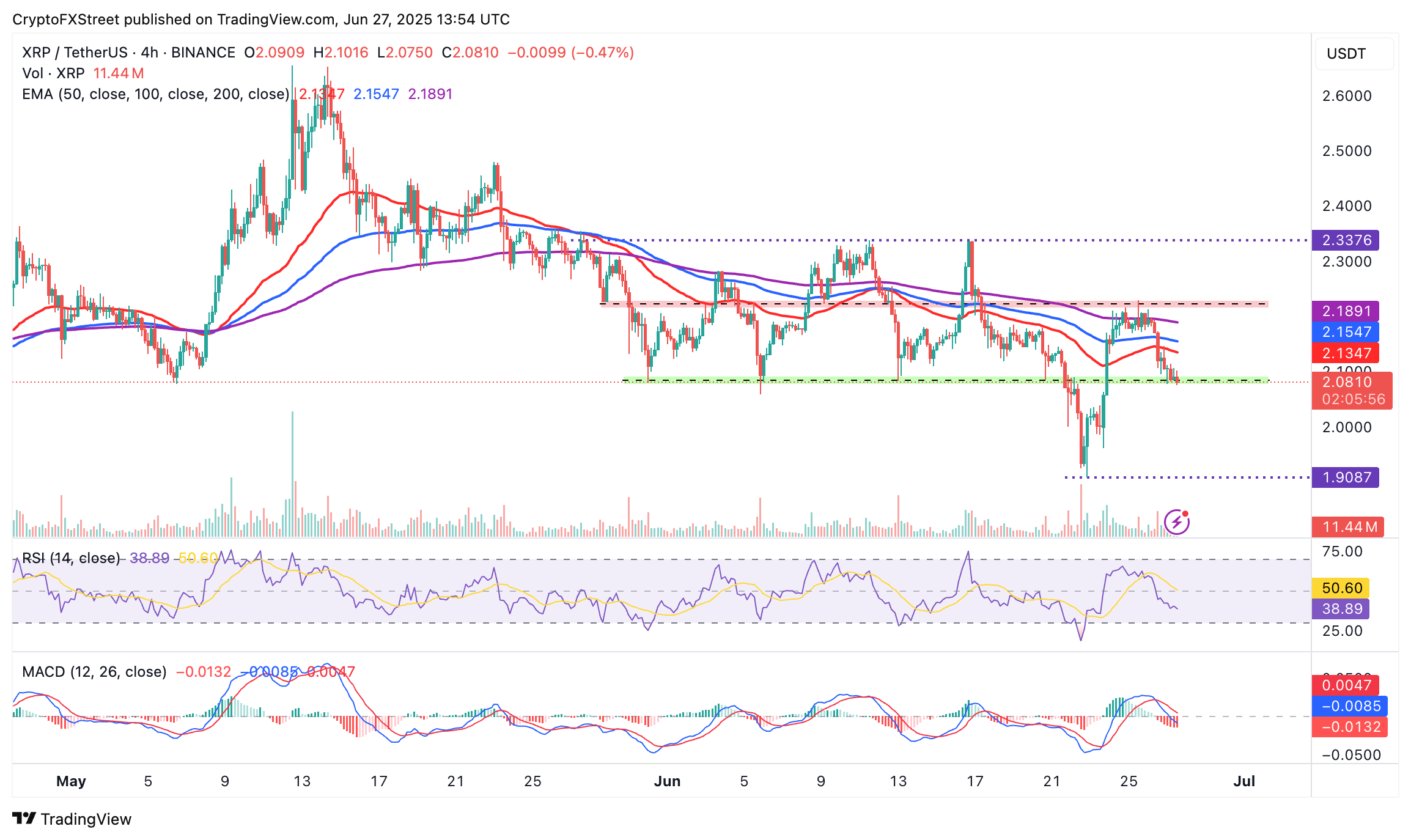
XRP has extended the downtrend below support at $2.09, signaling vulnerability to overhead pressure ahead of the weekend. A sell signal, maintained by the Moving Average Convergence Divergence (MACD) since Thursday, indicates increasing bearish momentum as traders consider reducing their exposure to XRP.
The red histogram bars below the MACD zero line cement the bearish grip, especially with XRP extending losses below the 50-period Exponential Moving Average (EMA) at $2.13, the 100-period EMA at $215 and the 200-period EMA at $2.18 on the 4-hour chart.
XRP/USD 4-hour chart
The path of least resistance could stay downward, increasing the possibility of the XRP price sliding below the $2.00 round-figure support, especially if the Relative Strength Index (RSI) continues to drop, nearing oversold territory.
Key areas for monitoring include $1.90, which was tested on Sunday, $1.80 and $1.61, last probed in April following the tariff-triggered sell-off.
Still, an immediate rebound above the support highlighted in green on the chart cannot be ruled out, which could build on risk-on sentiment if the XRP futures Open Interest (OI) continues to uphold the uptrend currently at $4 billion.
Cryptocurrency metrics FAQs
The developer or creator of each cryptocurrency decides on the total number of tokens that can be minted or issued. Only a certain number of these assets can be minted by mining, staking or other mechanisms. This is defined by the algorithm of the underlying blockchain technology. On the other hand, circulating supply can also be decreased via actions such as burning tokens, or mistakenly sending assets to addresses of other incompatible blockchains.
Market capitalization is the result of multiplying the circulating supply of a certain asset by the asset’s current market value.
Trading volume refers to the total number of tokens for a specific asset that has been transacted or exchanged between buyers and sellers within set trading hours, for example, 24 hours. It is used to gauge market sentiment, this metric combines all volumes on centralized exchanges and decentralized exchanges. Increasing trading volume often denotes the demand for a certain asset as more people are buying and selling the cryptocurrency.
Funding rates are a concept designed to encourage traders to take positions and ensure perpetual contract prices match spot markets. It defines a mechanism by exchanges to ensure that future prices and index prices periodic payments regularly converge. When the funding rate is positive, the price of the perpetual contract is higher than the mark price. This means traders who are bullish and have opened long positions pay traders who are in short positions. On the other hand, a negative funding rate means perpetual prices are below the mark price, and hence traders with short positions pay traders who have opened long positions.
Author

John Isige
FXStreet
John Isige is a seasoned cryptocurrency journalist and markets analyst committed to delivering high-quality, actionable insights tailored to traders, investors, and crypto enthusiasts. He enjoys deep dives into emerging Web3 tren