Ripple Price Prediction: XRP tests critical support as Webus files $300M XRP treasury with the SEC
- XRP consolidates in a narrow range between support offered by the 50-period EMA and resistance at the 100-period EMA.
- China-based Webus International files with the SEC to raise $300 million for XRP treasury strategy and Ripple-powered payments.
- Rising derivatives market Open Interest to $4 billion, accompanied by a surge in short liquidations, signals potential bullish momentum.

Ripple’s (XRP) price has stalled after testing resistance at $2.27. The token hovers at around $2.24 at the time of writing on Wednesday, amid lethargic sentiment in the broader cryptocurrency market. This narrow, range-bound movement comes after Webus International, a Chinese company, filed with the United States (US) Securities and Exchange Commission (SEC) to raise funds toward a strategic XRP treasury. The token shows signs of a near-term trend reversal supported by growing institutional demand.
Webus International plans to raise $300 million for XRP treasury strategy
Webus International, a fast-paced Artificial Intelligence (AI)-driven provider of customizable mobility solutions in the hospitality industry, has filed with the SEC outlining plans to raise $300 million for an XRP-focused corporate treasury strategy.
The filing, which used the Form 6-K to update the Commission and US investors, was published on Tuesday following an announcement made on May 29. Webus intends to raise funds through a non-equity credit facility to support the treasury initiative as well as Ripple-powered payments.
To spearhead the development, Webus signed a partnership agreement with Samara Alpha, an asset management firm. The company will help establish the strategic reserve and integrate Ripple-based blockchain payments into the Webus network to streamline cross-border transactions across its travel and hospitality business.
Webus is the latest company to announce the adoption of the XRP token and Ripple’s payment system. However, institutional interest in XRP and related products has been gaining traction in recent weeks. For instance, renewable energy company VivoPower announced a $121 million XRP-focused treasury on Tuesday. This follows the launch of XRP futures contracts by Coinbase Derivatives and the CME Group.
XRP consolidating amid rising institutional adoption
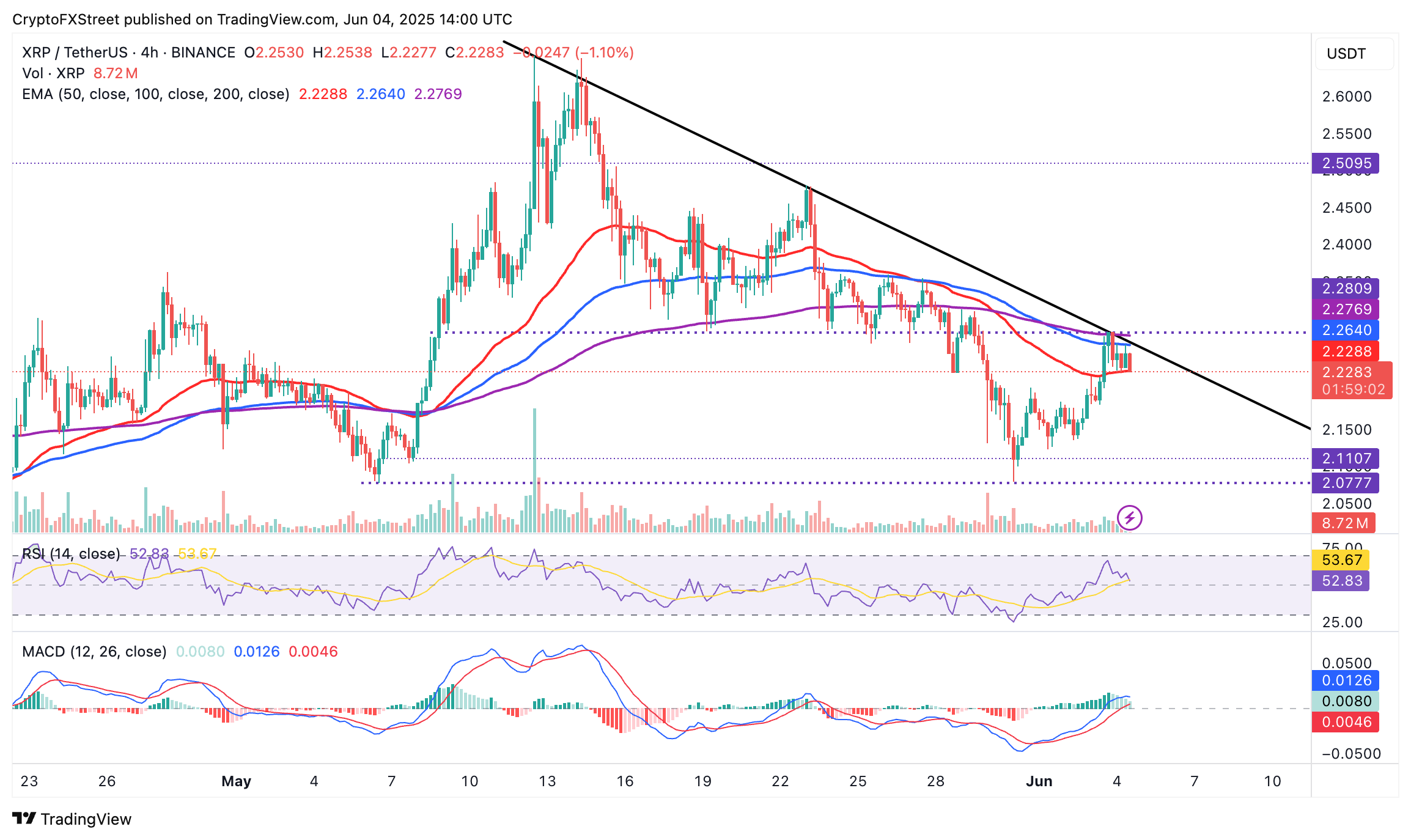
XRP’s price hovers sideways between the support offered by the 4-hour 50-period Exponential Moving Average (EMA) at around $2.22 and the resistance highlighted by the 100-period EMA at $2.26.
A recent recovery from last week’s drop to $2.07 failed to break above resistance at $2.27, resulting in the ongoing pullback.
The reversal of the Relative Strength Index (RSI) after briefly peaking at 66 signals a bearish shift. If the RSI slides below the 50 midline, reflecting changing market dynamics, the path of least resistance could remain downward in upcoming sessions.
XRP/USD 4-hour chart
Beyond the 50-period EMA support at $2.22, other key areas of interest include a recently tested level around $2.07 and the buyer congestion zones at $1.92, $1.85, and $1.61, all of which were tested in April.
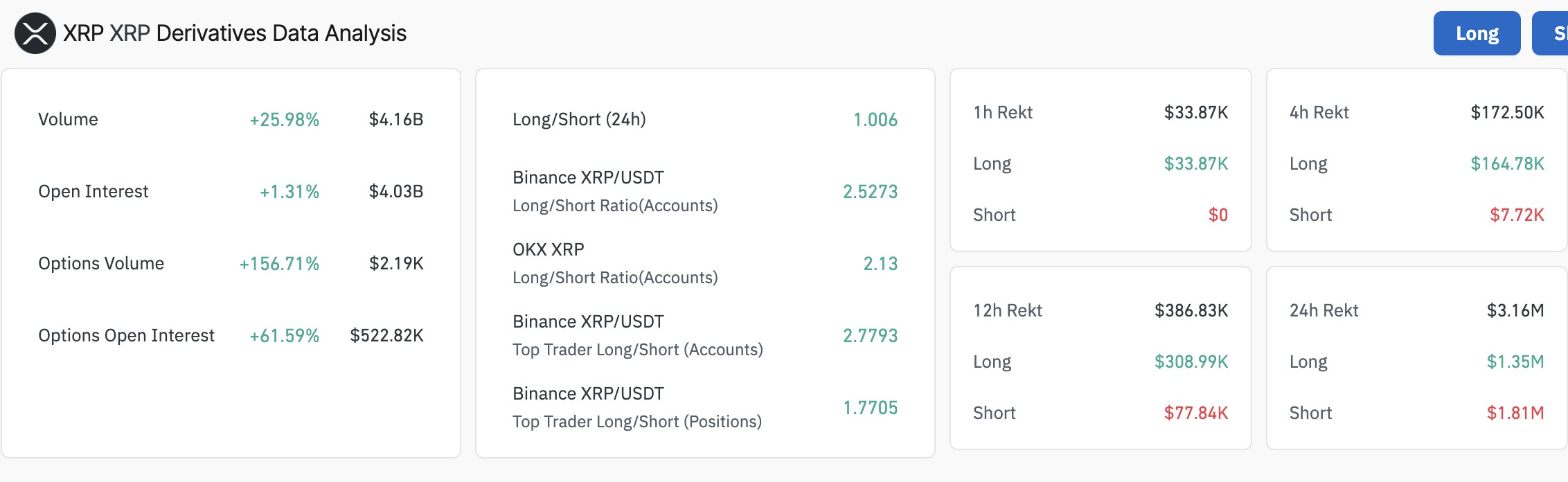
The XRP derivatives market data indicates bullish potential, with Open Interest (OI) rising by 1.31% to $4.00 billion.
XRP derivatives market Open Interest | Source: CoinGlass
Rising trading volume, along with higher short position liquidations of $1.81 million compared to $1.35 million over the last 24 hours, could create an environment suitable for a sustainable recovery.
SEC vs Ripple lawsuit FAQs
It depends on the transaction, according to a court ruling released on July 14, 2023: For institutional investors or over-the-counter sales, XRP is a security. For retail investors who bought the token via programmatic sales on exchanges, on-demand liquidity services and other platforms, XRP is not a security.
The United States Securities & Exchange Commission (SEC) accused Ripple and its executives of raising more than $1.3 billion through an unregistered asset offering of the XRP token. While the judge ruled that programmatic sales aren’t considered securities, sales of XRP tokens to institutional investors are indeed investment contracts. In this last case, Ripple did breach the US securities law and had to pay a $125 million civil fine.
The ruling offers a partial win for both Ripple and the SEC, depending on what one looks at. Ripple gets a big win over the fact that programmatic sales aren’t considered securities, and this could bode well for the broader crypto sector as most of the assets eyed by the SEC’s crackdown are handled by decentralized entities that sold their tokens mostly to retail investors via exchange platforms, experts say. Still, the ruling doesn’t help much to answer the key question of what makes a digital asset a security, so it isn’t clear yet if this lawsuit will set precedent for other open cases that affect dozens of digital assets. Topics such as which is the right degree of decentralization to avoid the “security” label or where to draw the line between institutional and programmatic sales persist.
The SEC has stepped up its enforcement actions toward the blockchain and digital assets industry, filing charges against platforms such as Coinbase or Binance for allegedly violating the US Securities law. The SEC claims that the majority of crypto assets are securities and thus subject to strict regulation. While defendants can use parts of Ripple’s ruling in their favor, the SEC can also find reasons in it to keep its current strategy of regulation by enforcement.
Author

John Isige
FXStreet
John Isige is a seasoned cryptocurrency journalist and markets analyst committed to delivering high-quality, actionable insights tailored to traders, investors, and crypto enthusiasts. He enjoys deep dives into emerging Web3 tren