Polygon price slides after whale moves 10.78 million MATIC into Binance
- Polygon price is down 3% in the last day, draws towards the support floor at $0.4994 with a possible continuation.
- Data from Lookonchain shows that a whale deposited 10.78 million MATIC tokens into Binance, worth approximately $5.5 million.
- While the whale still has 2.72 million MATIC tokens left, transferring tokens to exchanges often indicates intention to sell.
- On-chain data from Santiment shows increased activity, likely to provoke volatility in Polygon MATIC price.

Polygon (MATIC) price has been on a steep downtrend for the most part of the year, with the token withstanding the worst of the bear market. The situation was made worse when the US Securities and Exchange Commission (SEC) labeled MATIC a security, among other tokens like Solana (SOL and Cardano (ADA).
Also Read: MATIC price climbs as Polygon outlines proposals for 2.0 upgrade
Polygon price drops 3%, writes off mid-September gains
Polygon (MATIC) price is bearish, cutting down on the mid-September gains inspired by the developers’ proposals to implement the transition to Polygon 2.0. The proposals included the creation of a POL token to replace MATIC as the native gas and staking token of the ecosystem.
1/ The wait is over. Polygon 2.0 implementation kicks off now with the release of 3 Polygon Improvement Proposals (PIPs), and a roadmap for Phase 0.https://t.co/gk7FW0zCpc pic.twitter.com/YJo3BtQy4y
— Polygon (Labs) (@0xPolygonLabs) September 14, 2023
At the time of writing, Polygon price is $0.5054, with clear indications of a continued downtrend as long as it remains trapped underneath the foothold of the downtrend line. With the Relative Strength Index (RSI) dipping, momentum seems to be falling and MATIC could drop in value. Worse, the Awesome Oscillator (AO) remains in the positive, with its histogram bars flashing red to show bears are having their say in the market.
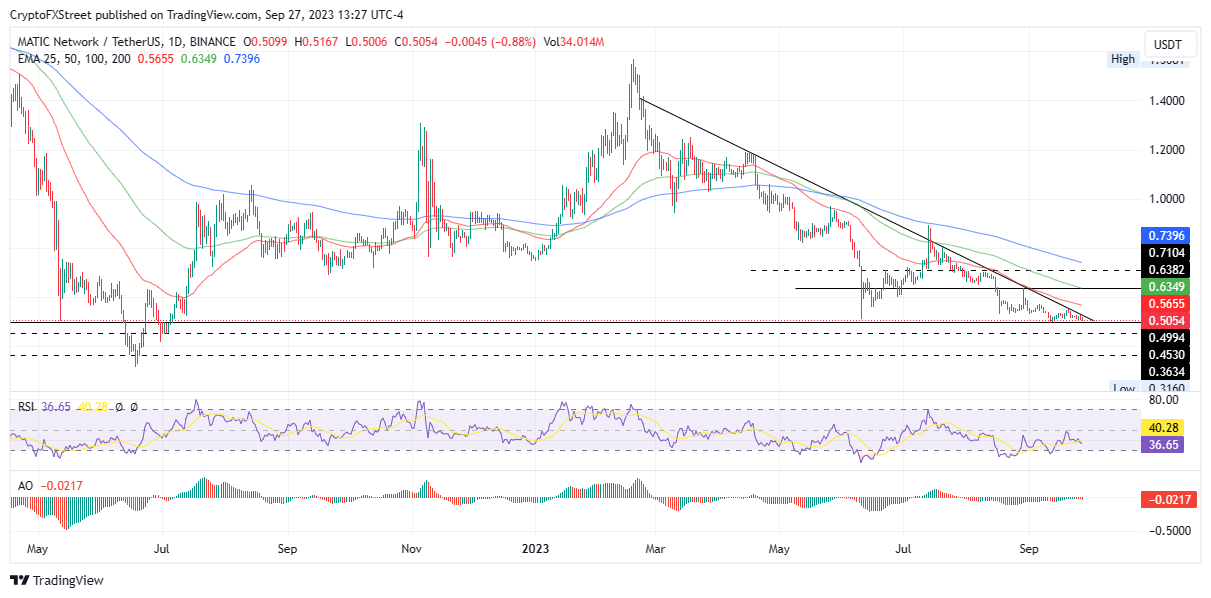
MATIC/USDT 1-day chart
However, the gains made during this hype have all been cut down, with a recent report by web3 data analysis tool Lookonchain attributing it to a whale moving a total of 10.78 million MATIC tokens to the Binance exchange. At current rates, that volume in MATIC tokens is worth approximately $5.5 million. The transaction happened over the last 26 hours, causing a 3% slump in Polygon price.
A whale deposited a total of 10.78M $MATIC ($5.5M) into #Binance in the past 26 hours and the price of $MATIC decreased by 3%.
— Lookonchain (@lookonchain) September 27, 2023
The whale currently has 2.72M $MATIC($1.37M) left.https://t.co/C4VNQ1QDq9 pic.twitter.com/8JcoySfsRP
Notably, moving tokens to exchanges is often interpreted as intention to sell, with the ongoing slump suggesting token holders are already closing their positions to avoid being caught as part of exit liquidity.
According to data from behavior analytics platform Santiment, the number of active addresses on a 24-hour scale has been on a steady rise since September 24, recording a 35% increase. In the same way, the whale transaction count for wallets with more than 100,000 MATIC and more than one million tokens has increased significantly.
 [20.18.27, 27 Sep, 2023]-638314450758401128.png)
MATIC Santiment
With these, it is likely that the Polygon MATIC price will record increased volatility over the coming days
Cryptocurrency metrics FAQs
What is circulating supply?
The developer or creator of each cryptocurrency decides on the total number of tokens that can be minted or issued. Only a certain number of these assets can be minted by mining, staking or other mechanisms. This is defined by the algorithm of the underlying blockchain technology. Since its inception, a total of 19,445,656 BTCs have been mined, which is the circulating supply of Bitcoin. On the other hand, circulating supply can also be decreased via actions such as burning tokens, or mistakenly sending assets to addresses of other incompatible blockchains.
What is market capitalization?
Market capitalization is the result of multiplying the circulating supply of a certain asset by the asset’s current market value. For Bitcoin, the market capitalization at the beginning of August 2023 is above $570 billion, which is the result of the more than 19 million BTC in circulation multiplied by the Bitcoin price around $29,600.
What is trading volume?
Trading volume refers to the total number of tokens for a specific asset that has been transacted or exchanged between buyers and sellers within set trading hours, for example, 24 hours. It is used to gauge market sentiment, this metric combines all volumes on centralized exchanges and decentralized exchanges. Increasing trading volume often denotes the demand for a certain asset as more people are buying and selling the cryptocurrency.
What is funding rate?
Funding rates are a concept designed to encourage traders to take positions and ensure perpetual contract prices match spot markets. It defines a mechanism by exchanges to ensure that future prices and index prices periodic payments regularly converge. When the funding rate is positive, the price of the perpetual contract is higher than the mark price. This means traders who are bullish and have opened long positions pay traders who are in short positions. On the other hand, a negative funding rate means perpetual prices are below the mark price, and hence traders with short positions pay traders who have opened long positions.
Author

Lockridge Okoth
FXStreet
Lockridge is a believer in the transformative power of crypto and the blockchain industry.