Here’s why Binance Coin is 33% down from its all-time high

Competitor blockchains, a slowdown in daily transactions and flat-lined TVL are a few challenges facing BNB, but data suggests Binance Coin is still a contender.
Binance Coin (BNB) holders enjoyed a 1,760% rally from $37 to $692 between January and May 2021, but as is customary in crypto, this surge was followed by a 69% correction two weeks later.
From there, it’s been a bit of a rough patch to regain investors' confidence and BNB failed to produce another all-time high in November even though the aggregate cryptocurrency market capitalization peaked at $3 trillion.
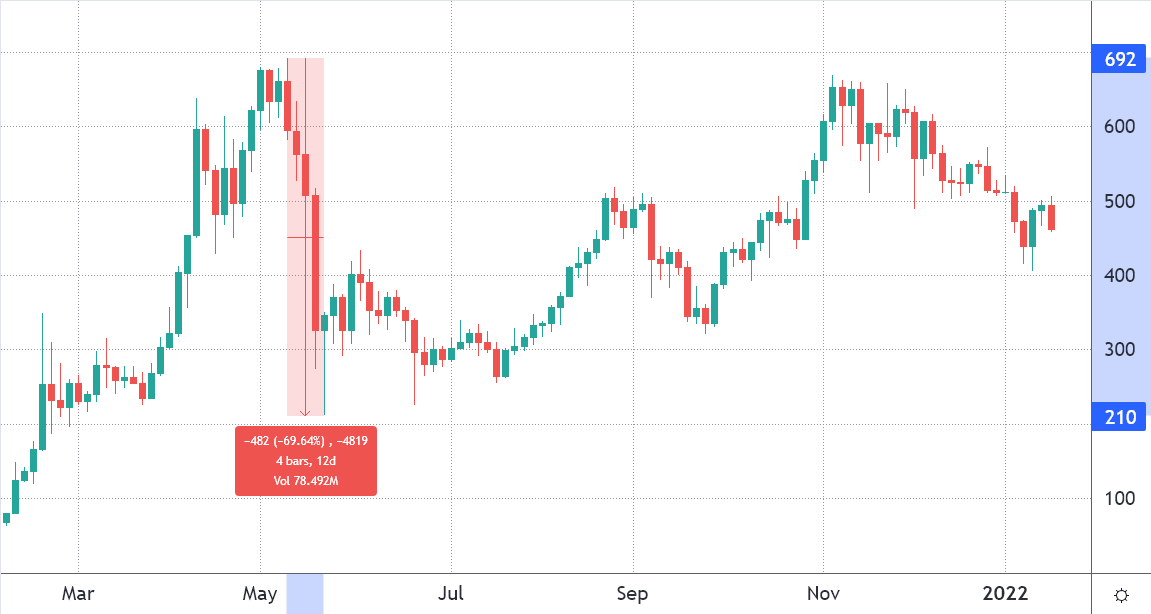
Binance Coin / USDT at Binance. Source: TradingView
In addition to being 33% down from its all-time high, BNB investors have other reasons to question whether the current $465 price is sustainable. Especially since traders were recently paying up to 3% per week to keep futures' short positions open, betting on the downside.
Traders flipped bearish on January 10
Unlike regular monthly contracts, perpetual futures prices are very similar to those at regular spot exchanges. This makes the process for retail traders a lot easier because they no longer need to calculate the futures premium or manually roll over positions near expiry.
The funding rate allows this magic to occur, and it is charged from longs (buyers) when they demand more leverage. However, when the situation is reversed and shorts (sellers) are over-leveraged, the funding rate goes negative and they become the ones paying the fee.
BNB 8-hour USDT/USD margin futures funding rate. Source: Coinglass.com
Notice how the funding rate on BNB futures was mostly flat between Dec. 15 and Jan. 10, but then quickly shifted to negative 0.13%. This rate is equivalent to 2.8% per week, a relatively high cost for shorts (sellers) to keep their positions. The movement happened while BNB tested the $410 support, its lowest price in 90 days.
Excessive premium versus competing blockchains
The reason behind the Binance short could be the excessive premium versus competing smart-contract chains. For example, BNB’s $78.2 billion market capitalization is 80% higher than Solana’s (SOL) $43.3 billion. Moreover, the premium versus Terra’s (LUNA) $28.2 billion is 178%, and 275% compared to Avalanche’s (AVAX) $20.8 billion. Other factors are in play could also be Binance Smart Chain's total value locked (TVL) stagnated at $15 billion.
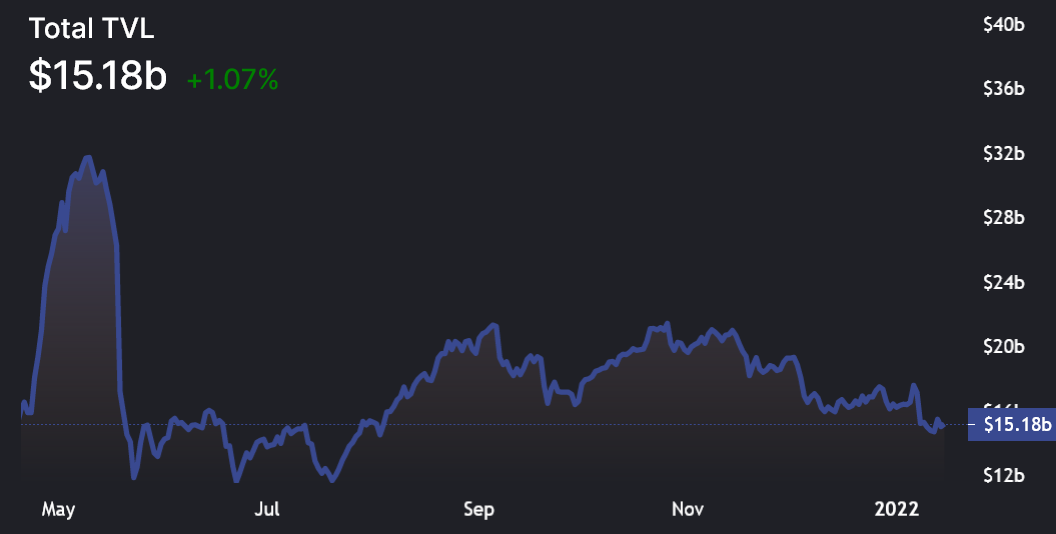
Binance Chain TVL in USD. Source: DefiLlama.com
For comparison, Terra's TVL increased from $9 billion to $19 billion in three months, while Avalanche grew from $6.5 billion to $11.6 billion in the same period. The competition has vastly surpassed Binance Chain's applications, except for the number of active users on PancakeSwap decentralized exchange.
To correctly assess whether Binance Smart Chain use has topped, one must analyze the network's activity. Some decentralized applications (dApps) like games, social, and NFT marketplaces require little total value locked (TVL) deposited on smart contracts.
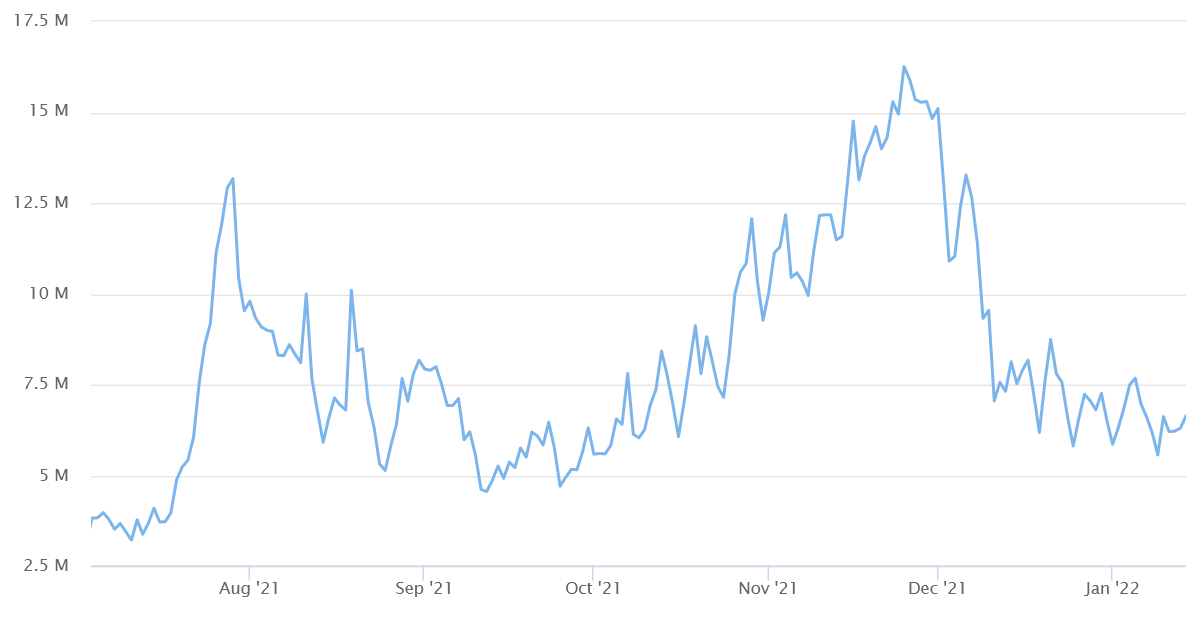
Binace Smart Chain daily transactions per day. Source: bscscan.com
Data shows that daily transactions on BSC peaked above 15 million on Nov. 25 and are recently averaging 6.5 million per day. One should also note that Binance Chain's main competitor Ethereum has been struggling with $40 or higher average transaction fees, which creates the perfect scenario for competing chains.
Despite this opportunity to seize market share, Binance Smart Chain seems to have flatlined in terms of daily transactions and TVL, both of which are signs of growth and adoption.
Binance's lead derivatives position could be challenged
The competition for Binance's leading position might be challenged as Coinbase, America's largest crypto exchange, plans to begin offering derivatives trading after the acquisition of FairX.
Moreover, FTX exchange raised $1.32 billion from private investors and FTX US finalized its acquisition of crypto options exchange LedgerX on Oct. 25. This solidifies its plans to offer derivatives contracts for U.S. investors.
There's a good chance that Binance will keep its leadership versus Coinbase and FTX derivatives considering that it has the first-mover advantage. Furthermore, Binance launched a $1 billion development fund on Oct. 12 to expand the capabilities of the Binance Smart Chain ecosystem.
Overvalued or not, solid fundamentals are backing the third-largest cryptocurrency and while the short-term price performance is not promising, there are still plenty of future catalysts for growth.
Author

Cointelegraph Team
Cointelegraph
We are privileged enough to work with the best and brightest in Bitcoin.