Grayscale law firm Davis Polk urges SEC to approve Bitcoin spot ETF, citing best use of resources
- Grayscale’s law firm filed a letter urging SEC to approve its BTC spot ETF after the August 29 win.
- The firm wants the commission to treat its Bitcoin Trust as an ETP investing in BTC futures contracts traded on CME.
- Grayscale says the Trust is ready to operate as an ETP upon Commission approval.

Grayscale Investment, one of the companies in the Bitcoin Spot Exchange-Traded Fund (ETF) race, has urged the US Securities and Exchange Commission (SEC) to approve its Bitcoin Trust (GBTC) conversion to an ETP, citing recent court victory. Grayscale CEO Michael Sonnenshein shared the development on social media platform X.
This afternoon, our legal team submitted a comment letter to $GBTC's 19b4 application on behalf of all @Grayscale investors.
— Sonnenshein (@Sonnenshein) September 5, 2023
We look forward to continuing to have a productive dialogue with with the SEC as we pursue next steps on GBTC's conversion.
I invite you to read the…
Also Read: Grayscale wins lawsuit against US SEC, Bitcoin price nears $28,000
Grayscale follows up the recent win with another letter to SEC
Grayscale Investment, through its legal representatives at Davis Polk, has asked the US SEC to approve its Bitcoin Trust conversion to an ETP. Noteworthy, an ETP is basically an ETF on Grayscale’s terms.
We would appreciate the opportunity to meet with the staff of the Securities and Exchange Commission as soon as practical to discuss the way forward in view of recent developments in the Trust’s ongoing effort to convert to an exchange-traded product (“ETP”).
After the SEC rejected Grayscale’s proposal to have the GBTC converted, the investment firm appealed in court and secured a victory on August 29, though the commission still has room to appeal. As the SEC continues modeling its entreaty, Grayscale’s lawyers have followed up with a letter in an attempt to expedite the process.
…we believe the Commission should conclude that there are no grounds for treating the Trust differently from ETPs that invest in bitcoin futures contracts traded on the Chicago Mercantile Exchange (“CME”).
Notably, the SEC has filed fifteen orders rejecting spot BTC filings even after Bitcoin futures ETPs began trading on the CME. This is one of Grayscale’s bones of contention on the matter, with others being that Bitcoin and Bitcoin futures are closely correlated, and that the surveillance sharing agreements (SSA) with the CME are similar therefore share the same potential to detect malicious activities in the market.
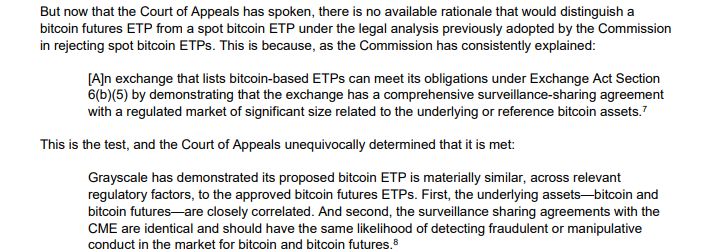
Excerpt from Davis Polk letter to the SEC
With this, Grayscale calls out the commission for dragging the matter too long, and in so doing, harming the Trust’s existing investors as their shares now trade at a discount to net asset value.
Grayscale’s lawyers articulate, “the Trust is ready to operate as an ETP upon Commission approval,” urging the SEC to agree that the best use of resources now is for the Commission to issue an approval order.
While the SEC’s stance is that, applicants are yet to prove beyond reasonable doubt that they can protect investors from market manipulation, the euphoria around BTC spot ETFs is that investors would be exposed to the flagship crypto even without being actual owners.
Also Read: Grayscale Bitcoin Trust to readjust fees if SEC approves its spot BTC ETF applications
Crypto ETF FAQs
What is an ETF?
An Exchange-Traded Fund (ETF) is an investment vehicle or an index that tracks the price of an underlying asset. ETFs can not only track a single asset, but a group of assets and sectors. For example, a Bitcoin ETF tracks Bitcoin’s price. ETF is a tool used by investors to gain exposure to a certain asset.
Is Bitcoin futures ETF approved?
Yes. The first Bitcoin futures ETF in the US was approved by the US Securities & Exchange Commission in October 2021. A total of seven Bitcoin futures ETFs have been approved, with more than 20 still waiting for the regulator’s permission. The SEC says that the cryptocurrency industry is new and subject to manipulation, which is why it has been delaying crypto-related futures ETFs for the last few years.
Is Bitcoin spot ETF approved?
Bitcoin spot ETF has been approved outside the US, but the SEC is yet to approve one in the country. After BlackRock filed for a Bitcoin spot ETF on June 15, the interest surrounding crypto ETFs has been renewed. Grayscale – whose application for a Bitcoin spot ETF was initially rejected by the SEC – got a victory in court, forcing the US regulator to review its proposal again. The SEC’s loss in this lawsuit has fueled hopes that a Bitcoin spot ETF might be approved by the end of the year.
Author

Lockridge Okoth
FXStreet
Lockridge is a believer in the transformative power of crypto and the blockchain industry.