Fresh $1B in Tether mints on Tron, closing gap again with Ethereum

The Tron network has drawn closer to regaining the lead from Ethereum in Tether circulation after another big mint by the US stablecoin issuer.
On May 5, Tether minted another $1 billion Tether (USDT $0.9998) on the Tron network, according to Arkham Intelligence. This brings the total USDT on Tron to $71.4 billion, according to the Tether Transparency report.
In comparison, there is currently $72.8 billion USDT circulating on the Ethereum network, so just $1.4 billion more USDT on Tron will see it become the leading network for the world’s largest stablecoin issuer, as it has been previously over the last two years.
Tron was ahead of Ethereum for USDT circulation between July 2022 and November 2024, but a large $18 billion mint on Ethereum pushed the network ahead again, according to CryptoQuant.
The third-largest network for USDT is Solana, which has $1.9 billion circulating, and there are smaller amounts on Ton, Avalanche, Aptos, Near, Celo and Cosmos.
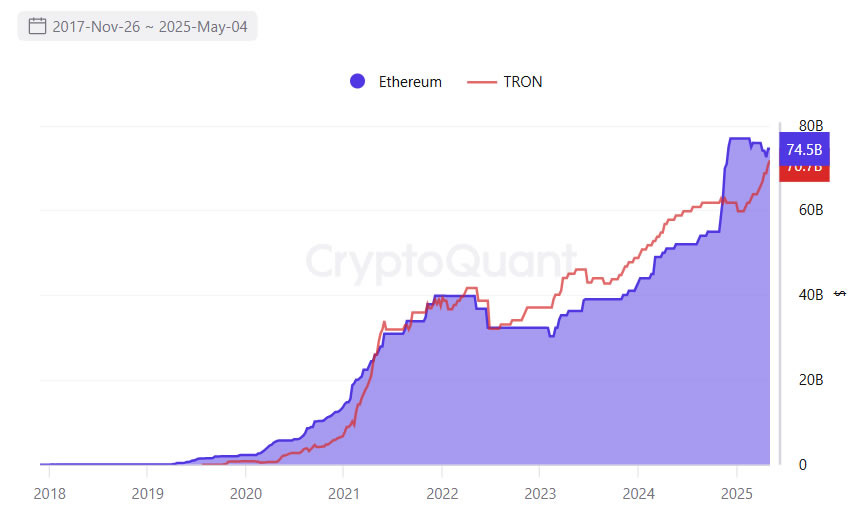
USDT circulation on Ethereum and Tron. Source: CryptoQuant
Tether’s total circulation is currently at a record high of $149.4 billion USDT, having increased by 8.6% since the beginning of this year. This gives the firm a commanding stablecoin market share of 61%, according to CoinGecko.
Its closest competitor, Circle, has a market share of 25% with almost $62 billion USDC (USDC $1.00) in circulation.
Stablecoin issuance has surged over the past six months, and they currently represent 8% of the total crypto market capitalization.
In a report in late April, the United States Treasury Department predicted that the stablecoin market could reach $2 trillion by 2028 if regulatory clarity is achieved.
Stablecoin legislation nearing next vote
It is widely believed that two key pieces of legislation need to be passed into law in the US to cement the position of stablecoins.
The Guiding and Establishing National Innovation for US Stablecoins (GENIUS) Act sets out clear definitions for “payment stablecoins” and reserve rules for stablecoin issuers.
Lawmakers in the US Senate will move forward with a vote on the GENIUS stablecoin bill before May 26, according to reports.
Meanwhile, the Stablecoin Transparency and Accountability for a Better Ledger Economy (STABLE) Act, which governs the approval and supervision of “federally qualified nonbank payment stablecoin issuers,” is also going through Congress.
Tether is also planning to launch a US-based stablecoin later this year, with timing dependent on the passing of legislation.
Author

Cointelegraph Team
Cointelegraph
We are privileged enough to work with the best and brightest in Bitcoin.