Fallout: Ethereum fees skyrocketed as traders raced to unwind leveraged positions

Traders racing to exit leveraged positions on-chain appeared to drive a record spike in Ethereum gas prices yesterday, with users reporting transaction fees of more than $1,000 still got stuck.
Ethereum fees surged to record highs amid the recent crypto downturn, with users paying more than 2,000 gwei to execute transactions at its peak.
Digital asset research firm, Delphi Digital, noted gas prices oscillated between 1,500 and 1,700 gwei for approximately one hour as DeFi liquidations drove “gas wars amongst liquidators and arbitrageurs.”
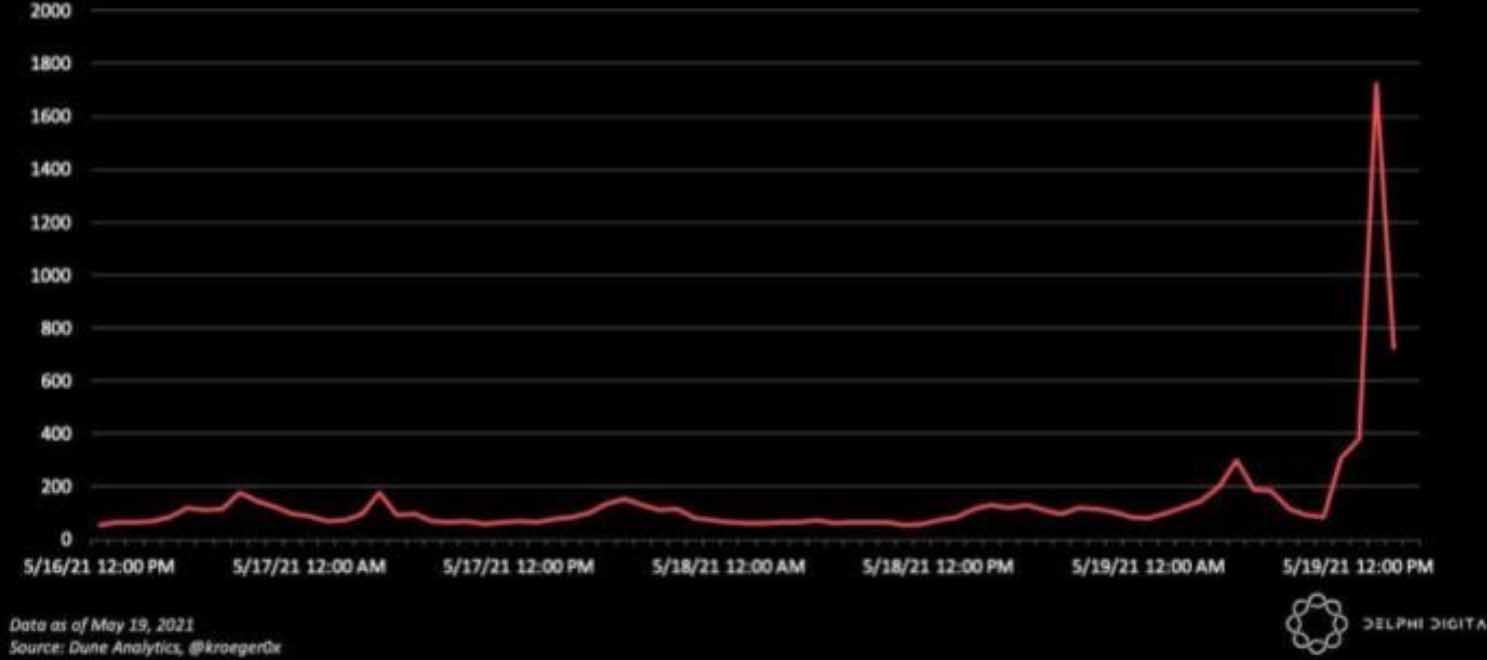
Ethereum gas prices amid crypto market crash: Dune Analytics
In the May 19 Daily Gwei newsletter, Ethereum developer Anthony Sassano speculated the fee frenzy was likely triggered by on-chain margin traders racing to exit their leveraged positions:
“The price was falling so fast that people were getting scared for their on-chain leveraged positions and were willing to pay anything to get their transaction included in the next Ethereum block (presumably to close their positions).”
Chris Weston of Melbourne-based brokerage Pepperstone also emphasized the role of leverage in the crash, estimating that cascading margin calls drove $9.13 billion worth of liquidations across crypto exchanges in 24 hours.
Alameda Research’s Sam Trabucco also noted high leverage in the Ethereum markets, criticizing the narrative that Ethereum’s rally was largely fueled by institutional spot buying.
“I saw a TON of speculation that the rallies (especially the ETH rallies) were low-leverage and spot-driven, and therefore more organic’ somehow [...] This narrative was super wrong,” said Trabucco.
Crypto luminaries were not exempt from the gas crisis, with CoinShares CSO, Meltem Demirors, tweeting about her stuck transactions in spite of paying more than $1,000 in gas fees.
However, some analytics were able to find a silver lining amid the skyrocketing fees, with Paradigm’s Hasu estimating that Ethereum stakers would have captured “tens to hundreds of millions of dollars” in fee revenue if EIP-1559 and Proof-of-Stake had been live during the crash.
Author

Cointelegraph Team
Cointelegraph
We are privileged enough to work with the best and brightest in Bitcoin.