Ethereum proposal to boost transaction speed and help DEXs save $100M sparks enthusiasm in community
- Ethereum will see a 50% speed increase and improved DEX efficiency if new proposal is approved.
- EIP-7781 is already getting support from key members within the Ethereum community.
- Ethereum has maintained consolidating below the $2,500 level after posting a Doji candle.
Ethereum (ETH) is up slightly by 0.1% on Monday following the appearance of a Doji candle, indicating a potential reversal in price trend. The potential price change follows a new Ethereum Improvement Proposal (EIP) EIP-7781, which aims to reduce slot time and boost the network's speed by roughly 50%.
Ethereum's new proposal to boost throughput and DEX efficiency
The new EIP-7781, initially proposed by Illyriad Games co-founder Ben Adams, aims to boost Ethereum's throughput by 33% through a process that will see slot time fall from 12 seconds to 8 seconds. Slot times are intervals during which validators propose new blocks to the Ethereum network.
The decrease in slot time also implies a reduction in based rollup latency. Based rollups are a new type of rollup that leverages the main chain for transaction sequencing as opposed to optimistic and ZK rollups.
The changes also imply an increase in blob — a data structure for storing L2 transactions introduced in the March Dencun — count from 6 to 8 or a hike in the gas limit from 30M to 40M.
There's a new EIP to increase Ethereum's throughput by 50%.
— cygaar (@0xCygaar) October 6, 2024
- 12 second block times -> 8 seconds
- 6 data blobs per block -> 9 blobs per block
- DEXes become around 1.22x more efficient
If approved, this would be a huge first step in improving Ethereum L1's performance. pic.twitter.com/MkX5gbiBFR
EIP-7781 is already getting support from key members within the crypto community, including Ethereum researcher Justin Drake, who said the proposal will improve speed by 50% and make decentralized exchanges like Uniswap v3 1.22x more efficient. Such efficiency could translate to $100M saved from the price discrepancies arbitrageurs profit from, "ultimately leading to a better execution for users."
While many have raised concerns about the potential hardware requirements from implementing the proposal, Adams noted that it could achieve these benefits without increasing the peak bandwidth.
EIP-7781 will go through the governance voting process of Ethereum before developers can take the next step toward its implementation.
Meanwhile, Ethereum ETFs globally posted a net outflow of $29 million last week, per CoinShares data.
Ethereum consolidates below $2,500 level following key indecision candle
Ethereum is trading around $2,450 on Monday, slightly up on the day. The top altcoin has sustained liquidations worth nearly $57 million in the past 24 hours, with long and short liquidations accounting for $41.23 million and $15.75 million, respectively.
ETH is consolidating within a key rectangle channel after it saw a rejection around the $2,500 psychological level, posting a Doji candle on the 4-hour chart.
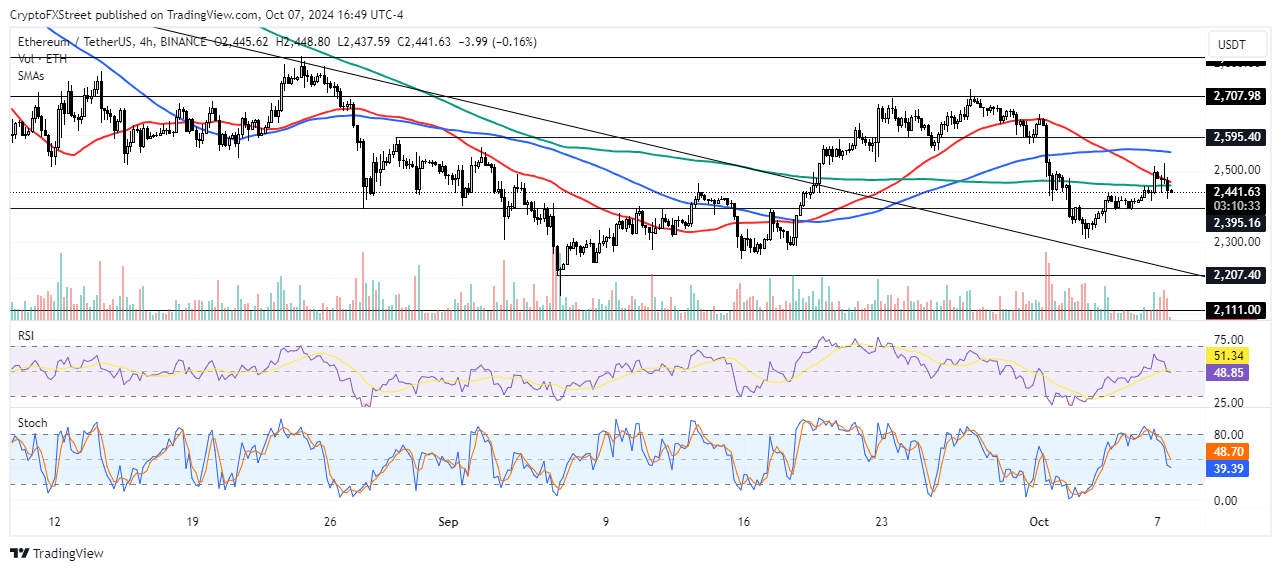
ETH/USDT 4-hour chart
Doji candles are formed when an asset's open and closing prices are almost the same. The candle represents indecision among traders and could signify a potential trend reversal. As a result, ETH could see a brief decline toward the support near $2,395.
The bearish move is supported by prices crossing below the convergence of the 50-day and 100-day Simple Moving Averages (SMA) near $2,470
The Relative Strength Index (RSI) and Stochastic Oscillator (Stoch) momentum indicators are slightly below their neutral levels, indicating bearish momentum among traders.
A daily candlestick close below $2,395 will invalidate the thesis.
Cryptocurrency prices FAQs
Token launches influence demand and adoption among market participants. Listings on crypto exchanges deepen the liquidity for an asset and add new participants to an asset’s network. This is typically bullish for a digital asset.
A hack is an event in which an attacker captures a large volume of the asset from a DeFi bridge or hot wallet of an exchange or any other crypto platform via exploits, bugs or other methods. The exploiter then transfers these tokens out of the exchange platforms to ultimately sell or swap the assets for other cryptocurrencies or stablecoins. Such events often involve an en masse panic triggering a sell-off in the affected assets.
Macroeconomic events like the US Federal Reserve’s decision on interest rates influence crypto assets mainly through the direct impact they have on the US Dollar. An increase in interest rate typically negatively influences Bitcoin and altcoin prices, and vice versa. If the US Dollar index declines, risk assets and associated leverage for trading gets cheaper, in turn driving crypto prices higher.
Halvings are typically considered bullish events as they slash the block reward in half for miners, constricting the supply of the asset. At consistent demand if the supply reduces, the asset’s price climbs.
Author

Michael Ebiekutan
FXStreet
With a deep passion for web3 technology, he's collaborated with industry-leading brands like Mara, ITAK, and FXStreet in delivering groundbreaking reports on web3's transformative potential across diverse sectors. In addition to