Ethereum Price Forecast: Whales increase buying pressure as developers set April 30 for Pectra mainnet upgrade
Ethereum price today: $1,930
- Ethereum developers tentatively scheduled the Pectra mainnet upgrade for April 30 in the latest ACDC call.
- Whales have stepped up their buying pressure in hopes of a price uptick upon Pectra going live on mainnet.
- ETH could face strong bearish pressure if its technical indicators confirm a breakdown signal.
Ethereum (ETH) has seen immense buying from whales on Thursday following core developers fixing April 30 as a tentative date for the Pectra upgrade to go live on mainnet.
Ethereum whales increase buying pressure ahead of Pectra mainnet upgrade
In its latest All Core Developers Consensus (ACDC) call, Ethereum developers tentatively scheduled April 30 for the Pectra mainnet upgrade.
The Pectra upgrade successfully went live on the new Hoodi testnet (or test network) on Wednesday. However, developers are still observing potential issues, considering the hiccups seen in the Holesky and Sepolia testnets after a similar upgrade.
If April 30 is confirmed in the ACDC call next Thursday, ETH could see increased volatility as investors may begin to position for potential price changes following the upgrade.
Short summary of big ACD:
— timbeiko.eth (@TimBeiko) March 27, 2025
- Pectra tentatively scheduled for April 30
- EOF still in Fusaka, full scope by April 10. P0: ship PeerDAS ASAP
- Pre-merge history dropping from Sepolia on May 1st, and mainnet ~1 month after Pectra ️
- Protocol Research Call #001 next week https://t.co/YHAOMIBPUh pic.twitter.com/aKR6CBhF7u
While Pectra has no updates that directly impact ETH's valuation metrics, the new features it brings could boost network activity and attract capital back to the Ethereum Layer 1. This is evidenced in recent positioning among ETH whales.
Whales increased their ETH buying pressure in the past few hours, with some depositing their assets in staking protocols and others adding leverage on their holdings through DeFi lending protocols, per Lookonchain data.
Notably, a whale bought 51,209 ETH for $103 million on the Coinbase exchange.
The immense decline in ETH's exchange reserve aligns with the latest whale activity. The reserves have plunged by nearly 1 million ETH since March 3, indicating immense buying pressure.
-638787327474267110.png)
ETH exchange reserve. Source: CryptoQuant
However, prices have remained fairly muted, weighed down by macroeconomic conditions and traditional investors' sentiments, as revealed in the sustained outflows recorded in Ethereum exchange-traded funds (ETFs) since February, per Farside Investors' data.
Meanwhile, the US government transferred 884 ETH worth $1.77 million to an unknown wallet in the past few hours, per Arkham data. This stirred attention from the crypto community, considering President Donald Trump signed an executive order for the US to create a Strategic Bitcoin Reserve and digital asset stockpile earlier in the month.
Ethereum Price Forecast: ETH technical indicators on verge of a breakdown confirmation
Ethereum saw $29.38 million in futures liquidations in the past 24 hours, per Coinglass data. The total value of long and short liquidations is $22.36 million and $6.02 million, respectively.
ETH crossed below the lower boundary of a key channel after seeing a rejection at the $2,069 resistance. A sustained decline below this trendline could send ETH to test the support level near $1,800.
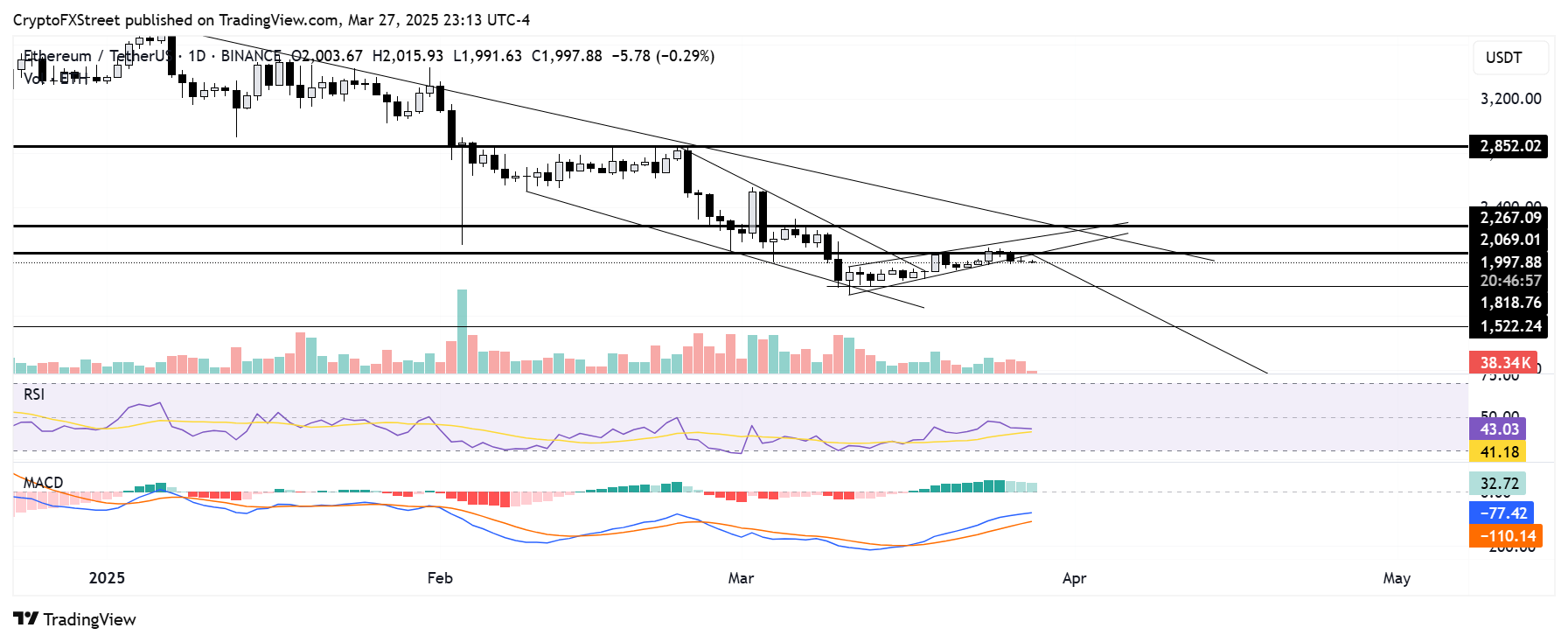
ETH/USDT daily chart
A firm move below $1,800 will validate a bearish flag pattern, potentially sending ETH below $1,500 and toward $1,200 — a level obtained by measuring the height of the flag's pole and projecting it downward from the breakdown point.
On the other hand, a recovery above the lower boundary of the key channel and the $2,069 resistance could trigger a short-term ETH rally.
The Relative Strength Index (RSI) is declining below its neutral level and could test its yellow moving average line. Meanwhile, the Moving Average Convergence Divergence (MACD) posted consecutive receding green bars.
The bearish momentum could accelerate if the RSI declines below its moving average line and the MACD histograms flip red.
Ethereum development FAQs
After the Dencun upgrade in March 2024, Ethereum users are looking towards the Pectra upgrade slated for early 2025. The upgrade will come in two phases, featuring improved wallet experience, an upgrade to the Ethereum virtual machine (EVM), PeerDAS for scaling L2s, improvement of blob capacity, etc.
Forks are upgrades or changes to the codebase/architecture of a blockchain network. Considering blockchain networks have no central governance, forks are only carried out after developers and validators reach a consensus. Hard forks are substantial permanent changes in a blockchain protocol that create two parallel chains – one with the old rules and the new with the implemented changes. Developers can either upgrade their software to build on the new chain or remain on the old chain as a separate network. During a hard fork, users receive an equivalent amount of their tokens on the new blockchain network 1:1. Soft forks, on the other hand, are subtle changes on a blockchain network that are backwards-compatible, meaning the network still operates as a single entity even when some developers don't implement the new changes.
Famously scribbled by Ethereum co-founder Vitalik Buterin in 22 minutes, Ethereum improvement proposal EIP-7702 is an advanced way of marrying EIP-3074 and ERC-4337 to unlock massive adoption for Ethereum's smart wallet functionality. Slated to go live in the upcoming Pectra upgrade, EIP-7702 will implement an advanced version of account abstraction enabling features like batching that allows users to pay a one-off transaction fee for multiple actions, sponsorship to enable an account pay gas fees for other users and wallet recovery options if users misplace their seed phrase.
Layer 2 is a collective term for protocols that aim to scale Ethereum by processing batches of transactions off the Mainnet. After performing a series of mathematical computations to ensure their validity, these L2s send a compressed version of the transactions back to the Mainnet for final processing. As a result, Layer 2 networks reduce transaction fees and enhance the Mainnet's speed while reaping its security. Think of them like several personal assistants that help their boss to process a series of paperworks. These assistants send a summarised version of the paperworks to the boss who confirms and signs on them.
Layer 3 solutions are application-specific blockchains built upon existing Layer 2 networks to offer high scalability and interoperability. For example, an L3 can focus on tackling privacy, increased scalability, gaming, or some complex functionality while still ultimately deriving security from the Layer 1.
Author

Michael Ebiekutan
FXStreet
With a deep passion for web3 technology, he's collaborated with industry-leading brands like Mara, ITAK, and FXStreet in delivering groundbreaking reports on web3's transformative potential across diverse sectors. In addition to