ETH may face incoming volatility, how to play it?

Overview
The cryptocurrency markets have been acting indecisively shortly after bitcoin’s third halving. However, initial signs show that a major shift of sentiment could be started to take place within the ETH market. It could be a symbol showing that major ETH investors could have begun to prepare for the next big move in the second-largest cryptocurrency. It is interesting because markets have seen an increasing conversation about the long-due ETH 2.0 upgrade, which could be the next major event this year after bitcoin halving. How could this upgrade affect the ETH prices and the market as a whole? What kind of trading instrument is ideal for an early set up for this event?
Ethereum 2.0: The next big thing in crypto after bitcoin halving?
BTC’s third halving has successfully delivered this week, and the halving hype is finally over. It is not hard to see the wait-and-see sentiment in the market after halving; BTC has been trading sideways, and major altcoins were pretty much the same.
While investors are still looking for the next focus in the market, ETH may deserve more attention, as the second-largest cryptocurrency is set to go through a significant upgrade despite having experienced multiple delays.
Ethereum 2.0 protocol upgrade will change the original proof-of-work mechanism to proof-of-stake, which could encourage ETH holders to accumulate more ETH. That is because if one has more stake in the network, the more powerhe has to validate transactions.
Although the 2.0 upgrade project has experienced multiple delays, we may not be far from the official launch, although the timing remained unknown.Vitalik Buterin, the co-founder of Ethereum, told Coindesk that “the testnet for Ethereum 2.0 was already live and the first phases of implementation began already.”
Although some market reports saying, the launch could be in July. However, But erinclarified that the launch is scheduled at the end of 2020 without providing a specific date.
Conditions may favor volatility
Early indications from miners and whales may signal that volatility of ETH prices in the future.Figure 1 shows that miners have started to accumulate ETH again recently, which came after the May 10 selloff.
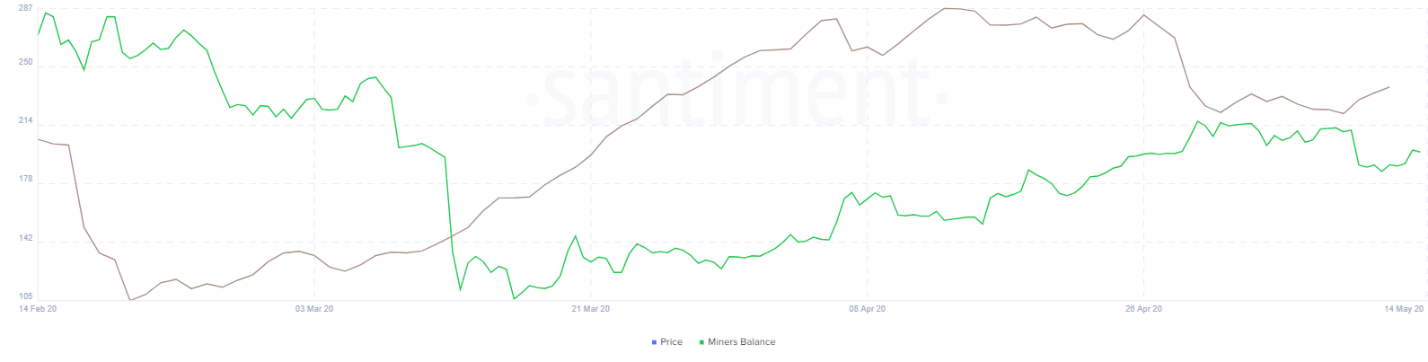
Figure 1: ETH Price (Green) vs. Miners Balance (Brown) (Source: Santiment)
A reduction of miners’balances often considered as an early indication of the pricethat could have been peaked in the short-term. Conversely, when miners’ balance started to increase or an uptrend, the prices could have been bottomed in the near-term.
It’s worth noting that this accumulation trend, even is confirmed, could be a medium/long-term trend, and the timing of that accumulation reflecting on price could be hard to determine.
That’s why we need more evidence to back up our assumption, and the ETH amount in non-exchange top holders may provide another clue.
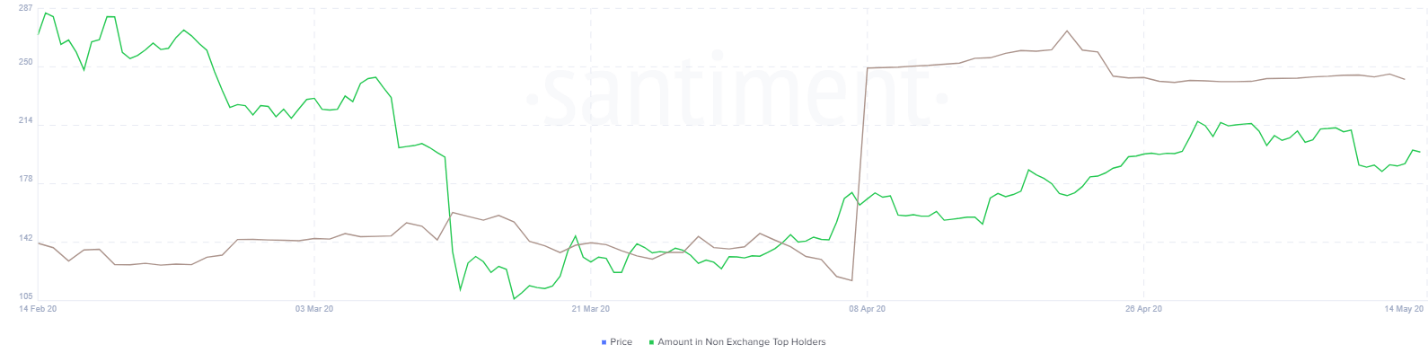
Figure 2: ETH Price (Green) vs. Amount in Non-Exchange Top Holders (Brown) (Source: Santiment)
It seems that whales have been keeping their ETH holdings at a relatively high level since April 8. The May 10 selloff did not reduce much of their confidence, and that could be another sign that whales have been expecting volatility of ETH prices may soon going to increase, perhaps with a bias on the upside.
Additionally, the social volume levels may give us a complete picture of how hot ETH or ETH 2.0 in the crypto community. Figure 3 shows the social volume of the term “ETH” or “ETH 2.0” on Telegram and Reddit. ETH has been on an uptrend since early May.
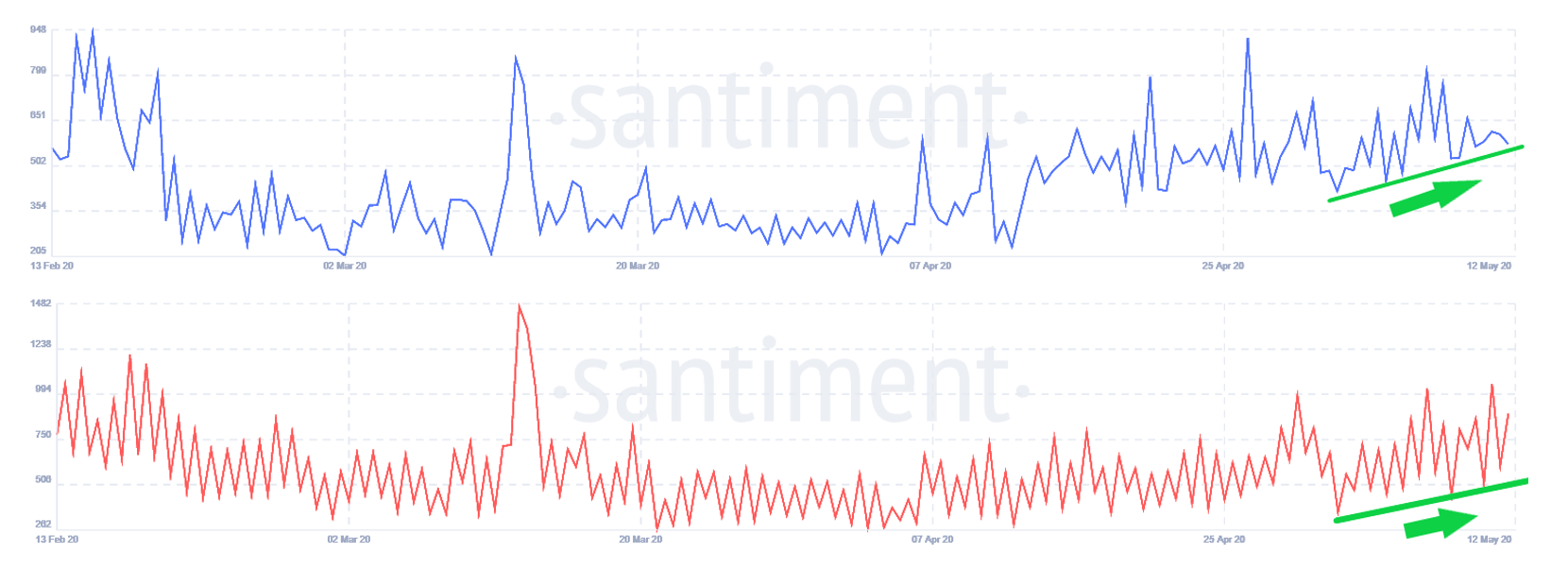
Figure 3: Social Volume of “ETH” or “ETH2.0” on Telegram (blue) and Reddit (red) (Source: Santiment)
While the price implication of adigital asset with a higher social volumeremained highly debatable, but one thing that we can confirm is, ETH or ETH 2.0 has been generating more noise among crypto communities, and that often generate volatility on the price of the given asset. That could be something that traders and investors want to put a close eye on.
Favor ETH futures over options
How traders and investors can capture and capitalize on the potential moves of ETH prices, that’s the million-dollar question. However, picking the right instrument to enter a trade could be more crucial than many traders and investors think. With the right tool, market participants may able to maximize the potential profile while minimizing their risks.
In this ETH case, we know that the 2.0 upgrade will eventually arrive; it is just a matter of time, regardless of whether it's July or year-end.That’swhy instruments like futures that have no time decay and fixed trading cost could be a better choice of weapon.
No time decay – One of the essential elements when it comes to pricing options is the time value, and the value of the options contract decreases over time.If an investorwanted to catch an impending volatility increase of the price of the underlying,without knowing the time of that specific event happens, like this ETH 2.0 upgrade case, futures have edges over options, because futures have no time decay.
Fixed trading cost –The margin cost of futures contracts with major crypto as an underlying are usually fixed, which means traders will know how much initial margin they need when they first set up a trade. For example, the initial margin of ETHUSD futures contractson OKEx could be as low as 2% with a maintenance margin ratio of 1%. In contrast, option premium could fluctuate, in some cases, if the underlying asset is getting more volatile, options buyers may need to bear a higher option premium.
Simpler pricing – Pricing an option contract sometimes could be complicated, and there were more variables that traders and investors may not easy to control and understand. Besides the time decay factor that we mentioned earlier, implied volatility could be another issue that options traders can’t ignore, yet it’s hard to control at the same time. IV is considered a gauge of the market's forecast of the likely movement ofthe underlying price. It has been a key element when it comes to options pricing. However, IV is also the part that is hardest to understand and forecast. In futures trading, there’s no such factor.
Long tenor or perpetual? Why not both?
We have identified futures as an ideal instrument for speculating the potential ETH price volatility increase. Still, picking the right tenor could be another issue. Currently, markets provide a wide variety of ETH futures contracts with different tenors that investors can choose, ranging from weekly, bi-weekly, quarterly, bi-quarterly to perpetual. So, which one to choose?
If investors believe that ETH's price volatility may increase in the future, and they wanted to make early moves for potential event-driven price actions, futures contracts with longer tenor, like OKEx's ETHUSD bi-quarterly futures could be one of the choices. Also, they may want to consider a spread trading strategy.
The spread trading strategy involves the buying of one futures contract and selling another futures contract. This strategy may help investors profit from an unanticipated change, and it could also be lessrisky than outright futures.
In this case, buying an ETHUSD perpetual swap and selling bi-quarterly ETHUSD futures could be another solution.
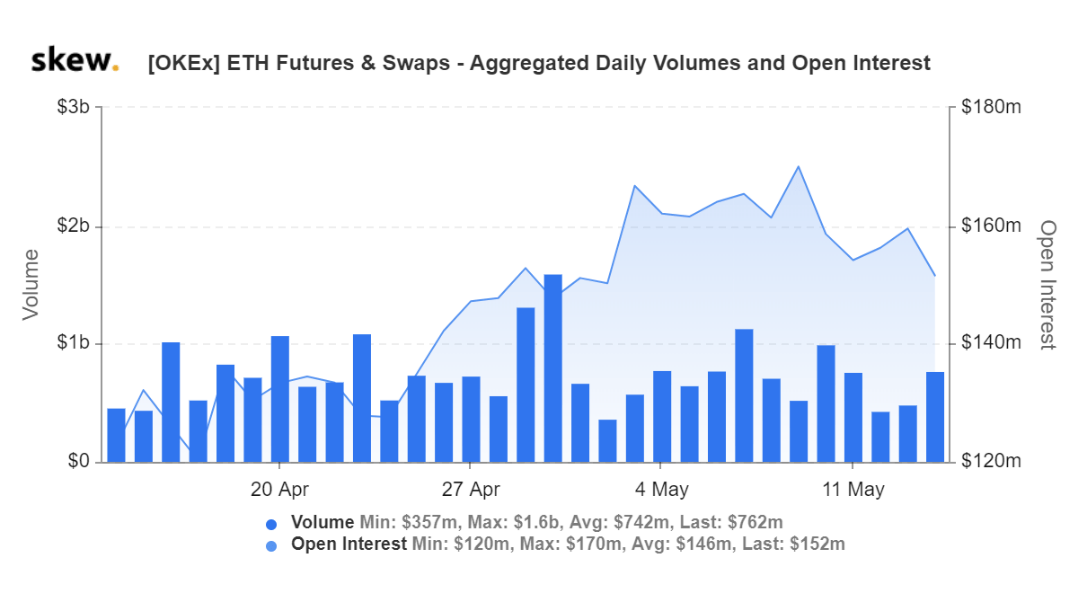
Figure 4: ETH Futures & Swaps Aggregated Daily Volumes and Open Interest (Source: Skew)
Conclusion
Market participants seem still looking for the next focus after bitcoin’s halving, and ETH 2.0 upgrade could easily become the next focal pointin the crypto space. However, with unknown timing and multiple delay history, it could be challenging for investors and traders to capitalize on such an event. That is why derivatives like futures and swaps may help investors capture these opportunities and reduce their risks by employing the right strategy. Investors should construct their strategies according to their risk profile
Author
Cyrus Ip
OKEx
Cyrus Ip has the privilege to work with OKEx as a Research Analyst, where he found some of the brightest talents in the crypto space.