Crypto venture capital surges to $14.5 billion amid market volatility

Venture capital investment in the crypto industry reached historic levels in November, sparking debate over the decentralized future of the crypto market.
According to the latest data from Cryptorank, total venture investment in the crypto industry soared to $14,48 billion in November, more than double the figures recorded in the previous two months and 70% higher than the last peak in July 2025. The meteoric rise in investment highlights growing institutional confidence in blockchain-based projects and the legitimacy of crypto assets in global financial markets, despite recent price pressure. Venture capital firms are increasingly viewing the crypto space as a viable venue for long-term growth and as a fuel for innovation across other major sectors of the global economy.
Are institutions a threat to crypto’s decentralized ethos?
The unprecedented influx of institutional capital into the Web3 ecosystem entails risks. Ray Youssef, CEO of P2P crypto platform NoOnes, emphasized that while investments are essential for the growth and development of the ecosystem, the sheer volume of institutional inflows could shift the balance of power in the market. He warned that dominant institutional participation in the industry could transform it from a system that develops independently under natural conditions into a centralized one, adding that:
“Investments, specifically in this situation, are fuel, but the industry's movement, powered by this fuel, should not be determined by institutional players. New projects must solve problems faced by ordinary people.
Youssef’s concerns reflect a broader discussion within the crypto community about the increased roles of institutional investors in the crypto ecosystem. The crypto industry has thrived as a largely decentralized system, enabling peer-to-peer transactions and financial empowerment for retail market participants. Analysts say the rise of large institutional funds and venture capital’s controlling influence in the industry could alter this dynamic, steering resources toward projects with the highest commercialization potential rather than those that address societal pain points, such as social and financial inclusion.
VC capital flows concentrated in select deals
In November 2025, the crypto industry witnessed some of the largest VC deals ever seen. Notable fundraising events included Naver Financial’s $10.3 billion all-stock acquisition of Dunamu — one of the largest M&A transactions to date — a $1 billion investment in Kalshi at an $11 billion valuation led by Sequoia Capital, a16z Crypto, and Paradigm, and a $500 million strategic round for XRP at a $40 billion valuation backed by Pantera Capital, Galaxy, and other major institutional investors. However, despite the high headline numbers, the bulk of VC funding remains concentrated in a small number of large deals, with most going to high-value crypto companies. Venture firms have increasingly prioritized cautious, selective investment strategies following the collapse of large crypto businesses like Celsius and FTX.
Regional concentration, macro drivers and industry implications
According to a Galaxy Digital report, In Q3 2025, 414 venture deals were completed. Still, just seven of these deals (Revolut $1b, Kraken $500m, Erebor $250m, Treasury $146m, Fnality $135m, Mesh Connect $130m, and ZeroHash $104m) accounted for half of all the capital raised. Most of these investments are heavily weighted toward established crypto firms founded before 2018, suggesting that venture capital is prioritizing companies with a proven track record rather than early-stage startups like Y Combinator. Pre-seed activity has declined drastically as the crypto sector matures, signaling the potential end of the “golden era” of speculative VC crypto investing.
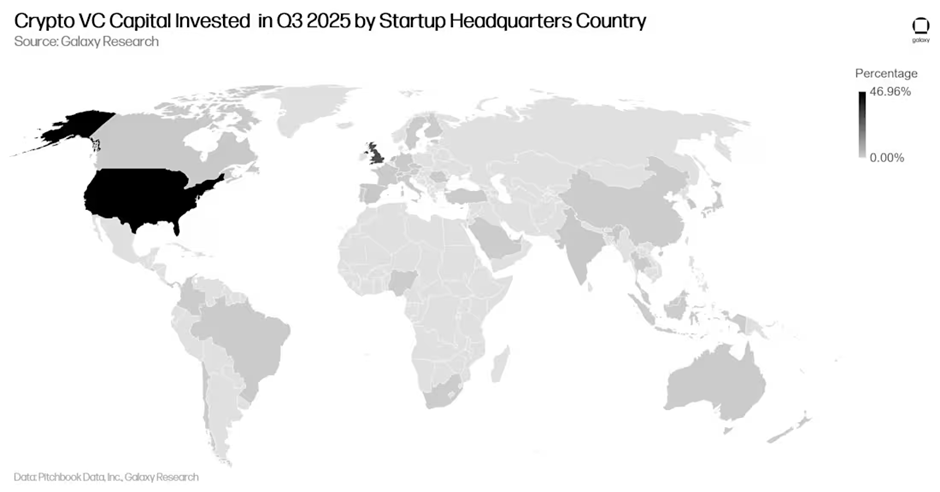
The implication of institutional dominance extends beyond price movements. The NoOnes executive highlighted that projects that fail to align with the strategic interests of institutional investors may struggle to survive, while others could receive disproportionate support. This produces a highly fractured and centralized system in which only VC-backed coins might survive.
Despite increased institutional inflows, the broader market has continued to decline. BTC has declined by over 16% in the last 30 days, while Ether and Solana have fallen by 21% and 24%, respectively.
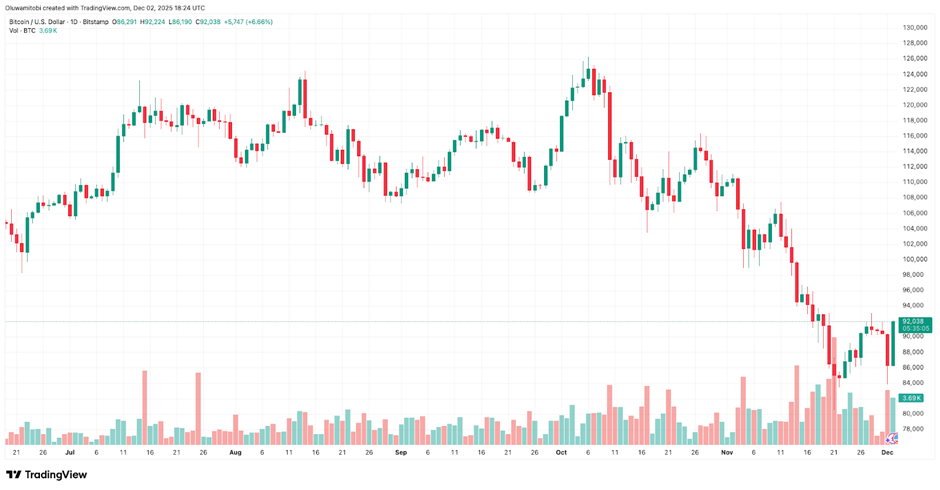
Some analysts suggest that institutions may be taking advantage of the market decline to secure cleaner entry points and control overall market capitalization in the long term.
“The continued decline of cryptocurrency markets amid record institutional inflows is a clear demonstration of institutional players’ intention to gain full control over the crypto market’s capitalization without any intention to use blockchain technology. This does not rule out scenarios of a delayed price recovery for major assets — BTC, ETH, XRP, and DOGE — in Q1 2026,” Youssef added.
He mentioned that institutional players may see value in selling BTC to retail investors at high prices after the successful market institutionalization.
Author

Julia Magas
Independent Analyst
Julia Magas is an analyst and writer specializing in cryptocurrency and fintech market trends. Her work has been featured in leading financial publications such as Nasdaq, InvestorPlace, Cointelegraph, and Investing.