Crypto use in money laundering ‘far below’ cash – US Treasury

Cash, not cryptocurrencies, remains the go-to money laundering method for criminals and organizations, according to a detailed risk assessment report from the United States Treasury Department.
Three separate reports delving into money laundering, terrorist financing and proliferation financing unpack the current landscape in which criminal organizations acquire, launder and move funds locally and abroad.
A primary takeaway is that criminals and transnational criminal organizations continue to use cash. The Treasury highlights the anonymity, stability and ubiquity of cash as a means of payment as a primary reason why it remains the preferred method of laundering illicit proceeds.
Meanwhile, the report highlights that virtual asset use remains far below fiat currency’s use for money laundering:
“Criminals use cash-based money laundering strategies in significant part because cash offers anonymity. They commonly use U.S. currency due to its wide acceptance and stability.”
The report highlights that bulk cash smuggling involving the transport of U.S. dollar banknotes remains a popular method to launder illicit proceeds inside and outside the country. Cash is typically transported across borders and deposited into foreign bank accounts.
The Treasury notes that 1,480 seizures of currency and monetary instruments were carried out in inbound movements of funds totaling $18 million. Meanwhile, there were 1,010 outbound currency and monetary seizures totaling approximately $53 million in 2023.
The U.S. Customs and Border Protection field operations office is responsible for screening foreigners, U.S. citizens and imported cargo at more than 300 ports of entry. Cash tied to domestic criminal activity is also transported widely on U.S. highways. Meanwhile, U.S. law enforcement agencies report an increased use of private aircraft to smuggle bulk cash:
“The use of aircraft is a more expeditious method to move currency into, through, and out of the United States over longer distances than by loading money into a vehicle or strapping it to a pedestrian.”
The report notes that U.S. registered aircraft are less likely to be inspected by law enforcement agencies, while small airports along the Mexican border typically lack security presence, which enables cash smuggling by air.
While the Treasury concedes that the use of virtual assets for money laundering is far below the use of fiat currency and other conventional methods, cryptocurrencies are still being misused in cases involving ransomware, scams, drug trafficking, human trafficking and other illicit activities.
The section on virtual assets pays particular attention to Anti-Money Laundering (AML) obligations and compliance failings of cryptocurrency exchanges and service providers. It states that companies that fail to maintain AML and Counter-Terrorist Financing controls or sanctions obligations can facilitate nefarious use of their platforms by criminals.
The report specifically references the high-profile $4.3 billion settlement involving Binance.US and U.S. authorities in late 2023 as a prime example of compliance failings leading to the abuse of exchanges for money laundering.
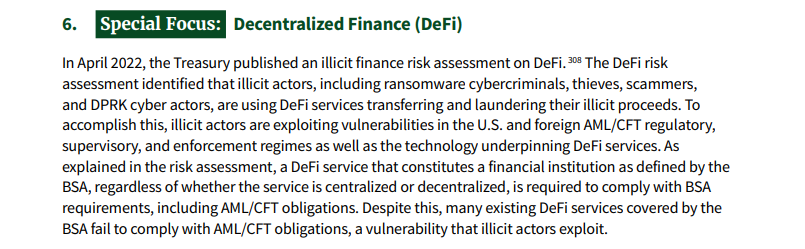
The Treasury highlights DeFi protocols as a novel way for criminals to transfer illicit funds. Source: 2024 National Money Laundering Risk Assessment
Decentralized finance (DeFi) protocols are also labeled as an emergent means for transferring and laundering illicit proceeds. Cryptocurrency mixing services are another avenue criminals use to move funds and functionally obfuscate the source, destination or amount involved in a transaction.
Author

Cointelegraph Team
Cointelegraph
We are privileged enough to work with the best and brightest in Bitcoin.