Cardano Price Forecast: ADA’s bullish outlook wobbles despite launch of first Bitcoin DeFi protocol
- Cardano’s recent uptrend stalls under $0.70, underperforming major digital assets such as Bitcoin and Ethereum.
- Cardano launched Cardinal, its first DeFi protocol, aimed at Bitcoin users.
- The Cardinal Protocol stands out for its compatibility with NFT use cases, wrapped BTC and instant value redemption.

Cardano’s (ADA) uptrend has stalled below $0.70 after staging a recovery from support at $0.62, seemingly underperforming other major cryptocurrencies, including Bitcoin (BTC) and Ethereum (ETH). The smart contracts token, valued at approximately $25 billion, is currently trading at around $0.68 at the time of writing, down over 1% on Tuesday.
The unsteady uptrend comes a day after Charles Hoskinson, the founder of the project, announced the launch of the Cardinal network, paving the way for the first Bitcoin Decentralized Finance (DeFi) protocol designed specifically for Bitcoin users.
Cardano introduces the Cardinal protocol
The newly launched Cardinal Protocol is designed to mint wrapped BTC Unspent Transaction Outputs (UTxOs) onto the Cardano blockchain by utilizing Bitcoin Ordinals as Cardano nonfungible tokens (NFTs).
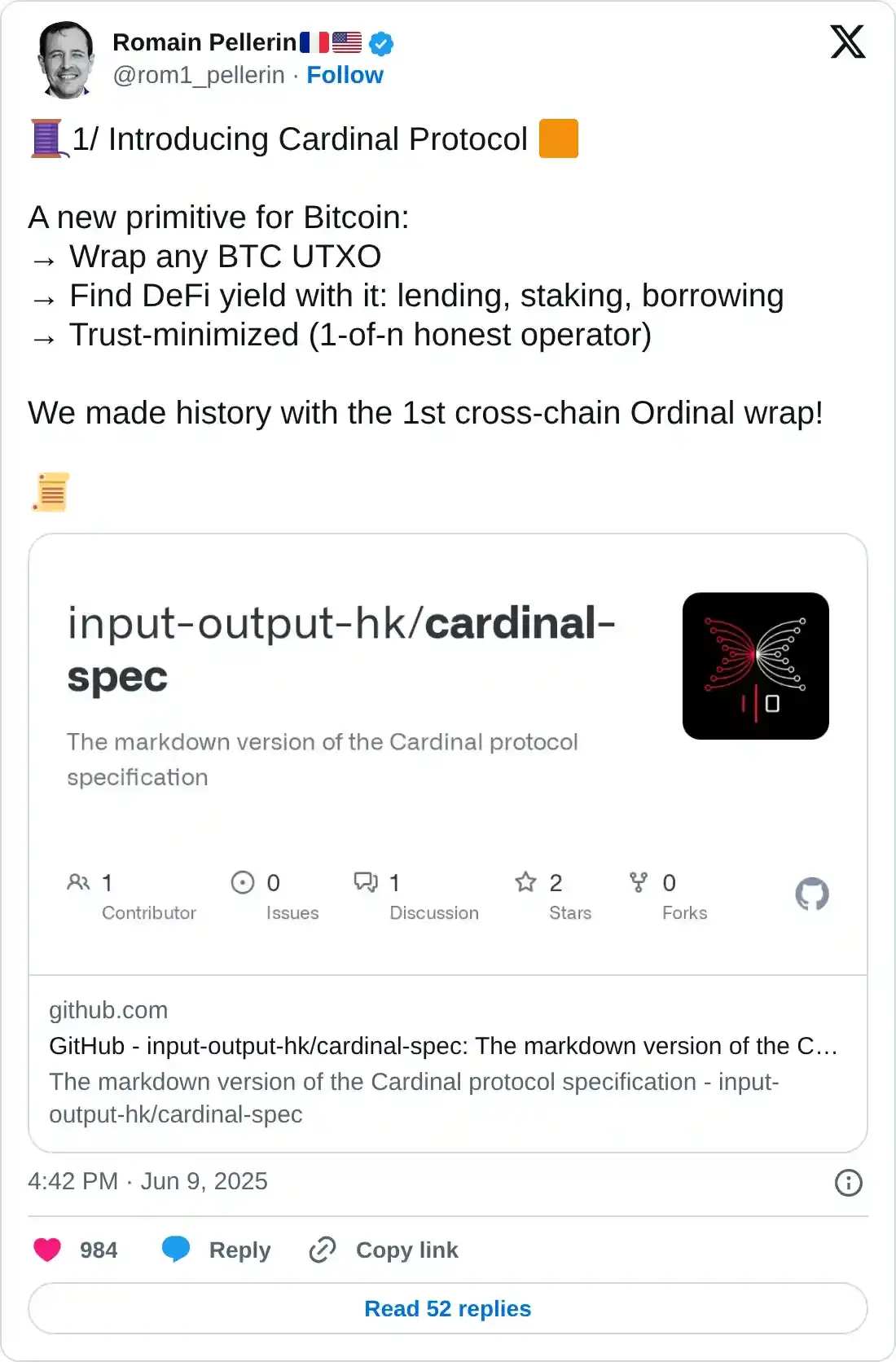
According to a GitHub post, the wrapped UTxOs ensure full transferability, mirroring assets native to the Cardano network. At the same time, it can preserve a one-to-one peg with the original Bitcoin asset. The protocol enhances the usability of wrapped UTxOs by allowing on-demand burning of the NFT tokens, thereby releasing the corresponding BTC asset back onto its native blockchain.
The Cardinal Protocol distinguishes itself from other “trust-minimized Bitcoin bridges” by operating independently of external liquidity providers. However, Cardano developers believe their integration to be feasible.
“Instead, a novel transfer-of-ownership mechanism is implemented, directly allocating Bitcoin assets to their verifiable owners,” Cardano explained on GitHub.
To ensure security and efficiency, the protocol has integrated multi-signatures and batch verification in both blockchain environments. Bitcoin’s MUSIG2 has been employed to enable key aggregation and multisignatures. With this, users can “collaboratively produce a single aggregated public key and corresponding aggregated signature,” the GitHub post added.
The second blockchain environment utilizes Cardano’s Mithril protocol for aggregating stake certificates. Meanwhile, Bitcoin Ordinals provide a convention for the unique identification, tracking and transferring of NFT assets on the Bitcoin blockchain.
The Cardinal Protocol is designed for Bitcoin users who desire to expand their DeFi interactions to other networks without compromising decentralization and the security of their assets.
Such users include BTC holders and Ordinals who prefer to leverage smart contracts for their efficiency, low transaction costs and decentralized applications (dApps).
Cardano’s price recovered along with other major digital assets on Thursday as sentiment improved in the broader cryptocurrency market. However, the uptrend stalling under $0.70 reflects trader exhaustion and potential profit-taking.
Technical outlook: Cardano’s uptrend falters
Cardano’s uptrend has encountered a major bottleneck at around $0.70, slightly below a confluence of resistance established by the 50-day Exponential Moving Average (EMA), the 100-day EMA, and the 200-day EMA at around $0.71.
The Relative Strength Index (RSI) sideways movement at the 50 midline backs the lack of conviction among traders. Traders may want to monitor the RSI’s uptrend continuation toward the overbought region to ascertain the bullish outlook from now on.
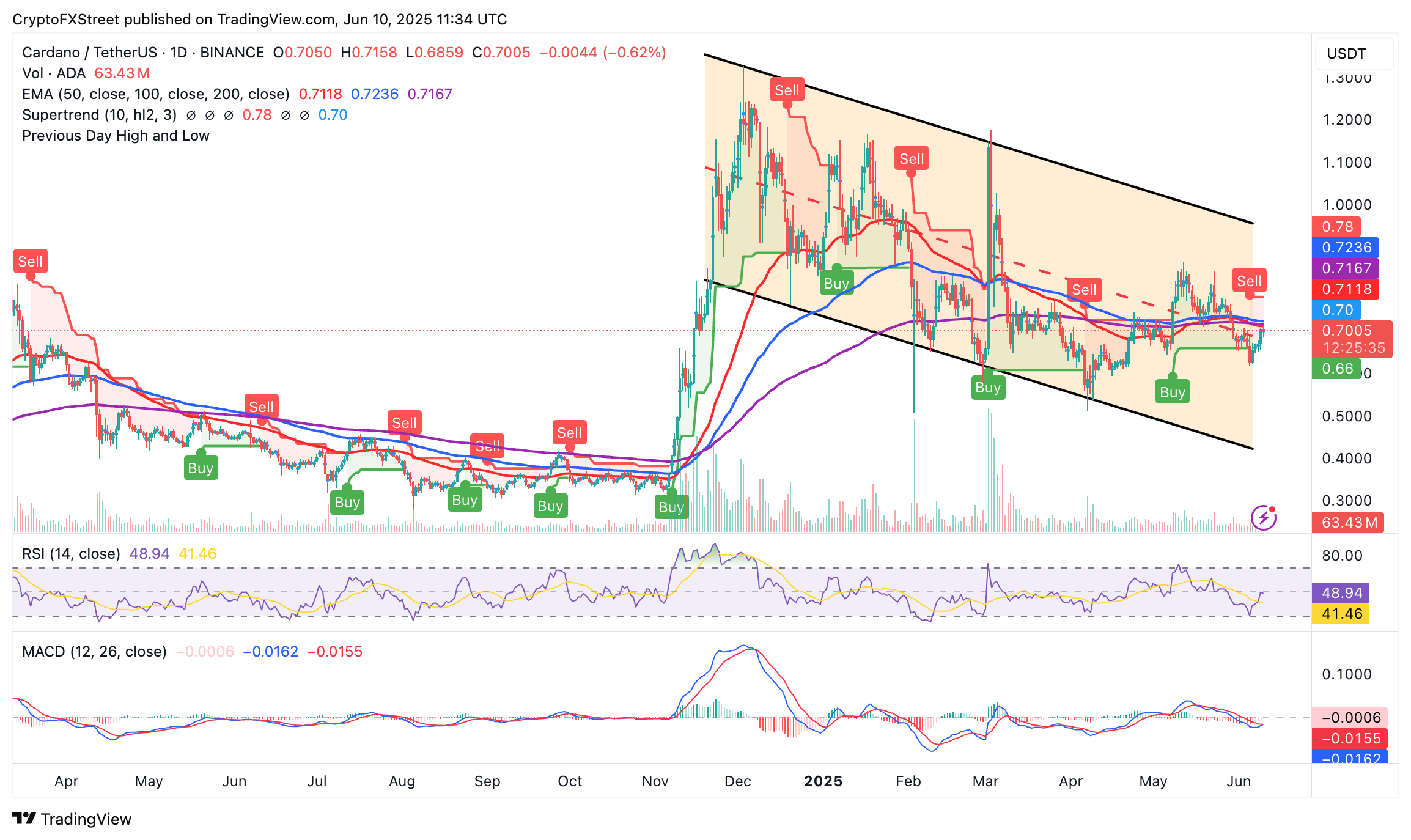
ADA/USDT daily chart
The Moving Average Convergence Divergence (MACD) indicator could confirm a buy signal in upcoming sessions, reinforcing the bullish outlook and increasing the probability of a breakout toward the supply-rich area at $1.00.
A buy signal occurs when the blue MACD line crosses above the red signal line, encouraging traders to seek exposure to ADA and anticipate an extended uptrend. Meanwhile, failure to break above the immediate confluence resistance at $0.71 could contribute to destabilizing the market, potentially leading to a pullback toward support levels at $0.62 and $0.50.
Cryptocurrency prices FAQs
Token launches influence demand and adoption among market participants. Listings on crypto exchanges deepen the liquidity for an asset and add new participants to an asset’s network. This is typically bullish for a digital asset.
A hack is an event in which an attacker captures a large volume of the asset from a DeFi bridge or hot wallet of an exchange or any other crypto platform via exploits, bugs or other methods. The exploiter then transfers these tokens out of the exchange platforms to ultimately sell or swap the assets for other cryptocurrencies or stablecoins. Such events often involve an en masse panic triggering a sell-off in the affected assets.
Macroeconomic events like the US Federal Reserve’s decision on interest rates influence crypto assets mainly through the direct impact they have on the US Dollar. An increase in interest rate typically negatively influences Bitcoin and altcoin prices, and vice versa. If the US Dollar index declines, risk assets and associated leverage for trading gets cheaper, in turn driving crypto prices higher.
Halvings are typically considered bullish events as they slash the block reward in half for miners, constricting the supply of the asset. At consistent demand if the supply reduces, the asset’s price climbs.
Author

John Isige
FXStreet
John Isige is a seasoned cryptocurrency journalist and markets analyst committed to delivering high-quality, actionable insights tailored to traders, investors, and crypto enthusiasts. He enjoys deep dives into emerging Web3 tren



