Bitcoin falls to $69,000 as bears seek to regain price control
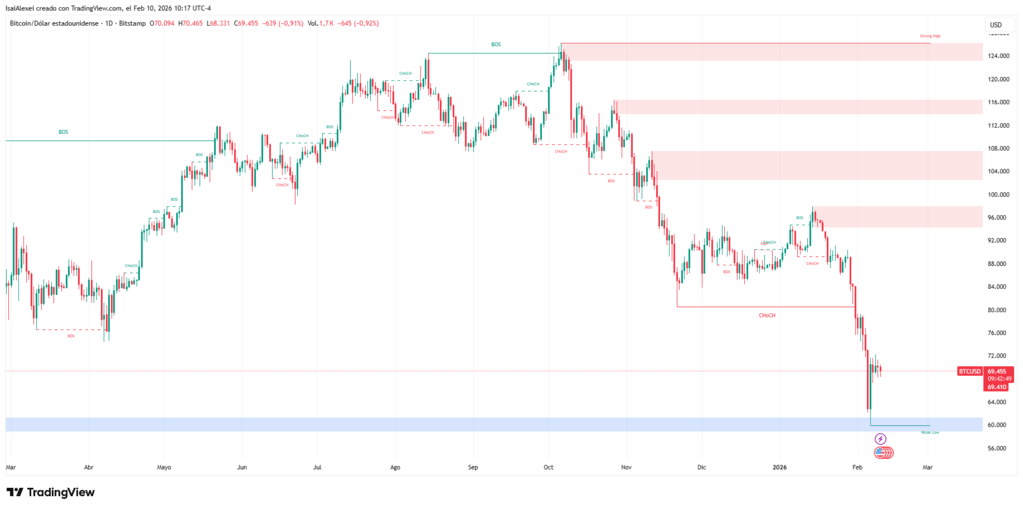
- Bitcoin retraces to $69,015, nearing a key support level at $68,500 after triggering liquidations in both directions.
- Price swings have caused cross-liquidations exceeding $250 million over the past 24 hours.
- On-chain analysis shows fresh capital demand is failing to absorb selling pressure from existing holders and miners.


Bitcoin (BTC) retreated to $69,015 dollars at the start of Tuesday's Wall Street session, recording daily losses of 2.3% according to TradingView data. The price points toward a key support level at $68,500, a zone that technical analysts identify as the floor of the local trading range.
Liquidations shook the market in both directions during the last 24 hours. Bitcoin climbed to $71,000 on Monday, liquidating $130 million in short positions. Then the price dropped back to $68,000, wiping out another $150 million in long positions. The cross-liquidation cycle surpassed $250 million total across cryptocurrencies according to CoinGlass records.
-1770733321872-1770733321872.jpg&w=1536&q=95)
The pseudonymous cofounder of trading community Wealth Capital, CryptoReviewing, described the situation precisely on his X account:
Above, at $72,000 - $74,000, we still have large liquidity waiting to be taken. However, at $66,000 - $68,000 we have even larger leveraged liquidity building up, making this zone the higher-probability area for a sweep next.
The analyst accompanied his post with a chart showing liquidation potential on both sides of the current price. His conclusion was direct: "Bears are attempting to regain control."

Trading resource Material Indicators previously warned about an imminent short-term support retest. Its proprietary tool FireCharts showed that purple whales continued selling over the last 24 hours.
Things are setting up for BTC to grind its way into a retest of local support" the platform told its followers.
Fresh demand fails to absorb distributed selling pressure
On-chain analytics platform CryptoQuant identified a structural problem that complicates recovery. Contributor analyst CryptoZeno published in the platform's "Quicktake" blog that fresh capital does not enter the market at the same rate that existing capital exits.
"Despite the increase in coins being spent, fresh capital inflows are not expanding at the same pace" wrote CryptoZeno.
Demand has slipped into negative territory, signaling that the market's ability to absorb distributed supply is weakening. Similar divergences in prior cycles often marked transition phases where bullish momentum slowed before either consolidation or correction unfolded.
The data confirms that Bitcoin faces a real demand problem, not just temporary technical pressure. Exchange inflows come primarily from existing holders selling positions, without new buyers compensating the flow with fresh capital.

The situation in the mining segment worsens the picture. Bitcoin miners increased their exchange deposits during recent sessions to cover operating expenses, as Cointelegraph previously reported. Miners send BTC to exchanges when they need liquidity to pay electricity bills, equipment costs, and payroll, adding extra selling pressure to the market.
The $68,500 level concentrates the attention of traders and analysts for its role as support within the local range. A confirmed break below activates the $66,000 zone, where accumulated leveraged liquidity could trigger a new round of cascading liquidations.
Author
Isai Alexei
Independent Analyst
I am Isai Alexei. I work as a journalist and financial analyst covering cryptocurrency markets and traditional securities. I have spent ten years analyzing digital assets, trading activity, and market structure.