Banks signal openness to "exemptions" in stablecoin yield prohibition
- A second, smaller, and more productive White House meeting shows progress in stablecoin yield negotiations.
- Banks introduced language about "any proposed exemption" to the yield prohibition, a meaningful shift from their previous hardline stance.
- The core disagreement remains over the narrow vs. broad definition of "permissible activities" for crypto firms to offer rewards.
The second White House meeting between banks and crypto firms ended without a final deal, but produced something the first gathering did not: a written set of concessions and a warmer tone on both sides. The session ran smaller and, by most accounts, considerably more productive than the first encounter.
Patrick Witt, Executive Director of the President's Crypto Council, led the proceedings. Senate Banking Committee staff also attended. On the crypto side, Paul Grewal of Coinbase, Miles Jennings of a16z, Stuart Alderoty of Ripple, Josh Rosner of Paxos, Summer Mersinger of the Blockchain Association, and Ji Kim of the Crypto Council all took seats at the table. Major banks Goldman Sachs, JPMorgan, Bank of America, Wells Fargo, Citi, PNC Bank, and US Bank sent representatives alongside trade groups BPI, ABA, and ICBA.
The core question driving the negotiations remains unchanged: can crypto firms offer stablecoin yields to their users, and if so, under what specific conditions? Banks arrived prepared with a written document outlining what they called "prohibition principles" — a detailed list of positions they consider non-negotiable when it comes to rewarding stablecoin holders.
A single phrase signals a real shift in the banks' position
Inside the document, one item drew immediate attention from sources in the room. The second paragraph contained the phrase "any proposed exemption" — language marking a genuine departure from the banks' earlier stance. Before the meeting, banks refused to entertain any exemptions related to transaction-based rewards. Including the phrase, even inside a document full of restrictions, signals they moved at least one step closer to compromise.
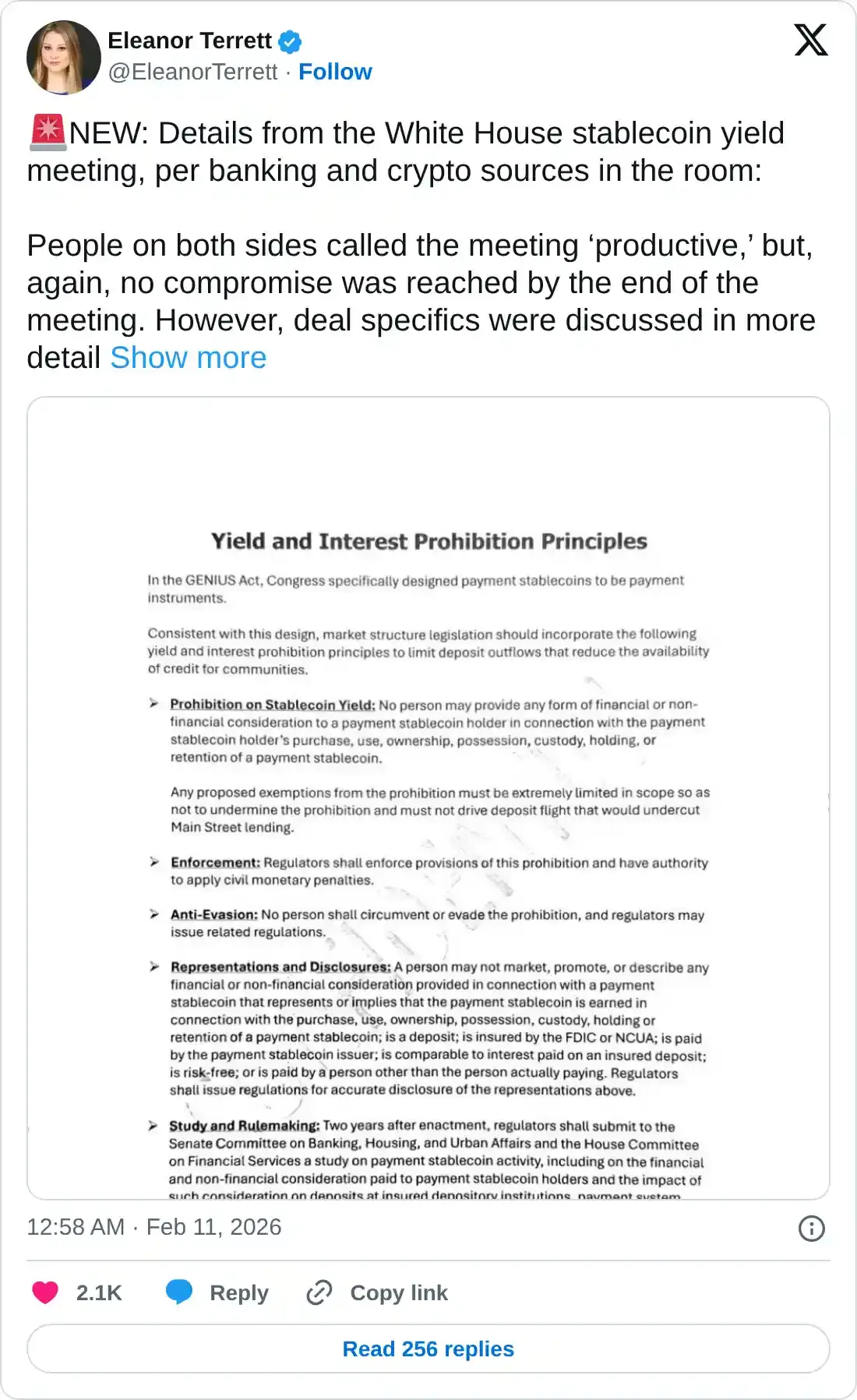
Most of the debate centered on so-called "permissible activities" — the specific types of account behavior qualifying a crypto firm to offer rewards. Crypto companies pushed for broad, flexible definitions. Banks pushed back hard, calling for narrow, tightly defined language that limits what actually qualifies. The gap between both interpretations remains the deepest point of disagreement and the hardest problem left to resolve.
Stuart Alderoty, Chief Legal Officer at Ripple, captured the mood with one direct sentence: "compromise is in the air." Coming from a room filled with representatives of seven major U.S. banks and the most influential crypto firms in the country, the comment carries real weight.
The White House set March 1st as the deadline for both parties to reach a resolution. Sources in the room confirmed that further discussions will happen in the coming days. Whether another meeting of comparable size convenes before the end of the month remains unclear.
Smaller rooms tend to produce sharper conversations, and the evidence from the session supports the read. Fewer attendees meant considerably less posturing and more direct exchanges. Both sides described the meeting as productive — and in a negotiation with a hard deadline, productive counts for a lot.
Meanwhile, the clock still runs toward March 1st. Banks and crypto firms both recognize what pressure a deadline creates, and the next few days will determine whether the concessions made so far translate into a final agreement both sides can sign.
Author

Isai Alexei
Independent Analyst
I am Isai Alexei. I work as a journalist and financial analyst covering cryptocurrency markets and traditional securities. I have spent ten years analyzing digital assets, trading activity, and market structure.