Will EUR/TRY eventually find its way?

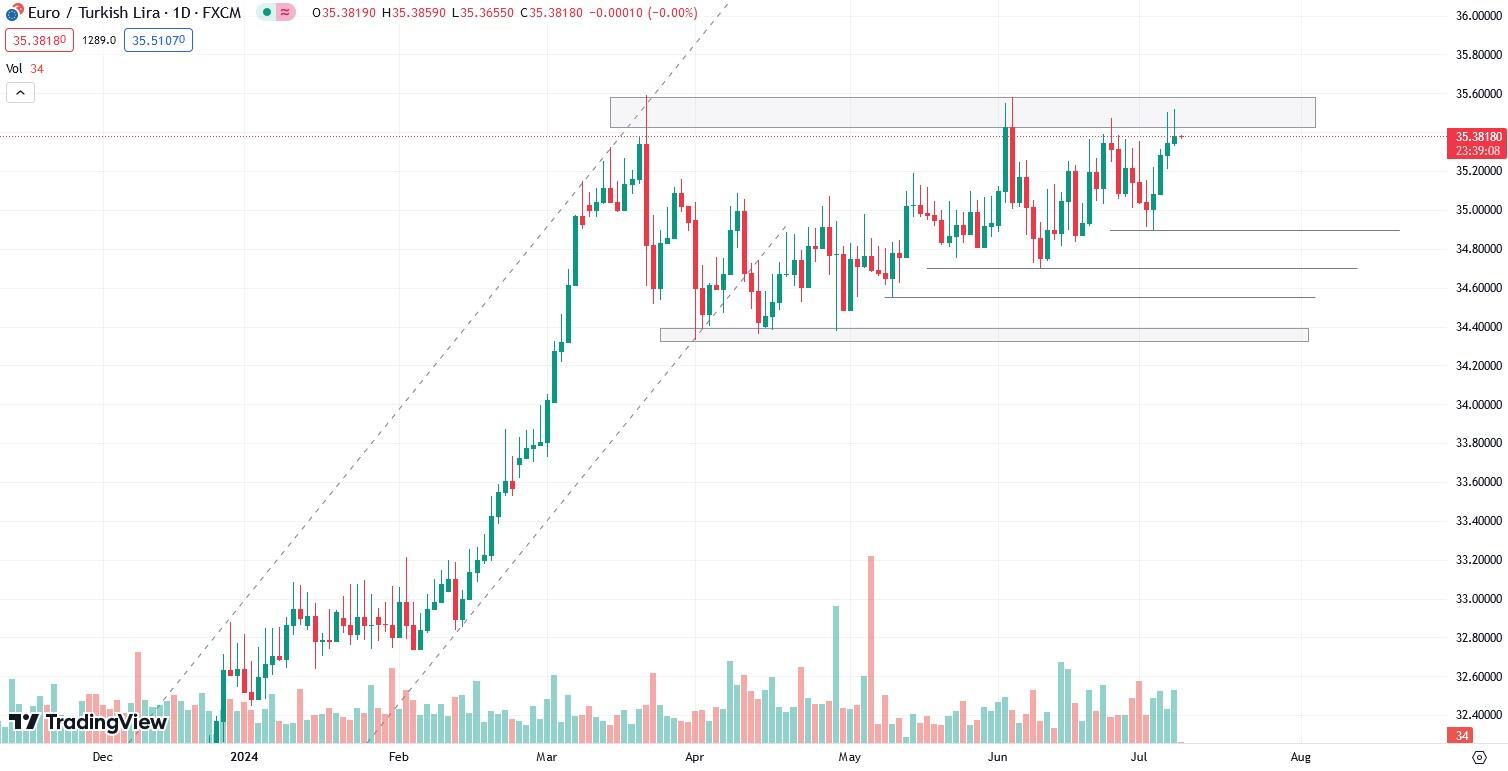
After reaching an all time high on March 21st, the Eur/Try currency pair has been moving within a tight trading range, whose boundaries extend roughly from 35,59-35,42 on the upper end (peak of march 21st and close of june 4th respectively), to 34,33-34,45 on the lower end (low of april 1st and close of april 15th), as per FXCM data. Within these boundaries, the pair has shown a sequence of higher lows and several failed attempts to break out above the resistance level, denting at the resistance without the necessary strenght to break through.
After reaching an all-time high on March 21st, the EUR/TRY currency pair has been moving within a tight trading range, whose upper boundary extends roughly from 35.59 (peak of March 21st) to 35.42 (close of June 4th), while the lower boundary ranges from 34.33 (low of April 1st) to 34.45 (close of April 15th), according to FXCM data. Within this perimeter, the pair has shown a sequence of higher lows and several unsuccessful attempts to break through the resistance level, denting at the resistance without the necessary strenght to leap over it.
Last week, on July 3rd, Turkstat (the Turkish Statistical Institute) published the June inflation reading, showing that the inflation rate has cooled for the first time in eight months: consumer prices increased 71.6% y.o.y., down from the high of 75.5% in May.
The monetary tightening cycle initiated by former MPC Governor Hafize Gaye Erkan has been continued by the present head of the MPC, Fatih Karahan, who raised the one-week repo rate to 50%, pledging to maintain an hawkish stance until the monthly inflation trend clearly reverses.
Regarding the pair possible direction, a recent study by Barclays Bank suggests the possibility of a slight weakening of the Lira during summer (in their view, maintaining a fixed exchange rate for an extended period could pose a risk of widening the current account deficit). Barclays predicts that interest rates will remain stable throughout 2024, forecasts an end-of-year inflation rate of 46.5% and anticipates a better performance from the turkish Lira in the last quarter.
At the time of writing, the pair is trading at around 35.40, again testing the upper resistance level and struggling to muster the necessary strength for a decisive upward momentum. Although a brakethrough is certainly possible, it seems quite reasonable to expect a potential easing of the exchange rate in the coming months, especially if upcoming monthly CPI readings confirm a slowdown in the inflation trend (next CPI data is expected on August 5). Additionally, the influence of the EURO/USD pair and the recent strength of the Euro should not be underestimated.
From a technical perspective, should the pair swing upward, the mouvement could initially target a new all time high around 36,12 – 36,65, according to the 0,382% and 0,5% trend-based Fibonacci extension, calculated from the December 2023 retracement on a daily basis. Conversely, in the event of a downward development, the first support lines beyond the 34,39 April low lay around 33,39, with further support in the 32,75-33,10 channel. It is worth noting that the weekly chart shows a divergence in momentum, favoring a possible turn to the downside.
At present we remain on hold and wait for the market's next moves.
Author

Giuseppe Bocci, CTA
Independent Analyst
Giuseppe Bocci is an independent trader primarily active in the U.S. stock market, international bonds, commodities, and forex. He has been trading full-time for about ten years, turning a passion into a profession.