Why the euro is not weaker is a mystery and a rather frightening one

Outlook: Markets would really prefer to be more risk averse but who can stomach the returns on cash and fixed income assets when inflation is so high? The tension in the air can be cut with a knife. Morgan Stanley notes the sell off in Treasuries has resulted in “flattening the 5s30s curve to 14b p, a new low since 2007.”
This observation does not pass the “So What?” test. Fed chief Powell advised we look at the short-end of the curve only. Bloomberg today has the 3 month at 0.49%, the 6-month at 0.94% and the 2-year at 2.16%--nicely normal.
Yield-seekers are glad about central banks in Brazil and Mexico front-running the Fed, although AMLO confused everyone by announcing the rate hike before it happened. At least in those two countries the short-term return has a sane relationship with inflation. You can’t say that about the US or the West generally.
And weirdly—very weirdly—the yield diff might even be starting to become a factor in Japan. After a hint of inflation in Tokyo, the 10-year JGB yield was up almost to 0.24% from near zero where it has languished for months under the policy of yield curve control. This is more a “hmm moment” than an “aha! moment” but worth noting. The dollar/yen is at the highest since December 2015 and that can’t last. As noted before, old-timers are accustomed to drawing imaginary lines in the sand. At a guess. 125 is a number the MoF and BoJ will not like.
It’s almost impossible to convert some observations into trading ideas, but note that next week is month-end and quarter-end, and both can have an effect on position changes by the Big Traders that convert to crowd-following.
We continue to see the market coming to accept the Fed is serious about taking ed funds to 2.25-2.50%, with the whole curve higher in lockstep. We can expect more rhetoric pushing sentiment that way. It’s hard to imagine this environment failing to be strongly dollar-supportive, especially with decent US hard data and Europe getting disappointing markers. Why the euro is not weaker is a mystery and a rather frightening one. But stay the course.
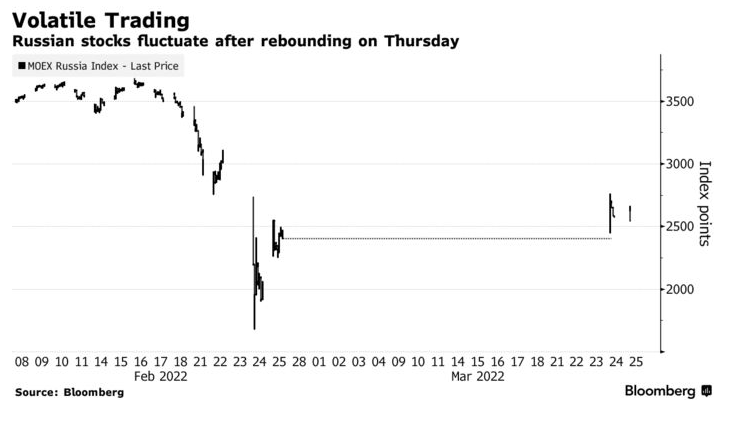
Russian Finance: Bloomberg reports the MOEX index fell 3.7% after climbing 4.4% yesterday, led by Gazprom. It’s pointless to watch equities in Russia when a big category of traders (foreigners) cannot sell and when short-selling is banned. Still, Gazprom fell on the news that Germany will seek to cut it out of its supply chain altogether by 2024, so some news is getting through to Russia. Ordinary Russians must be getting some hint when McDonalds and other Western names are closing down. Nobody thinks sanctions and the ruble/MOEX are going to change a single thing in Putin’s conduct, but let’s keep watching.
This is an excerpt from “The Rockefeller Morning Briefing,” which is far larger (about 10 pages). The Briefing has been published every day for over 25 years and represents experienced analysis and insight. The report offers deep background and is not intended to guide FX trading. Rockefeller produces other reports (in spot and futures) for trading purposes.
To get a two-week trial of the full reports plus traders advice for only $3.95. Click here!
This is an excerpt from “The Rockefeller Morning Briefing,” which is far larger (about 10 pages). The Briefing has been published every day for over 25 years and represents experienced analysis and insight. The report offers deep background and is not intended to guide FX trading. Rockefeller produces other reports (in spot and futures) for trading purposes.
To get a two-week trial of the full reports plus traders advice for only $3.95. Click here!
Author

Barbara Rockefeller
Rockefeller Treasury Services, Inc.
Experience Before founding Rockefeller Treasury, Barbara worked at Citibank and other banks as a risk manager, new product developer (Cititrend), FX trader, advisor and loan officer. Miss Rockefeller is engaged to perform FX-relat