Loonie stays out of the trade war until autos are in it
Canadian beer, wine, spirits, whey, molasses, and motorcycles over 800cc have been barred from the US beginning Tuesday, and USD/CAD barely moved on the day the ban took effect. The Loonie has stopped reacting to this round of the trade war because every US duty and ban so far has missed the goods that make up most of Canada's sales to the US. The one threat that would reach those goods is a 50% tariff on every Canadian car, truck, and auto part from January 1, and so far it exists only as a social media post.
Most goods that qualify under the Canada-United States-Mexico Agreement (CUSMA) still cross the border duty-free, outside a 50% list that covers about 5% of what Canada ships south. Those sales bring in most of the US Dollars Canadian exporters convert into Loonies, and an auto tariff that reached CUSMA-qualifying parts would be the first US measure to touch them.
The bans cover goods that were already paying 50%
The bans are added on top of the 50% duty that took effect on August 22 under Section 338 of the Tariff Act of 1930, a Depression-era law that had never been used to impose tariffs until July. That duty covers $27.6 billion of Canadian goods and applies whether or not they qualify under CUSMA. Energy, potash, fish and critical minerals are excluded, which keeps the list away from most of Canada's USD-denominated earnings. Since September 15, most goods on the list that also fall under the separate US national-security tariffs on steel, aluminum and autos pay both, up to 100% on some items.
The part of the list written in answer to Canada's own 25% tariff on US cars was drawn up in July without Canadian cars on it, because they were already under those national security tariffs. So it taxed furniture and hockey sticks instead, and effective Tuesday it has banned motorcycles over 800cc. By the Associated Press's count, the banned drinks, dairy by-products, molasses and motorcycles are worth just under a twentieth of what was already paying 50%, which makes the ban about 5% of the 5%. Trade economists have called the step from a 50% duty to a ban more symbolic than material, since the duty had already done most of the damage, and USD/CAD hasn't moved on it.
One weekend moved USD/CAD, and two weeks undid it
The first US tariff order of this dispute, signed in February 2025, sent USD/CAD to a spike near 1.4800. The weekend of August 21 moved it a little over half a percent. Talks broke down that Friday night, the 50% duty took effect on Saturday, and on Monday, August 24, President Trump posted the January 1 threat against Canadian cars, trucks, parts and steel. By September 8, the pair was back near where it had been before the talks collapsed, so a failed negotiation, a new 50% duty and a threat against Canada's car industry cost the Loonie two weeks.
There was no jump in USD/CAD when the bans were announced on September 8 either. The climb since then has come one small session at a time and has run on events outside the trade file. Momentum was already rising before the bans were announced: the daily Stochastic Relative Strength Index (Stoch RSI), a 0-100 gauge of how hard a move is running, had been climbing for two weeks by September 8. That leaves USD/CAD just under 1.4200, with the 2026 high near 1.4250 the next level up.
The cost shows up in growth and exports, not the price
The Bank of Canada (BoC) has put numbers on the damage. BoC Governor Tiff Macklem said in Halifax on September 21 that the products hit by the latest US tariffs are about 5% of Canada's goods exports to the US and that he doesn't expect a large direct effect, with federal support programs covering some of the harm. The larger cost he described runs through uncertainty: the affected sectors get hit hard, the unpredictability could delay firms' investment and hiring, and if the new tariffs stay in place, growth in the fourth quarter could be roughly halved, to below 1%. That reaches USD/CAD through investment, since a plant a foreign company decides not to build in Canada is money that never gets changed into Loonies.
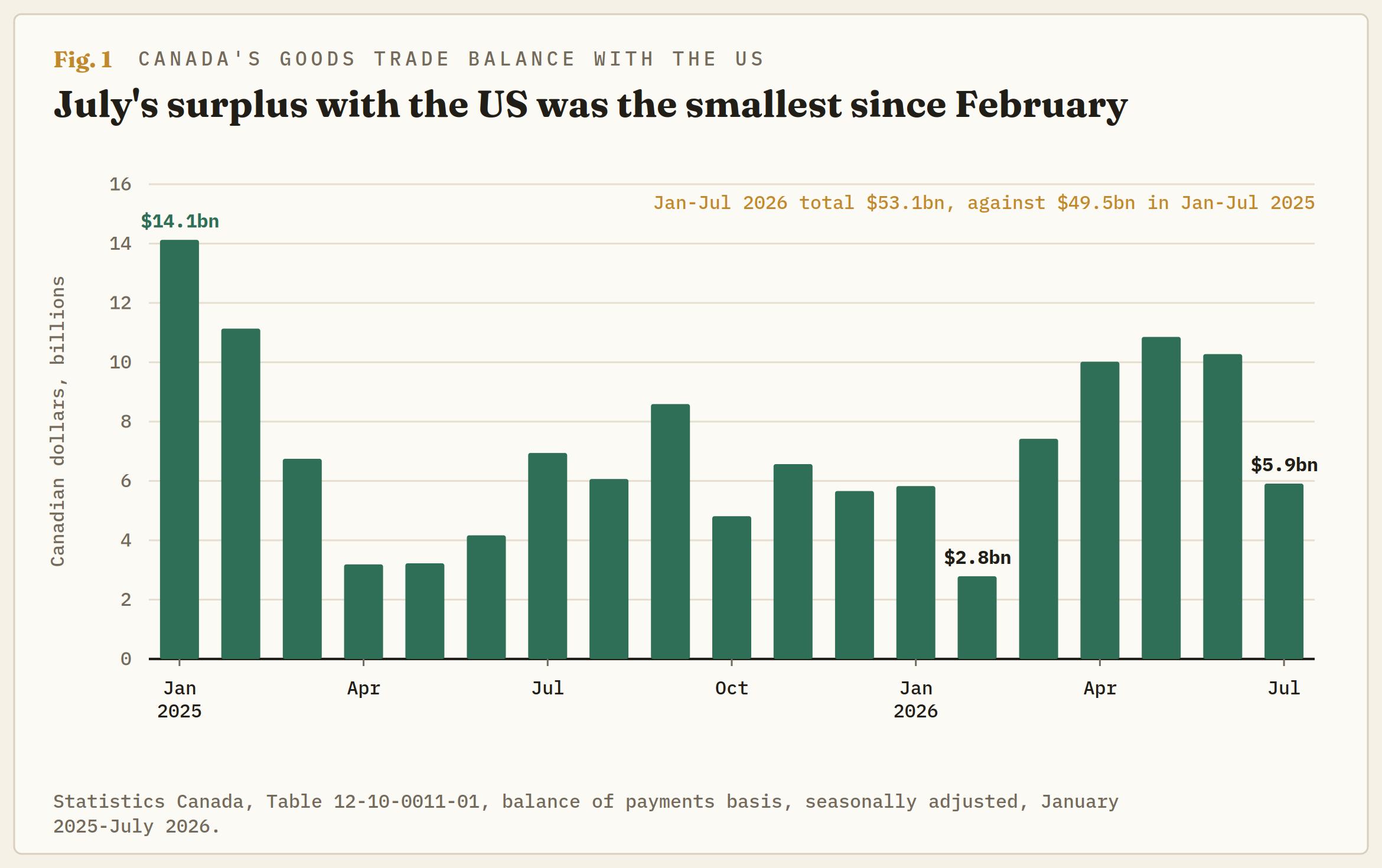
Canada sells more to the US than it buys from it, and that surplus is US dollars that exporters convert into Loonies. In July, exports to the US fell 6.6%, the biggest monthly drop since April 2025, and the surplus with the US shrank to $5.9 billion from $10.3 billion in June, the smallest since February. A smaller surplus means fewer US dollars coming home to be sold for Loonies, which is how the trade war reaches the currency without moving it on any given day.
Canada's counter-tariffs push the other way. Since September 8, Canada has charged 15%, 25% or 50% on about 700 US products worth $27.6 billion, matched dollar for dollar to the US duty. Every US product Canadians stop buying is a US Dollar they no longer need Loonies to buy. The August numbers, due October 6, will include whatever exporters rushed across the border before August 22, so the first full month under both sides' duties is September, which Statistics Canada publishes on November 4.
Autos are the risk that isn't in the price
The January 1 threat is a different kind of measure. The US charges 25% on the non-American share of a CUSMA-qualifying Canadian car's value, and parts that qualify cross duty-free. The post would raise the duty on all Canadian cars, trucks and parts to 50% and would reportedly end the duty-free treatment for qualifying parts. For the Loonie, that's the difference between taxing goods that were already paying a duty and taxing goods that weren't.
Autos are one of Canada's largest exports to the US, and parts can cross the border several times before a vehicle is built. The post covers all cars, trucks and parts, and no document has been published to say what all leaves out: no proclamation, no exemption list and no method for working out what's owed.
No talks on the calendar before January 1
The White House's September 8 fact sheet named China and Canada as the two countries that had retaliated instead of negotiating. Chinese President Xi Jinping's three-day state visit to Washington ended on September 25 with China's trade truce extended to January 10. That truce now runs nine days past the date set for Canada's auto tariffs.
Canada has no meeting like that on the calendar. US Trade Representative Jamieson Greer has said President Trump is comfortable with the pause in talks and sees no urgency to return. Canada-US Trade Minister Dominic LeBlanc has said Canada is ready to negotiate but isn't waiting for a call, so the two sides agree on at least one thing. Prime Minister Mark Carney has said Canada has no plans to escalate, which leaves the Loonie's tariff risk date with nothing scheduled before it.
The fork runs through a document nobody has published
The Loonie's tariff risk between now and January 1 comes down to one document. A proclamation that ends duty-free treatment for qualifying Canadian auto parts would be the first US measure to tax the CUSMA trade outside the 5% list, and August's weekend reaction is the smallest move to plan for. From just under 1.4200, a repeat of that reaction is enough to take USD/CAD through the 2026 high.
If talks resume and the January date lapses, there's little for the Loonie to recover in price, since the one tariff move in USD/CAD was retracted within two weeks and the bans produced none. If neither happens, the cost keeps showing up in the trade account rather than in USD/CAD, starting with the August figures on October 6. It's possible the January 1 date moves the way August 19 did, which was pushed back three days on a promise of progress and then arrived anyway.
Author

Joshua Gibson
FXStreet
Joshua joins the FXStreet team as an Economics and Finance double major from Vancouver Island University with twelve years' experience as an independent trader focusing on technical analysis.