Silver is more volatile than Gold ahead of PCE and NFP. This chart shows the positioning gap

The market’s attention is focused on American data this week, but there’s something only those with a trained eye may be looking at: Gold and Silver positioning gap. Financial markets are moving on fears, mostly related to persistently high energy prices driven by the Middle East war.
Sure, the US Dollar (USD) is strong, but at what cost? While the United States (US) economy keeps growing at a solid pace, the country’s debt is mounting to record levels. Adding persistent inflation concerns to the formula, the result is soaring government bond yields: the return on the 10-year Treasury peaked at a multi-decade high of 5.26% on Tuesday, with no signs of giving up in the foreseeable future.
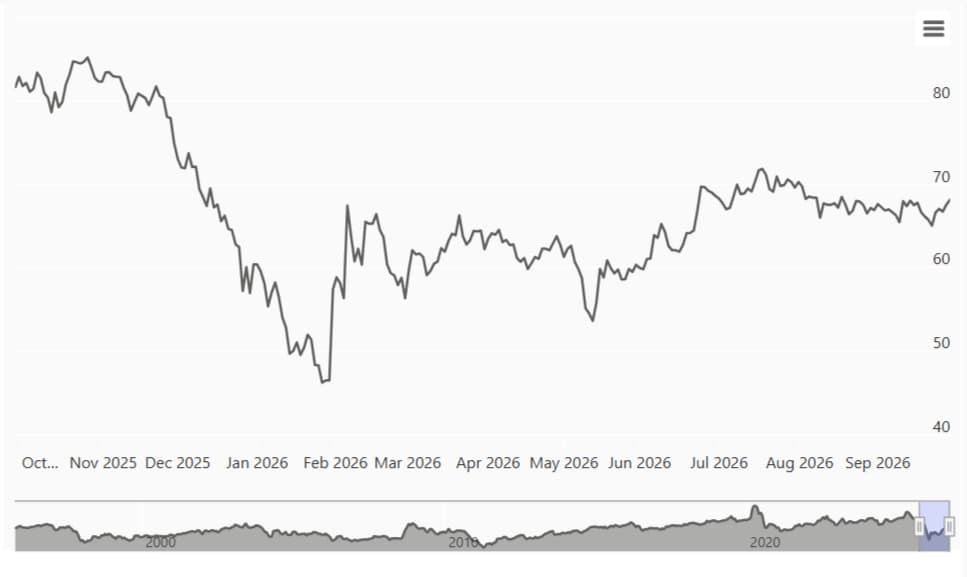
The scenario took its toll on precious metals, with spot Gold losing roughly 3.3% on Monday and Silver shedding nearly 5% on the same day. At the time of writing, the Gold/Silver ratio stands at 68.4. This ratio is simply the price of an ounce of Gold divided by the price of an ounce of Silver, a track of historical price behavior.
Source: goldsilver.com
Generally speaking, a ratio of 80 or above means Silver is relatively cheap compared to Gold. A ratio of 20 or below means exactly the opposite: that Gold is relatively inexpensive compared to Silver. An extreme ratio usually results in the weaker one rallying to catch up. At 68.4, it means that sooner rather than later, Silver could recover at a faster pace than Gold, if a recovery actually happens.
But what if not? And why is Silver weaker?
According to the Commitment of Traders (COT) report, the divergence could be partially explained by fund positioning moving away from Silver amid macroeconomic volatility. It could also be explained by decreased industrial demand: according to BMO Capital Markets, solar manufacturers are reducing the amount of Silver required in each cell through narrower metallization lines, increased Copper substitution, and wider use of Silver-coated Copper pastes.
Silver is underperforming Gold, and the picture is unlikely to change in the near term. And according to the Silver/Gold ratio chart, there’s no imminent risk of a change.
And what does US data have to do with it?
The most notorious risk is that both metals will extend their recent bleeding as demand for the USD remains high. And of course, upcoming inflation and employment figures are expected to confirm or deny such a theory. Simply put, USD strength comes from speculation that the Federal Reserve (Fed) has no other option but to keep raising interest rates. The Fed’s mandate is dual: promoting maximum employment and price stability.
And at this point, the inflation leg seems the most worrisome. The Personal Consumption Expenditures (PCE) Price Index, the Fed’s favorite inflation gauge, is foreseen at 3.4% YoY in August, nearly doubling the central bank’s 2% goal. The data will be released on Wednesday, and ahead of the announcement, market participants anticipate the Fed will hike interest rates in October, with odds above 70% at the time of writing.
A higher-than-anticipated outcome should boost such odds and fuel USD demand, to the detriment of precious metals. On the contrary, lower-than-expected readings could build doubt about how many additional hikes the Fed would have to deliver. Be aware, however, that one single reading will not change the big picture: it would take at least three consecutive lower readings for speculative interest to start pricing in odds for no hikes.
After the PCE release, investors will turn to the September Nonfarm Payrolls (NFP) report scheduled for Friday. Market players will look for ‘healthy,’ but not too strong, figures to confirm the Fed will remain on the hiking path. The Unemployment Rate is forecast to remain steady at 4.1%, while the economy is expected to have added 84K new job positions.
Such figures will confirm the Fed has no reason to worry about the labor market. A stronger-than-anticipated outcome, with easing Unemployment and solid job creation, will support the case for a continued USD rally, while the opposite scenario will hardly have a negative impact on the Greenback, as a swallow does not make a summer. As with inflation data, a single discouraging report could hardly change the market’s view.
Bottom line, Silver and Gold are likely to remain pressured, with Silver having better recovery odds should market players turn their back on the USD.
Author

Valeria Bednarik
FXStreet
Valeria Bednarik was born and lives in Buenos Aires, Argentina. Her passion for math and numbers pushed her into studying economics in her younger years.