|

What’s next for the Canadian Dollar

The Canadian dollar has two drivers: Central bank policy and the price of oil.

Central bank policy

The Bank of Canada is meeting next week to decide its current interest rate. The Bank of Canada surprised markets in December with a more bullish outlook than the marled was expecting. The BoC highlighted surprising strength in business investment and the economy was operating, ‘near capacity’. The key area of concern for the BoC in December was global trade tensions. With the optimism concerning the US-China phase 1 trade deal still in the market, it seems that the Bank’s concern has receded for now, at least from between the US and China. If this situation remains I am expecting the BoC to lean towards a more bullish outlook when it meets on Wednesday next week at 1500GMT

Oil prices

The price of oil impacts CAD. With Canada, a key exporter in oil an increase in oil prices helps boost the CAD. The negative correlation between oil and the USDCAD pair is around 96%. So this means that a fall in USDCAD usually results in a rise in oil and vice versa. Take a look at the chart below to see the relationship.
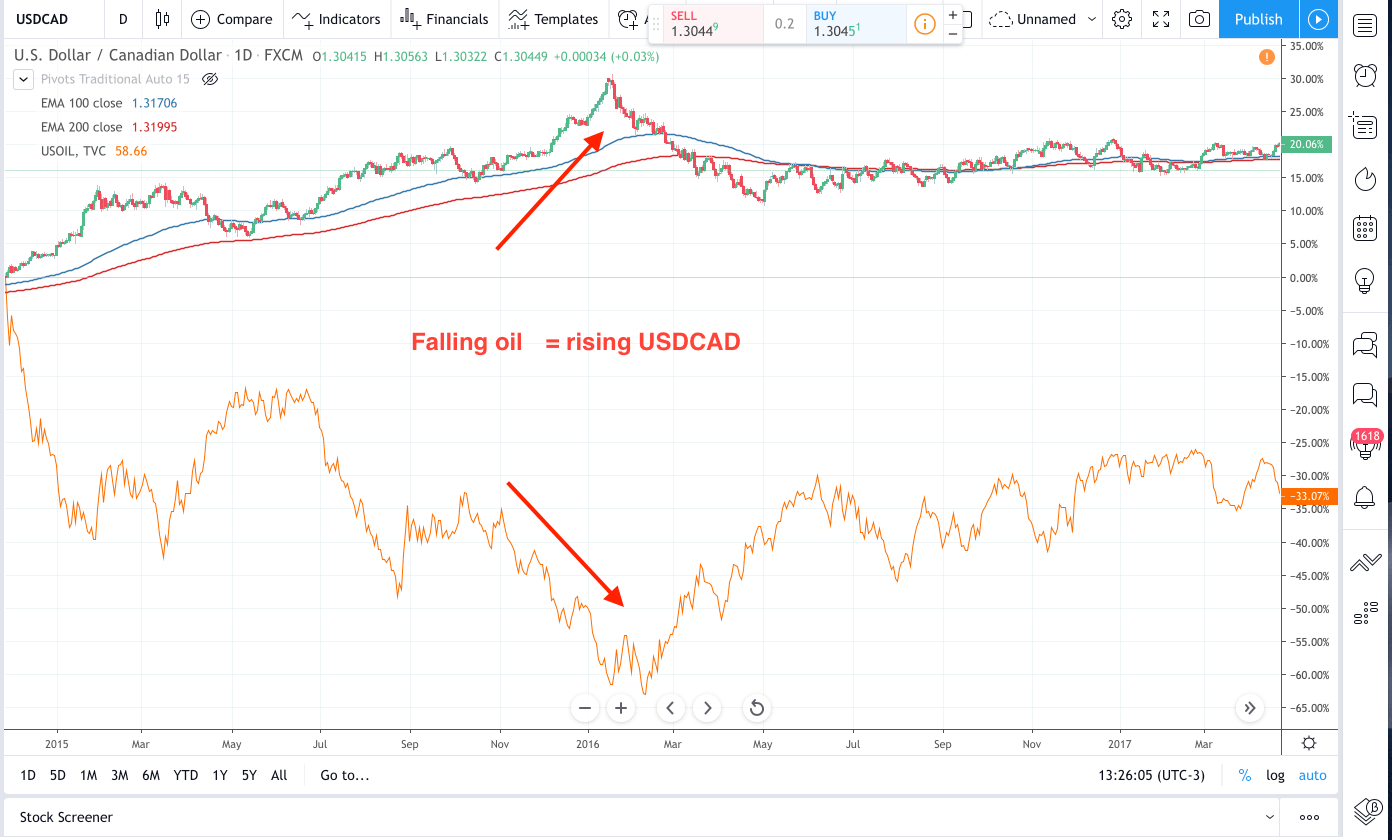
USDCAD

Going forward the path of CAD will continue to be determined by these twin influences from the central bank and the price of oil. Whenever you are trading CAD you always want to know what is happening with these two key drivers. Ideally, to place a CAD trade, you want both drivers to compliment each other. So, a bullish central bank meeting next week and a rise in oil prices would be supportive of oil prices going forward. Similarly, a bearish central bank meeting and a fall in oil prices would result in CAD weakness.


Learn more about HYCM


Author

Giles Coghlan LLB, Lth, MA

Giles is the chief market analyst for Financial Source. His goal is to help you find simple, high-conviction fundamental trade opportunities. He has regular media presentations being featured in National and International Press.


More from Giles Coghlan LLB, Lth, MA
Share:

Editor's Picks

EUR/USD weakens to near 1.1900 as traders eye US data

EUR/USD eases to near 1.1900 in Tuesday's European trading hours, snapping the two-day winning streak. Markets turn cautious, lifting the haven demand for the US Dollar ahead of the release of key US economic data, including Retail Sales and ADP Employment Change 4-week average.

GBP/USD stays in the red below 1.3700 on renewed USD demand

GBP/USD trades on a weaker note below 1.3700 in the European session on Tuesday. The pair faces challenges due to renewed US Dollar demand, UK political risks and rising expectations of a March Bank of England rate cut. The immediate focus is now on the US Retail Sales data. 

Gold sticks to modest losses above $5,000 ahead of US data

Gold sticks to modest intraday losses through the first half of the European session, though it holds comfortably above the $5,000 psychological mark and the daily swing low. The outcome of Japan's snap election on Sunday removes political uncertainty, which along with signs of easing tensions in the Middle East, remains supportive of the upbeat market mood. This turns out to be a key factor exerting downward pressure on the safe-haven precious metal.

Bitcoin Cash trades lower, risks dead-cat bounce amid bearish signals

Bitcoin Cash trades in the red below $522 at the time of writing on Tuesday, after multiple rejections at key resistance. BCH’s derivatives and on-chain indicators point to growing bearish sentiment and raise the risk of a dead-cat bounce toward lower support levels.

Dollar drops and stocks rally: The week of reckoning for US economic data

Following a sizeable move lower in US technology Stocks last week, we have witnessed a meaningful recovery unfold. The USD Index is in a concerning position; the monthly price continues to hold the south channel support.

Bitcoin Cash trades lower, risks dead-cat bounce amid bearish signals

Bitcoin Cash (BCH) trades in the red below $522 at the time of writing on Tuesday, after multiple rejections at key resistance. BCH’s derivatives and on-chain indicators point to growing bearish sentiment and raise the risk of a dead-cat bounce toward lower support levels.