Weekly column: Cool inflation data propels S&P to record highs while others lag
Review
Two straight days of soft inflation data lifted the S&P 500 index to an all-time high.
—Jack Pitcher, “Cool Inflation Data Propels Stocks to Fresh Records,” The Wall Street Journal, August 13, 2026.
It’s been a relatively muted week across much of the equity markets as hopes that Iran and the U.S. would reach an arrangement to reopen the Strait of Hormuz faded, leading to a 6% increase in Crude Oil prices. Yet the S&P 500 rallied to a new all time high (ATH) as benign inflation data reduced the perceived urgency of another Federal Reserve rate increase. This set us up for a case of intermarket bearish divergence, as the Nasdaq and DJIA both failed to make new highs. However, we are early in the primary cycle, and there is still plenty of time for them to catch up.
It was a pretty benign picture across international markets from Europe to Asia and South America, with the Japanese Nikkei as the outlier with a 5% gain for the week. The key factor to note is that equities are starting to decouple from geopolitical inflation risk as the VIX index is headed for a fourth weekly decline. We had little movement in the precious metals or cryptocurrencies.
The stars of the week were grains, with Wheat gaining 8%, Corn up 5%, and Soybeans just under 3%. The rise in Wheat prices was driven by disruptions to Black Sea exports; more on this below.
Short-term geocosmics
We are now in the most intensive period of the eclipse season, with important events due to occur between the Solar Eclipse of August 12 and the Lunar Eclipse of August 28. During eclipse seasons, I am on the lookout for natural disasters, especially in the region of the Sub-Solar Point (near the Caribbean and into the northern regions of South America) or across the path of the eclipse (from the North Pole, through Greenland, Iceland, and northern Spain). These are the events that dominated the week:
- The Colombian earthquake: A magnitude-7.4 earthquake struck western Colombia on Monday, August 10, causing extensive destruction in Cali, Pereira, and areas of Chocó and surrounding areas. This was right within the Sub-Solar zone I had highlighted within the July edition of the MMA Monthly Addendum Report Plus+.
- Extreme heat and wildfires across Europe: Europe’s prolonged heatwave developed into a continent-wide wildfire emergency. The fires were geographically dispersed but together formed one of the week’s largest continuing stories. Spain, which was on the path of the Solar Eclipse, has been the worst-affected EU country.
- Typhoon Dolphin and widespread Chinese flooding: The typhoon moved from Japan’s southern islands into eastern China, becoming the strongest cyclone to strike China so far this year. More than one million people were evacuated, and winds approached 150 km/h.
- Record rainfall and flooding around Tokyo: Unprecedented rainfall struck the Chiba Prefecture, east of Tokyo. More than 360 mm fell within 24 hours, flooding roads, homes and railway lines.
- British Columbia wildfires: The Bald Range wildfire became Canada’s most prominent disaster story, with approximately 18,000 people ordered to evacuate and the fire burning more than 10,300 hectares.
As noted in my column from two weeks ago, “This list should grow in number and intensity, with the most important events occurring within a 3-day orb of the solar eclipse (August 12) and the lunar eclipse (August 28). Make a note of the themes that are triggered by the eclipse, as we should see them reappear in early November as Mars transits and triggers the eclipse degree.”
Over the coming week, the Sun will transit the final degrees of Leo, before entering Virgo on August 22. The Mean Lunar North Node will commence its 18-month transit of Aquarius from August 18. We also have the Venus–Saturn opposition on August 21. The MMA rule of thumb is to buy any assets dropping into a hard aspect between Venus and Saturn. Keep up to date with the MMA weekly and daily reports to track the upcoming opportunities.
Longer-term thoughts and opinion
Continuing with the eclipse theme, I wanted to go beyond identifying regions where natural disasters might occur and consider which countries are most directly affected by the eclipse. India and Pakistan gained independence on August 14 and 15, 1947, when the Sun was at 20° to 21° Leo. Bahrain also gained independence on August 14, 1971, with the Sun at the same degree. These countries may therefore experience significant new developments and warrant close watching.
The eclipse will affect each of us to some degree. To understand how, we must locate it in our natal chart and identify the house in which it falls. This can indicate change and new beginnings in the areas of life governed by that house. Its influence is likely to be considerably stronger when it forms a close conjunction or opposition with a natal planet or one of the chart’s principal angles.
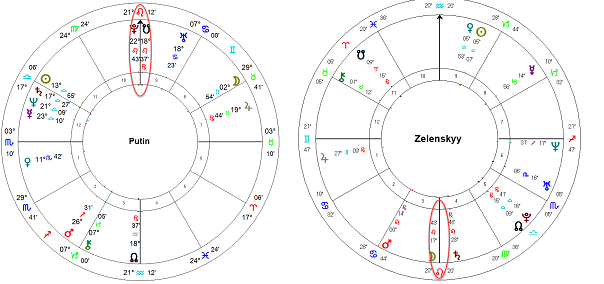
Looking at the charts of global leaders, it was interesting to see that the eclipse falls on the MC of Vladimir Putin (using the Scorpio rising chart versus the Capricorn rising preferred by some), between his natal Pluto and the South Node. It also falls on the IC of Zelenskyy, and in orb of his natal Moon. In Putin’s case, regardless of which chart one uses, the eclipse conjoins his natal Pluto.
As these two men continue to lock horns in the geopolitical arena, their confrontation appears to be mirrored in the geocosmic picture, with the eclipse triggering the following angular cusps:
Putin: The eclipse triggers themes concerning power, command, reputation, leadership, and legacy. A solar eclipse here with the influence of Pluto, as lord of the 1st house, signals that the existing public role cannot continue unchanged. It can coincide with a change in status, a crisis of leadership, a redefinition of authority, or the beginning of a new political chapter. However, Pluto does not always mean loss of power. It can produce further concentration of power through crisis. Whatever happens is unlikely to be superficial.
The presence of the South Node makes the contact more suggestive of depletion, culmination and consequences arising from the past. It indicates that an established method of maintaining control has reached the end of its usefulness. Putin may be forced to relinquish something connected with status, position, territory, personnel or prestige.
Zelenskyy: The eclipse triggers themes concerning homeland, territory, population, security and emotional foundations. The eclipse places the emphasis upon Ukraine itself as the homeland and place of belonging, rather than primarily on Zelenskyy’s international status.
The presence of the natal Moon reinforces this. In a national or leadership chart, the Moon can signify the people, public mood, families, women and children, displacement, food and shelter, as well as the leader’s emotional relationship with the population. The Moon is also lord of the 2nd and 3rd houses, suggesting a change or transition with neighboring nations, trade, and finances.
Because the eclipse is in Leo, the conflict also concerns sovereignty, honor, and each leader’s personal identification with his nation. Both may be confronted with the question of what can be surrendered without appearing to surrender the right to rule.
If a settlement emerges under this eclipse, it is unlikely to be a simple diplomatic compromise. It would probably involve painful questions of territory, sovereignty, prestige and historical judgment. If the war escalates instead, the same symbolism suggests that events on Ukrainian soil could rebound directly upon the stability of Putin’s command. The outcome remains open, but I expect the meaning of this eclipse to become clearer by early November, when Mars activates the eclipse degree.
Two developments around the eclipse reflected these themes. Russia moved to include occupied Ukrainian territories in its parliamentary elections, linking Putin’s authority with the Plutonian control of land taken by force. Ukraine declared the proposed voting illegal on August 13.
That same day, Ukraine proposed a halt to attacks on civilian shipping in the Black Sea after strikes on Odesa and other ports that have contributed to a 76% fall in grain exports. This echoed the symbolism of Zelenskyy’s Moon through its association with the sea and food, as well as its rulership of trade, finances and national income.
Author

Raymond Merriman, CTA
The Merriman Market Analyst
Raymond A. Merriman is the President of the Merriman Market Analyst, Inc and founder of the Merriman Market Timing Academy.

















