Week ahead – RBA, RBNZ decisions and Fed Minutes eyed as trade deals awaited [Video]
- July 9 tariff deadline looms as trade deals remain elusive.
- Fed minutes to be watched after positive jobs report.
- RBA expected to cut but RBNZ to likely stay on hold.
- OPEC+ to probably raise output again.
- UK GDP, Canadian employment and Chinese CPI data also on tap.
![Week ahead – RBA, RBNZ decisions and Fed Minutes eyed as trade deals awaited [Video]](https://editorial.fxsstatic.com/images/i/RBA_1_XtraLarge.png)

The race to the finish line
It’s been three months since President Trump delayed the start of the punitive reciprocal tariffs, allowing negotiators time to strike more favourable trade deals with America’s main trading partners. However, as the July 9 deadline approaches, the US has only signed two trade deals – with the United Kingdom and Vietnam – while it has agreed a formal trade truce with China that has, at least temporarily, massively lowered the triple digit tariff rates.
However, despite repeated reports that trade talks with India, Japan and South Korea are progressing well, no deal has been reached with any of those countries, and in a surprise turnaround, negotiations with the European Union appear to be going somewhat better. A deal with Canada is also possible in the coming days.
But even if there are several announcements incoming on or before July 9, it’s looking increasingly likely that the White House’s aim of completing deals with all 18 of America’s biggest trading partners won’t be possible by that deadline. This then raises the question of whether Trump will extend the deadline with those countries that no agreement has been reached yet, or will he re-impose the reciprocal tariffs.
The most likely outcome is that Trump will make some threats to slap levies that are much higher than the ones announced on ‘Liberation Day’ to squeeze enough concessions from those countries that the US is still negotiating with before granting a further extension.
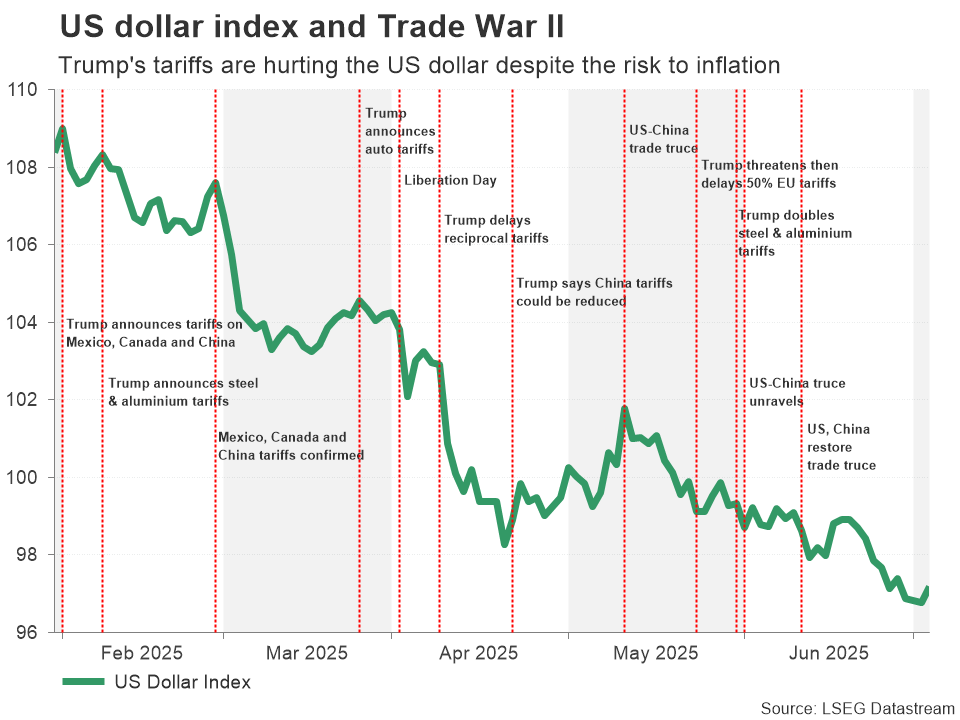
As for the market reaction, that will probably depend on how many deals are signed over the coming week. If there are agreements with just a handful of countries and they don’t include any of the major ones such as Japan, India and the EU, then only a cautious sense of optimism is to be expected, which would modestly boost risk assets but may not necessarily do much in lifting the US dollar.
Fed minutes to dominate in quiet data week
Investors will also be preoccupied with how soon the Fed will cut rates again. Hopes of a July cut were dashed following the stronger-than-expected nonfarm payrolls report for June. But if the data continues to surprise to the upside, the odds of a September move may also start to dwindle.
But any update on the economy will have to wait for mid-July as there aren’t any major releases on the agenda next week and traders will be getting their cues from Wednesday’s minutes of the Fed’s June policy meeting and the limited Fedspeak that’s on the schedule.
After the dollar staged a much-needed recovery in the past few days, a hawkish tone from the FOMC minutes could help it extend its rebound.
RBA set to cut for third time
The Reserve Bank of Australia has lagged other central banks in lowering rates, mainly due to inflation in Australia being more persistent. But it now appears to be well and truly on an easing path, and it is widely expected to trim its cash rate by a further 25 basis points on Tuesday when it meets.
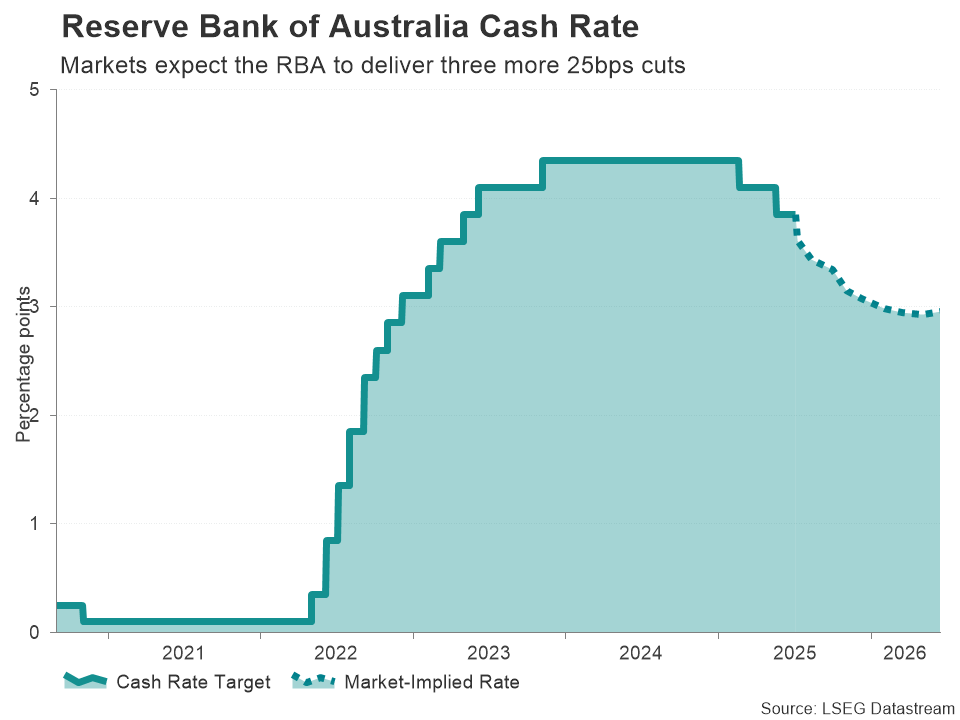
Investors have priced in two more cuts of similar size after the July meeting so the focus will be on whether or not Governor Michele Bullock will signal a rate path that is steeper or shallower than that implied by the markets. In the absence of explicit clues, investors will be watching how worried Bullock will sound about the impact of the trade war on the economy.
But with the Australian dollar having just recorded its fourth straight month of gains versus the US dollar, a dovish set of remarks risks sparking a near-term correction in the pair.
RBNZ expected to go on pause
Across the Tasman Sea, the Reserve Bank of New Zealand will also be setting policy 24 hours after its Aussie counterpart. Unlike the RBA, the RBNZ has been quite aggressive in slashing rates, lowering the cash rate six times by a cumulative 225 basis points since last August.
Recent data have been mixed: the unemployment rate is stuck at the cycle peak of 5.1%, but GDP posted a solid rebound in the first quarter, while inflation edged up to 2.5%.
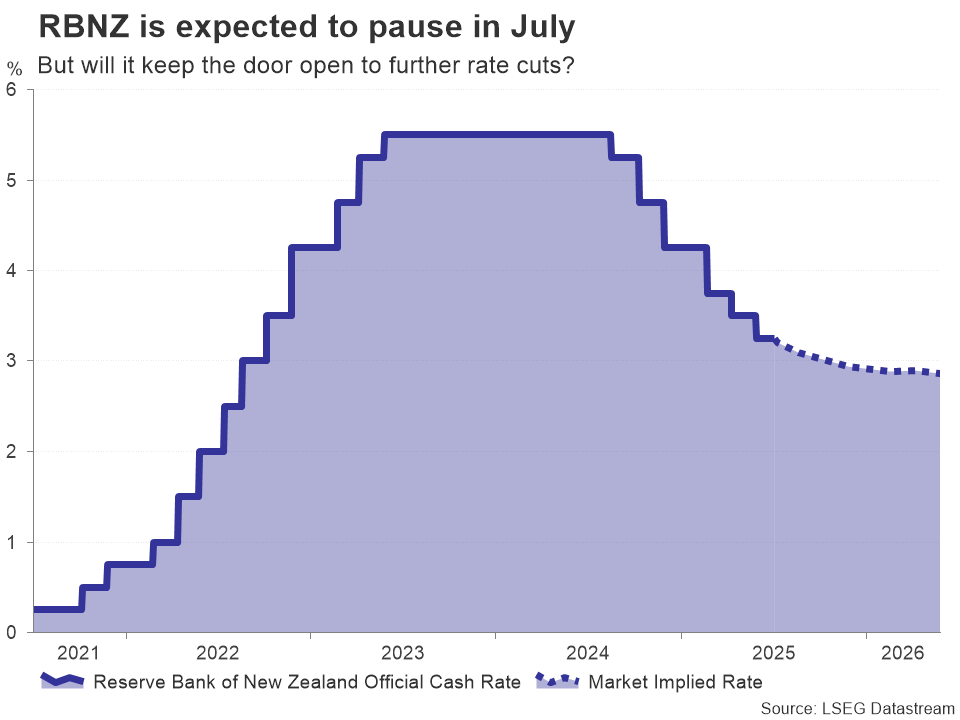
Investors think there’s about an 80% probability that the RBNZ will keep the cash rate on hold at 3.25% on Wednesday but foresee one final 25-bps cut by year-end. If the Bank signals that it’s done with rate cuts, the New Zealand dollar could appreciate against the greenback. But should it keep the door wide open, the kiwi could slip slightly.
OPEC+ could opt for a larger output hike
Amid the ongoing trade uncertainty and recent geopolitical flare-up, one relief for central banks has been the speed at which oil prices tumbled back down after Israel and Iran agreed a ceasefire, lowering the risks to inflation. Moreover, there’s strong indications that OPEC and its non-OPEC allies are not deterred by this pullback and will push for another monthly output hike when they meet on July 5.
The OPEC+ alliance has shifted its stance from supporting high oil prices to defending its market share during 2025. The problem isn’t just other producers such as the US gaining a bigger market share but also member countries like Kazakhstan overproducing and refusing to abide by their supply quotas.
If there is a surprise from the OPEC+ meeting over the weekend, it’s more likely to be an output increase that’s greater than the 411,000 barrels per day that was agreed for May, June and July.
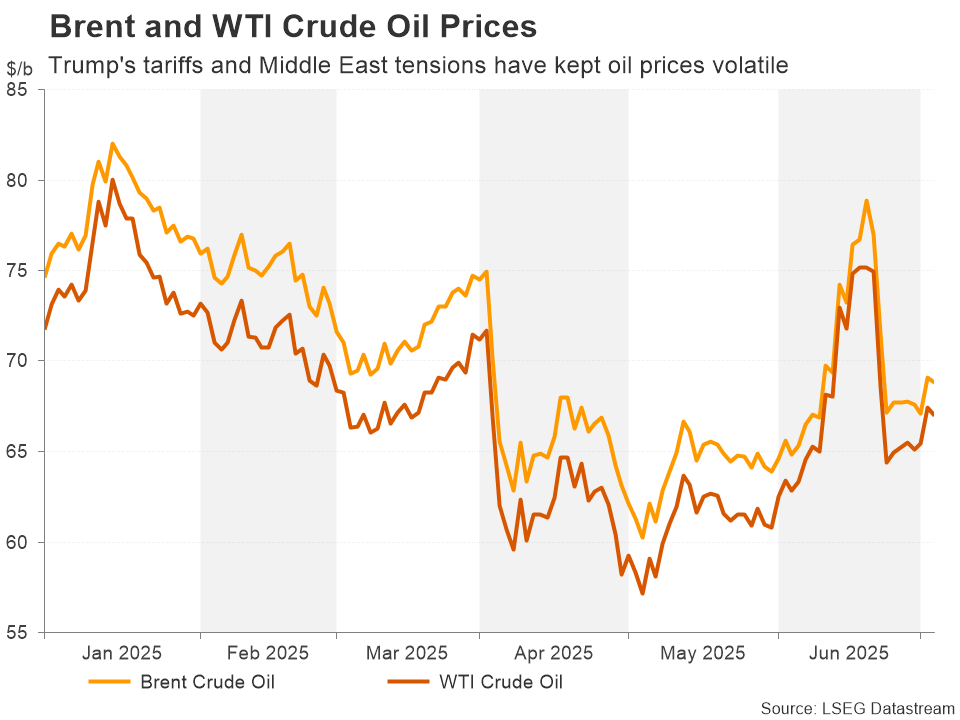
Should that turn out to be the case, there’s a good chance oil futures will start the week in the red.
Canadian jobs depressed by trade war with US
Elsewhere, investors will be keeping an eye on some major economic releases due in Canada, China, Japan and the United Kingdom. Starting with the Canada where the June employment report is out on Friday, another lackluster print could see the odds of a rate cut later this month rising from the current 25%.
the odds of a rate cut later this month rising from the current 25%.
There was some good news for the Bank of Canada when two of three core inflation readings eased in May. So, unless there was some kind of a rebound in the jobs market in June, the BoC could well cut interest rates again at its July meeting, or strongly signal one later in the year, especially if there’s still no permanent trade deal in place with Washington.
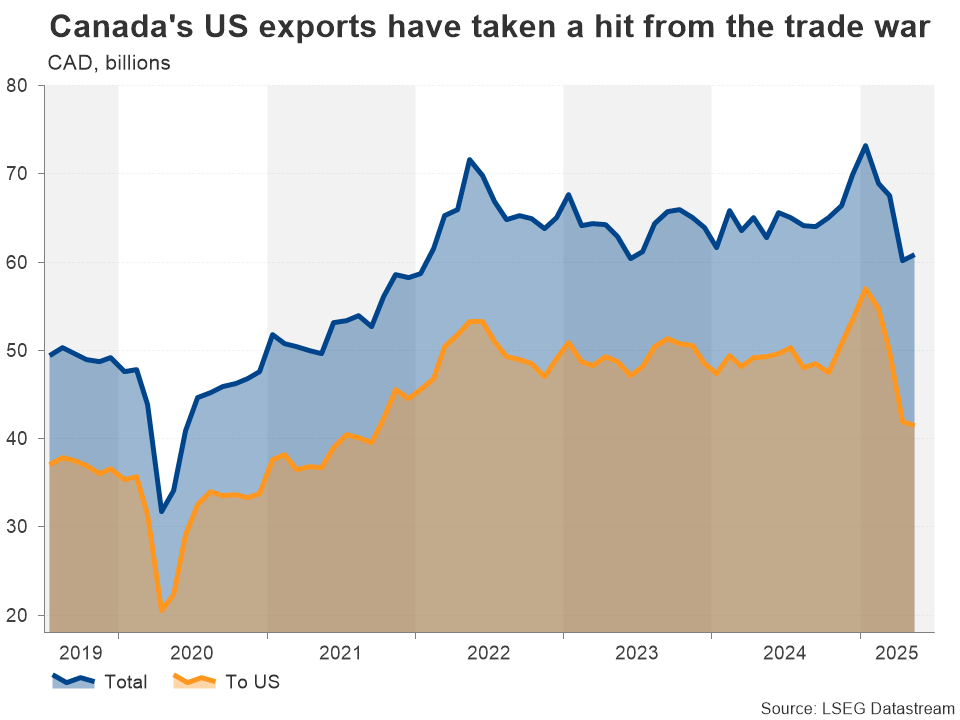
The loonie, however, is more likely to be driven by the strength or weakness of the US dollar.
Key data from China, Japan and UK
In China, CPI and PPI numbers are due on Wednesday. Both consumer and producer price inflation have been negative since February. If this trend remains unchanged in June, worries about a worsening deflation picture in China could weigh on market sentiment.
One country that is definitely glad to be out of deflation is Japan, where inflation has been strong enough for the Bank of Japan to finally exit negative interest rates. With the energy shock now fully faded, the BoJ is focusing primarily on sustained wage growth for guiding it on when to resume its policy tightening.
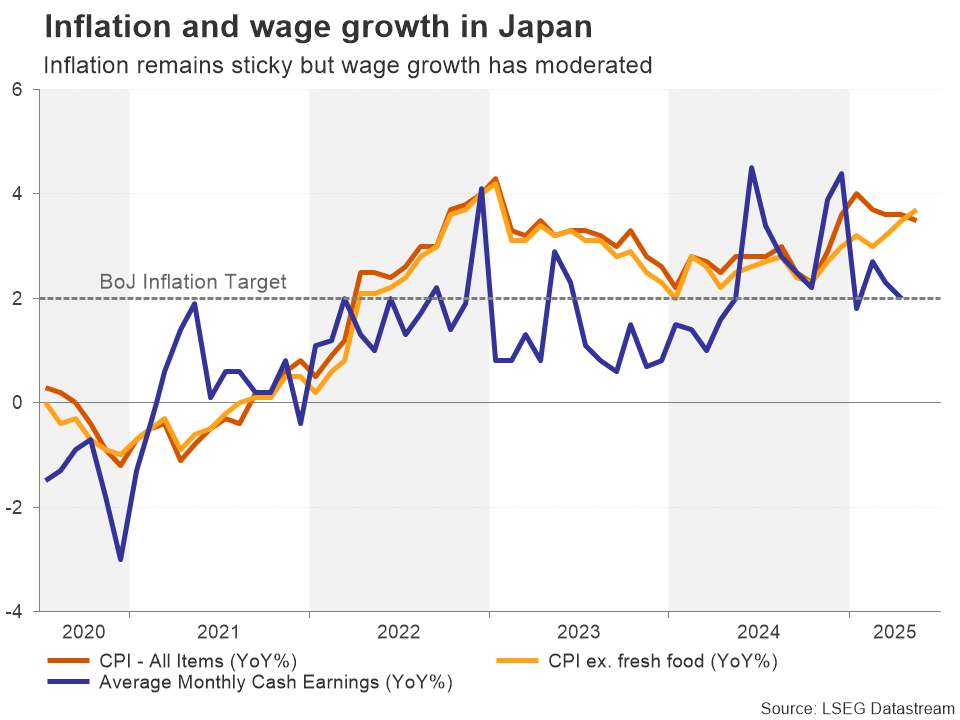
Wage growth figures for May are out on Monday and corporate good prices for June will follow on Thursday. The Japanese yen could strengthen slightly if wage growth comes in hotter than expected.
Finally in the UK, the focus is again on the government’s mismanagement of public finances, which triggered a spike in gilt yields during the past week, pushing the pound lower. Next Friday’s monthly GDP readings could help sterling regain its positive footing, as stronger growth tends to boost government revenue and would lessen the pressure for spending cuts or tax increases.
Author
Mr Boyadjian graduated from the London School of Economics in 1999 with a BSc in Business Mathematics and Statistics. Following graduation, he joined PricewaterhouseCoopers in the Business Recoveries team, where he was responsibl