Wall Street II: Why the bond market signals a global meltdown

The next financial crisis has already started again from the US. Unlike 2008, when subprime loans froze market trading and Lehman Brothers went bankrupt, in 2022, it may be the $27 trillion U.S. Treasury bond market that brings worldwide collapse. When historians of the future look back on 2022, they will remember it as a year when nothing ever worked.
Throughout its duration, interest rates, Russia’s invasion of Ukraine, increased energy costs, inflation, which has climbed to the highest levels in 40 years, and liquidity outflows from stocks and bonds have squeezed markets violently. Since 1980, bonds have been a defacto hedge. However, in 2022, they suffered the worst sell-off in 100 years, with the typical 60/40 stock and bond portfolio returning a terrifying -34.4%, as fund managers revealed.
The fall in bonds is the important one. This market is the “life” of the economy. Today, more than ever, the economy requires ever-increasing levels of debt to function: from companies issuing bonds for stock buybacks to consumers increasing leverage to maintain their standard of living. Also, governments require continued debt issuance to finance spending programs, as total tax revenues are insufficient to pay transfer payments, pensions, and debt relief.
The problem occurs when interest rates rise. Higher interest rates reduce the number of willing borrowers, and debt buyers don’t want prices to fall. The last one is the most important. When debt buyers evaporate, the ability to issue debt to finance spending becomes increasingly problematic.
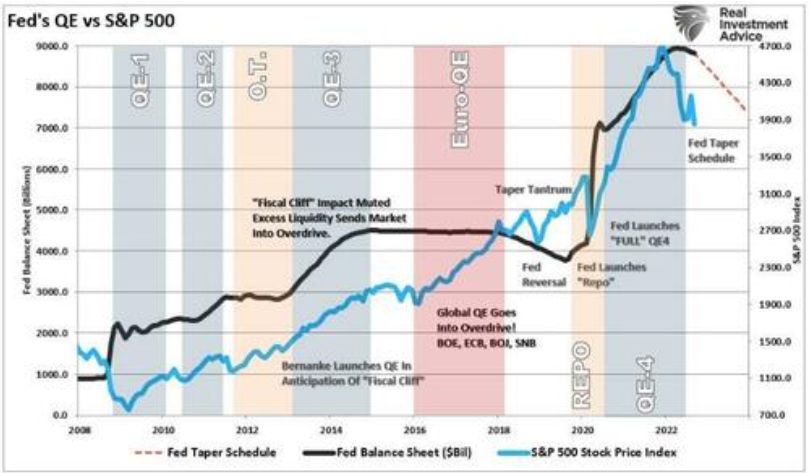
The outstanding debt (bonds) has increased by $7 trillion since 2019. However, at the same time, large financial institutions acting as “major traders” are not willing to act as net buyers. One of the main reasons for this is that for the past decade banks and brokerages have had one primary buyer to whom they could offload the bonds they held: the Federal Reserve. Today, the Federal Reserve no longer acts as a willing buyer. Consequently, traders are also reluctant to buy bonds. Also, liquidity continues to evaporate.
Each rate hike brings the Fed closer to the unwanted “event horizon. But what should worry the Fed and the US Treasury most is the worsening demand in US debt auctions. A key indicator called the supply-to-coverage ratio of the government’s latest ten-year bond issuance, $32 billion, was more than one standard deviation below last year’s average.
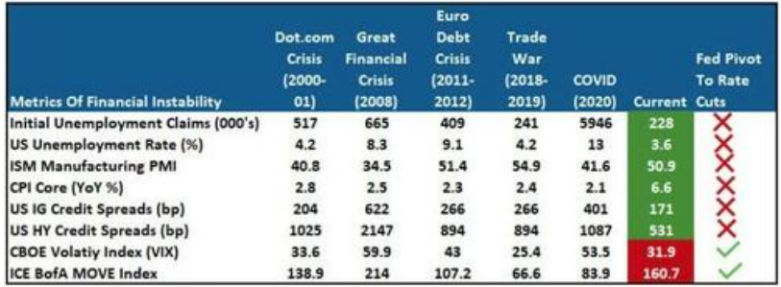
Unfortunately, history is littered with monetary policy mistakes, with the Federal Reserve tightening policy too much. As markets rebel against quantitative tightening, the Fed will eventually acquiesce to a deluge of selling. The destruction of “wealth” threatens the functioning of both stock and credit markets. We are already seeing the first cracks in both the foreign exchange and government bond markets. However, volatility is rising to levels that signal systemic episodes, and when the effect of monetary policy lag collides with accelerating economic weakness, the Fed will realize its mistake.
Get Full Access To Our Premium Analysis For 14 Days. Click here!
Get Full Access To Our Premium Elliott Wave Analysis For 14 Days. Click here.
Author
Gregor Horvat
Wavetraders
Experience Grega is based in Slovenia and has been in the Forex market since 2003.