USDCAD Forecast: Canadian dollar slides to 1-year low as Trump Prepares China Tariffs

The Canadian dollar continues to lose ground in the Friday session, after strong gains on Thursday. Currently, USD/CAD is trading at 1.3129, up 0.18% on the day. Earlier in the day, the Canadian currency dropped to its lowest level since June 2017. On the release front, Canadian Manufacturing Sales is expected to fall to 0.6%. In the U.S, the Empire State Manufacturing Index is forecast to drop to 19.1 points. We’ll also get a look at UoM Consumer Confidence, which is forecast to soften to 98.5 points.
As widely expected, the Federal Reserve raised interest rates by a quarter-point, to a range between 1.75 percent and 2.00 percent. Fed Chair Jerome Powell sounded hawkish in his press conference, saying that the economy was performing well and that “overall outlook for growth remains favorable”. This message echoed the rate statement, in which policymakers said that “economic activity has been rising at a solid rate”, pointing to stronger consumer spending and business investment. What was may have been the most notable development was that the Fed rate projections were revised upwards, predicting two additional rate hikes in 2018, for a total of four hikes. Until now, the Fed had projected three rate hikes this year. This represents a nod to the strength of the U.S economy and could boost the dollar against its rivals.
Prime Minister Justin Trudeau is still smarting from the disastrous G7 summit which he hosted. Canada, along with other members of the G7, vociferously complained about the tariffs which Trump imposed on Canada and the European Union. The summit ended in disarray, with Trump labeling Trudeau “weak” and “dishonest”. The meeting exposed fault lines between Trump and the other leaders over trade, and Trump’s protectionist stance could spell trouble for the Canadian economy and send the wobbly Canadian dollar even lower. Trump is expected to impose further tariffs on China as early as Friday, which has lowered risk appetite and weighed on the Canadian currency. Meanwhile, negotiations to update the NAFTA agreement are deadlocked, with Canada unhappy about a U.S demand for a sunset clause after five years, which would require the parties to hammer out a new agreement. Mexico is holding general elections on July 1, and a left-wing candidate, Andrés Manuel López Obrador, leads in the polls. If López Obrador becomes president, it could mean more complications for the NAFTA talks.
Canadian Foreign Minister Says US Has Agreed to Continue NAFTA Talks
Dollar is King, but trade tensions cap risk appetite
USD/CAD Fundamentals
-
8:30 Canadian Foreign Securities Purchases. Estimate 54.9B
-
8:30 Canadian Manufacturing Sales. Estimate 0.6%
-
8:30 US Empire State Manufacturing Index. Estimate 19.1
-
9:15 US Capacity Utilization Rate. Estimate 78.1%
-
9:15 US Industrial Production. Estimate 0.2%
-
10:00 US Preliminary UoM Consumer Sentiment. Estimate 98.5
-
10:00 US Preliminary UoM Inflation Expectations
-
16:00 US TIC Long-Term Purchases. Estimate 58.5B
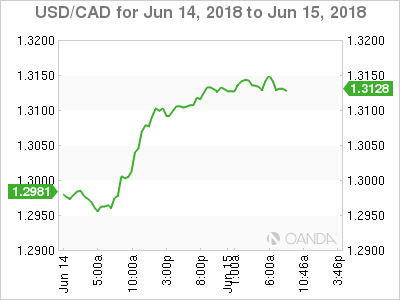
Open: 13105 High: 1.3160 Low: 1.3100 Close: 1.3124
USD/CAD Technical
|
S3 |
S2 |
S1 |
R1 |
R2 |
R3 |
|
1.2850 |
1.2943 |
1.3015 |
1.3125 |
1.3224 |
1.3315 |
USD/CAD edged higher in the Asian session and is showing limited movement in European trade
-
1.3015 is providing support
-
1.3125 is under pressure in resistance. It could break in the North American session
-
Current range: 1.3015 to 1.3125
Further levels in both directions:
-
Below: 1.3015, 1.2943, 1.2850 and 1.2757
-
Above: 1.3125, 1.3224 and 1.3315
Author

Kenny Fisher
MarketPulse
A highly experienced financial market analyst with a focus on fundamental analysis, Kenneth Fisher’s daily commentary covers a broad range of markets including forex, equities and commodities.

















