USD/JPY Forecast: Time for an upside correction? Trade optimism may push it higher
- USD/JPY has tumbled down on the Fed's dovish turn and the BOJ's lack of action.
- US durable goods orders, GDP, and US-Sino relations stand out in the last week of Q2.
- Mid-June's daily chart points to further falls for USD/JPY.
- Experts see a short-term drop before a bounce later on.

What just happened: Fed goes dovish, BOJ does not
The Federal Reserve has opened the door to cutting interest rates by dropping the word "patience" from its statement when referring to interest rates. Moreover, the Fed has expressed concern over increasing uncertainties due to trade tensions. US-Sino tensions have been intensifying from early May – just after the previous decision. Also, the Fed has stopped describing low inflation as a temporary phenomenon.
The central bank has taken the first step toward easing but has also refrained from painting a gloomy picture. Jerome Powell, Chair of the Federal Reserve Board of Governors, has expressed satisfaction over recent developments in the labor market and US consumption. Moreover, the Washington-based institution's projections for interest rates still point to leaving them unchanged this year – but for a rate reduction in 2020.
Nevertheless, bond markets were quick to raise their bets for the Fed to slash rates as soon as their next meeting in July. Several commercial banks have changed their forecast to reflect a cut of 50 basis points – a double dose.
The US dollar dropped across the board alongside bonds yields. The benchmark 10-year Treasury yield dipped below 2% – the lowest since November 2016 – and stock markets rallied.
USD/JPY has been tumbling down as the sell-off in the US dollar beat the positive mood in markets – which tends to disadvantage the yen.
On the other side of the Pacific, the Bank of Japan has left its policy unchanged. Despite enacting the loosest monetary policy in the world, the BOJ's lack of additional stimulus contrasted the Fed and pushed the yen higher – exacerbating the falls. Governor Haruhiko Kuroda has expressed concern about low inflation, but his words were not enough to stop the yen's ascent.
President Donald Trump – who has reportedly sought legal means to replace Fed Chair Powell – has given another his own boost to stock markets by announcing a constructive telephone conversation with his Chinese counterpart Xi Jinping. The leaders have finally announced they will hold an "extensive meeting" on the sidelines of the G20 meeting in Japan at the end of the month. Moreover, the excellent encounter's goal is to resume trade talks between the world's largest economies.
The Japanese yen has ignored simmering geopolitical tensions. Xi has traveled to Pyongyang for a historic meeting with North Korea's Kim Jong-un – showing that the rogue regime has additional powerful friends after the failure of the Kim-Trump summit earlier this year.
Tensions between the US and Iran have ratcheted up after the Middle-Eastern nation shot down an American drone in the Persian Gulf. Both countries dispute the drone's location – in Iranian airspace or above international waters. The incident follows attacks on oil tankers sailing in the region.
US events: Final GDP and preparations for the summit
After the dust has settled from the Fed decision, US-Sino relations are likely to the take center stage. Preparations toward the Trump-Xi summit that will take place after markets have closed for the week will likely consist of upbeat remarks by both countries that will probably want to maintain the newfound optimism – albeit cautious ahead of the meeting.
Any pre-summit commentary may move markets. If both sides hint of progress, USD/JPY has room to rise alongside markets. Yet if officials lower expectations, the safe-haven yen.
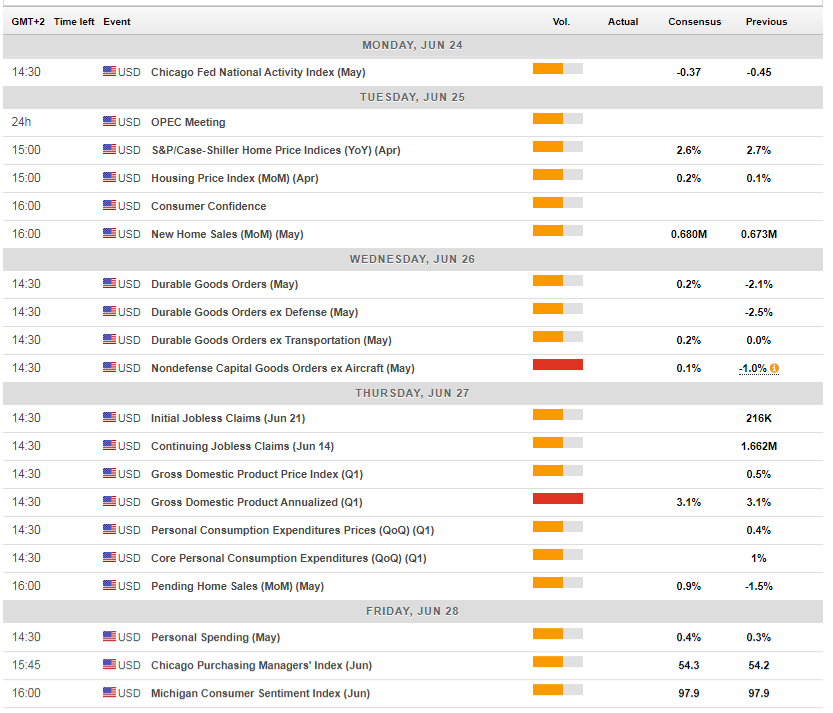
The trading week kicks off in earnest on Tuesday with housing figures. The S&P Case Shiller Home Pirce Index is set to show another deceleration in house price rises while sales of new homes also carry expectations for a drop in May after hitting a high of 673K in April.
The Conference Board's consumer confidence gauge will also be watched for a potential drop from the peak of 134.1 seen in May – the University of Michigan's gauge also ticked down.
Durable goods orders for May are due on Wednesday. The data represents investment, feeds into GDP, and is also watched carefully by the Fed. ORders excluding defense and air fell by 1% according to the revised figures for April and are now projected to rise.
The most important indicator of the week is scheduled for Thursday – the final GDP read for the first quarter. The second release has shown that the economy grew at a fast clip of 3.1% annualized – but it came on top of meager inflation. Therefore, the personal consumption expenditure prices component is no less important than the headline figure.
Inflation will also be eyed on Friday with the publication of the core PCE PRice Index – the Fed's preferred measure of inflation – which is forecast to remain unchanged at 1.6% year on year – below the 2% target and keeping the pressure on the central bank. Personal spending, personal income, and the final consumer sentiment from UoM will also be of interest due to the timing of the release – just before the week ends.
And it is not only the week that draws to close but also the month and the quarter. Money managers will rush to make last-minute adjustments to their portfolios and may trigger choppy price action.
Here are the top US events as they appear on the forex calendar:
Japan: BOJ meeting minutes and Tokyo inflation numbers
The Japanese yen will likely be sensitive to any headlines related to the upcoming Trump-Xi summit, fluctuations in bond markets, and any simmering tensions between the US and Iran.
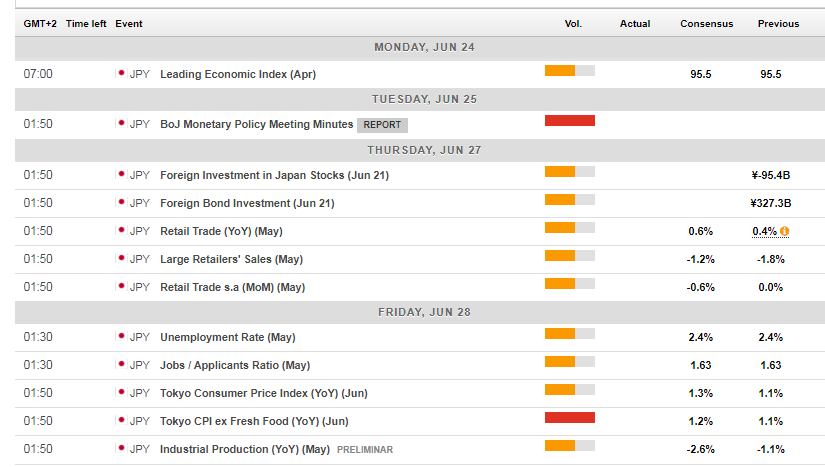
The BOJ's meeting minutes stand out on the Japanese economic calendar. The document may reveal concerns about low inflation, as well as any potential intentions to present new monetary stimulus.
Later in the week, new inflation figures for the capital region for June are of interest. Consumer prices which exclude fresh food will likely draw special attention. Prices in Core prices in Tokyo have risen by 1.1% year on year in May, and they are expected to accelerate to 1.2% this time – still far from the 2% target.
Here are the events lined up in Japan:
USD/JPY Technical Analysis
The downtrend resistance line has proved decisive once again. USD/JPY has failed to break higher and tumbled down to new five-month lows. Momentum remains to the downside, but the Relative Strength Index on the daily chart points to oversold conditions – below 30 points.
107.50 provided some support in January and remains a battle line. June's fresh low of 107.05 is the next support line to watch. It is followed by 106.60 which was a stepping stone for the pair on its way up in April 2018. It is followed by 105.40, which was a support line in March 2018. Most importantly, the 2019 trough of 104.75 is a critical line to watch.
107.55 provided support in early June and now switches to resistance. It is followed by 108.15 that was a cushion later in the month. 108.80 was the high point this month. Further up, we find 109.90 that served as support in mid-May, and 110.65 which was a swing high and also where the 50 Simple Moving Average meets the price.
-636967113360888673.png)
USD/JPY Sentiment
USD/JPY is not only suffering from oversold conditions but has probably fallen too much considering the upbeat state of the US economy and fresh hopes for a positive outcome from the Trump-Xi summit. There is more room to recover than fall.
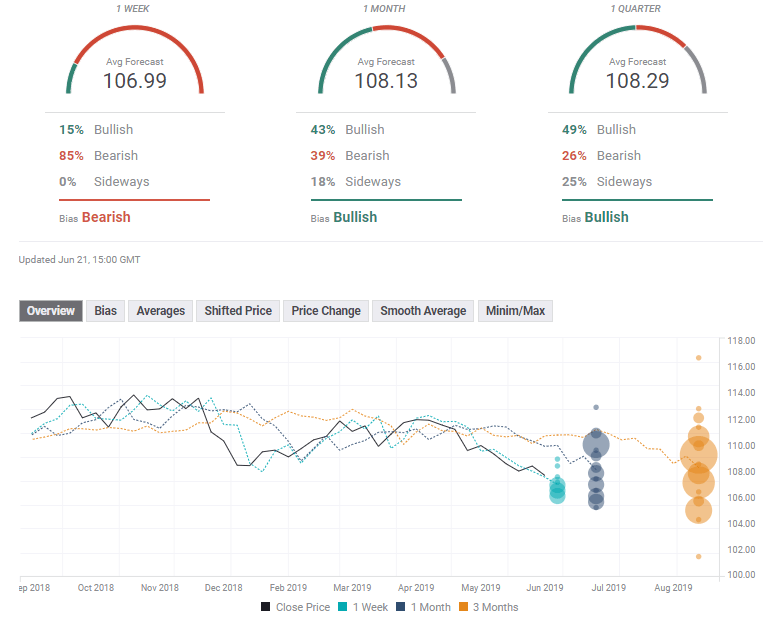
The FXStreet Poll shows a bearish bias in the short term with a considerable bounce expected afterward. Average targets have all been downgraded in the past week, with a notable downward move in the long-term target which is usually stable.
Related Forecasts
Author

Yohay Elam
FXStreet
Yohay is in Forex since 2008 when he founded Forex Crunch, a blog crafted in his free time that turned into a fully-fledged currency website later sold to Finixio.