USD/JPY Forecast: Fed in focus after another week of trade optimism
- USD/JPY has enjoyed a third consecutive week of gains amid hopes for a trade deal.
- The all-important Fed decision is left, right, and center.
- Mid-September's daily chart remains bullish for USD/JPY.
- Experts are bullish in the short term but see USD/JPY falling afterward.

Is the trade war about to end? It may take time, but investors have been cheered the US and Chinese gestures – selling off the safe-have yen. And now, all eyes are on the Fed – which is expected to deliver a rate cut and lay down plans.
This week in USD/JPY: Trade truce
China will be celebrating 70 years since the Communist revolution on October 1 – and President Donald Trump has decided not to spoil the celebrations by delaying new tariffs. The 5% increase on all levies that have already been imposed on Beijing will occur on October 15. China has also been positive by allowing local companies to buy US agricultural goods.
These gestures of goodwill have come on top of the previous announcement to resume high-level talks next month. They have pushed money out of safe-haven US treasuries and the yen, allowing yields and USD/JPY to rise.
Later on, the media reported that the world's largest economies might settle for an "interim deal" – removing some tariffs, normalizing trade – and that China would relax some of its demands related to Intellectual Property. The reports were quickly denied. Trump and his team may be under pressure as fresh opinion polls have shown a slump in the president's approval ratings. He may want to safeguard the economy – as he did by postponing some of the tariffs to December 15.
The greenback also received a boost by rising inflation. While the headline Consumer Price Index slowed down to 1.7% YoY in August, core CPI surprised with 0.3% MoM and 2.4% YoY. This acceleration may limit the Federal Reserve's urge to cut rates next week. Retail sales have been mixed while consumer sentiment beat expectations.
The Bank of Japan also announces its rate decision next weeks, and policymakers are also considering further stimulus. Fresh reports suggest the BOJ may tweak its language pledge lower rates for longer.
All eyes on the Fed
Tension is set to limit market volatility ahead of the Fed decision on Wednesday and markets are set to rock afterward. The all0-important event overtowers everything else in the upcoming week.
The Federal Reserve is set to cut rates by 25 basis points as trade tensions are weighing on the local and global outlook, and investment is weak. And while inflation has picked up, job growth has slowed.
Markets are pricing in a 25 basis point cut and Jerome Powell, Chair of the Federal Reserve, has not come out against this potential move in his latest speech ahead of the decision. If the Fed meets these projections, the reaction will likely depend on the Fed's forecasts for interest rates – the dot plot. Other scenarios include an aggressive rate cut of 50 basis points or no cut at all. The accompanying statement and Powell's press conference are also set to move markets.
For all the details, see Fed Preview: Far more than a rate cut – Five scenarios for the dollar
Other US events: Trade tensions and housing figures
Apart from the Fed, further developments on the trade front will be in the limelight. If the US and China do get closer to a permanent truce, markets may rally, and USD/JPY will receive some support. The Fed may refrain from adding more stimulus in its next meetings if downside risks diminish. If the idea is shot down and both sides stick to their guns, hopes for a resolution may fade, and the safe-haven yen may find demand.
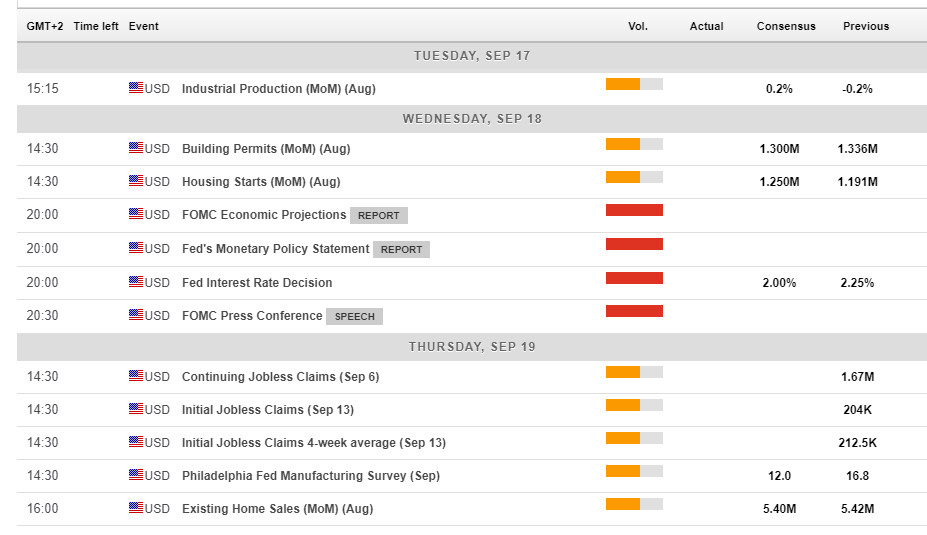
The economic calendar consists of few figures that may compete with the central bank's decision and trade. Industrial Production, due out on Tuesday, is projected to show an increase in August. Building Permits and Housing Starts are published just before the Fed decision and are unlikely to move markets. Moreover, the numbers tend to offset each other.
More housing data are scheduled for Thursday, with Existing Home Sales expected to remain around 5.4 million units annualized in August.
All in all, Trump's tweets are likely to be the only notable competition to the Fed decision.
Here are the top US events as they appear on the forex calendar:
Japan: BOJ in focus
The Japanese yen is set to remain the safe-haven of choice, set to gain ground on gloomy Fed forecasts and more importantly – if US-Sino relations deteriorate once again. The yen may come under pressure if the current detente prevails and if the US removes some of the sanctions against Iran – defusing tensions in the Middle East.
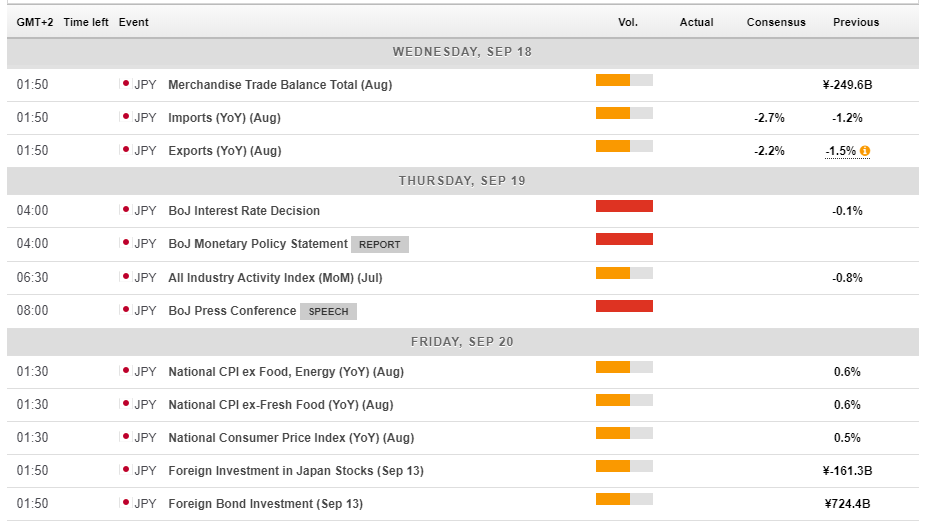
And for a change, a top-tier Japanese event is due out next week. Less than 12 hours after the Fed decision, the Bank of Japan also announces its policy. The BOJ has limited scope to act as its interest rate has been negative for several years. Governor Haruhiko Kuroda and his colleagues will likely leave rates unchanged at -0.1%. The negative rate has hit Japanese banks.
The Tokyo-based institution may offer to hold rates at a low level for longer, or perhaps reaffirm its commitment to maintaining long-term yields at low rates. The BOJ currently keeps 10-year yields around 0%. Any surprise rate cut or any other unconventional measure may weaken the yen, but it is highly unlikely.
Friday's inflation figures at the national level will probably be of little interest as figures for Tokyo are already out. Moreover, they are due out after the BOJ will have already had its word. Nevertheless, any considerable surprise will feed into the next decision of the central bank.
Here are the events lined up in Japan:
USD/JPY Technical Analysis
USD/JPY continues enjoying upside momentum on the daily chart and is moving above the 100-day Simple Moving average after leaving the 50 SMA behind. The Relative Strength Index (RSI) remains below 70 – thus staying out of overbought conditions.
The pair remains on the ascent after breaking above the then downtrend resistance line. It is trading alongside a sharp uptrend support line and faces a downward resistance line.
The first noteworthy cap is 108.25, which was the high point in mid-September. The next level to watch is 108.80, which held it down in June. The swing high of 109.35, seen in early August, is critical resistance as it nearly converges with the 200-day SMA. Next, we find 109.95, which was a swing high in May.
Support awaits at 107.50, which was a support line in July. Next, 107.30 worked as support in late July. It is followed by 106.65, that was a stubborn resistance line in August. Further down, 105.70 was the springboard for the recent surge, while 105.05 held it up in mid-August.
-637039712704211293.png)
USD/JPY Sentiment
If the trade truce continues and the Fed refrains from hinting imminent cuts in October, USD/JPY has room to rise. A fresh trade battle and extreme easing will send it the other way. The upside has higher chances than the downside.
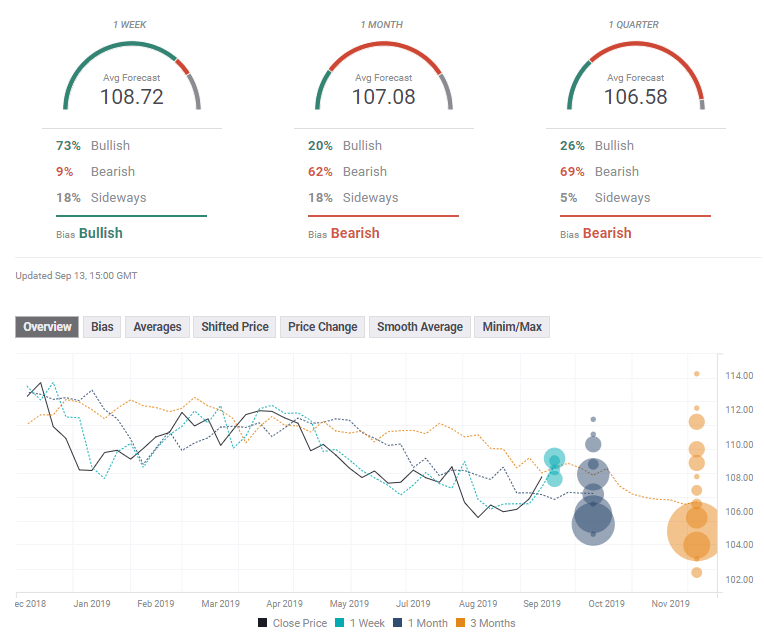
The FXStreet Poll is showing that experts are bullish in the short run but bearish afterward, with significant falls from current levels as time goes by. The short-term target has risen while medium-term and long-term objectives have been left unchanged.
Related Forecasts
Author

Yohay Elam
FXStreet
Yohay is in Forex since 2008 when he founded Forex Crunch, a blog crafted in his free time that turned into a fully-fledged currency website later sold to Finixio.