|

USD/JPY forecast: Elliott Wave signals resumption of bearish momentum [Video]

The USD/JPY currency pair is showing a bearish trend that began on July 3, 2024, and is expected to continue declining toward the 136.50 level. In the short term, the price movement since the March 28, 2025 high is forming a zigzag pattern, according to Elliott Wave analysis.

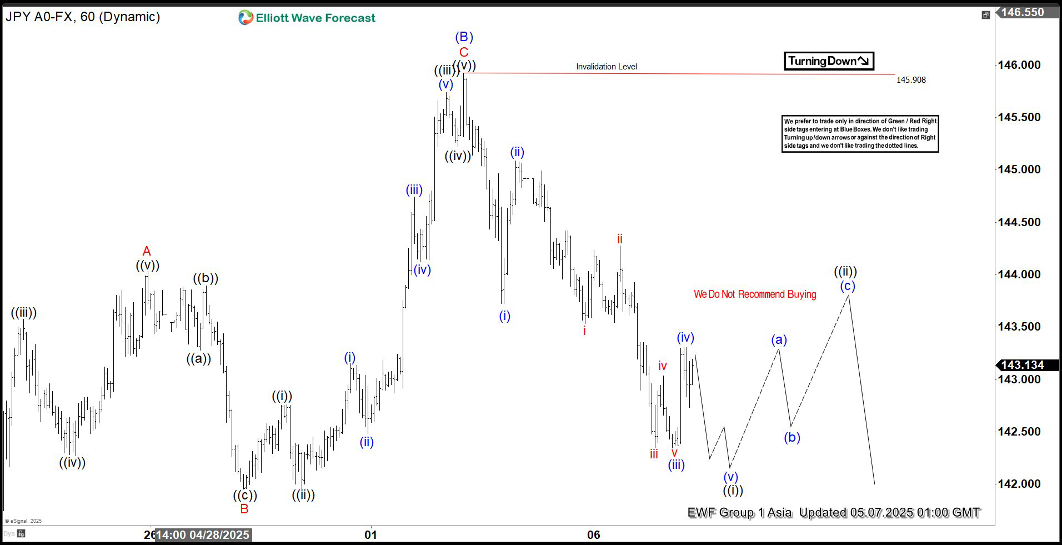
From the March 28, 2025 high, the decline in wave (A) reached 139.89. This was followed by a corrective wave (B), which also unfolded as a zigzag. Within wave (B), the price rose to 144.03 (wave A), then dipped to 141.95 (wave B). Afterwards, it climbed to 145.90 (wave C), completing wave (B). The pair has since turned lower, starting wave (C).

Wave (C) is currently developing as an impulse pattern in Elliott Wave terms. From the May 2, 2025 high, the price dropped to 143.72 (wave (i)), then rallied to 145.08 (wave (ii)). The decline resumed, reaching 142.34 (wave (iii)). A corrective rally in wave (iv) is believed to have finished at 143.30. The pair is now expected to decline further to complete wave (v). This will finalize wave ((i)) in the larger structure. After this, a corrective rally in wave ((ii)) should occur, partially recovering from the May 2, 2025 high, before the downward trend resumes.

In the near term, as long as the high at 145.90 holds, any upward movements are likely to be limited and fail in a pattern of 3, 7, or 11 swings, leading to further declines.

USD/JPY 60 minute Elliott Wave chart
USD/JPY Elliott Wave [Video]

Author

Elliott Wave Forecast Team

Elliott Wave Forecast Team

ElliottWave-Forecast.com

More from Elliott Wave Forecast Team
Share:

Editor's Picks

AUD/USD struggles near 0.7150 as Fed hike bets and Middle East risks underpin USD

AUD/USD kicks off the new week on a weak note and hovers near Friday's low, around mid-0.7100s, as the US Dollar holds up on rising Fed rate-hike bets, bolstered by the US CPI. Furthermore, escalating Middle East tensions and clashes in the Strait of Hormuz underpin the safe-haven USD. However, hawkish RBA expectations could help limit deeper losses for the Aussie.

USD/JPY holds steady near mid-153.00s as traders await Fed/BoJ rate decisions

USD/JPY consolidates near a seven-month low touched last Tuesday as traders move to the sidelines ahead of the FOMC decision on Wednesday and the BoJ policy update on Friday. Meanwhile, a more hawkish repricing of the BoJ's normalization path supports the Japanese Yen, while rising Fed rate-hike bets and geopolitical risks underpin the US Dollar, leading to the pair's subdued price action at the start of the new week.

Gold consolidates above $4,300 as traders await Fed rate decision this week

Gold struggles to capitalize on Friday's modest bounce from sub-$4,300 levels and kicks off the new week on a subdued note as traders move to the sidelines ahead of a slew of central bank events. Meanwhile, the latest US inflation figures reaffirmed September Fed rate-hike bets and cap the non-yielding bullion. Moreover, escalating US-Iran tensions act as a tailwind for the safe-haven US Dollar, keeping XAU/USD bulls on the back foot.

Week ahead: Fed, BoJ and BoE decide amid inflation dilemma
A crucial central bank week looms for markets as both the Federal Reserve and Bank of Japan are under pressure from all sides, with their credibility at stake. The Bank of England looks set to have an easier ride, at least for now, while inflation releases will be watched too as war continues to rage in the Middle East.
CFTC Report: Japanese Yen reversal leads a broader positioning reset
The week in one sentence: Yen positioning swung back into net longs in the week to September 8, leading to a 103.0K-contract improvement. Canadian Dollar shorts also fell sharply, while Oil buying accompanied another price rise. Euro, Sterling and Swiss Franc positioning weakened despite firmer currencies, leaving those moves unconfirmed by speculative flows.
Venezuela’s 65-billion-barrel Oil deal could reshape America’s inflation fight
The United States (US) has secured unprecedented access to part of Venezuela’s vast Oil reserves. The timing is particularly significant as the war with Iran is disrupting Middle Eastern supplies, keeping energy prices elevated and reviving concerns about inflation.