USD/JPY Forecast: Bearish case gains supporters

USD/JPY Current price: 108.74
- Japan’s Tokyo March inflation at 0.4% YoY, slightly below expected.
- Equities turning lower as sentiment remains sour, dollar’s decline pauses.
- USD/JPY at risk of extending its decline on a break below 108.20.
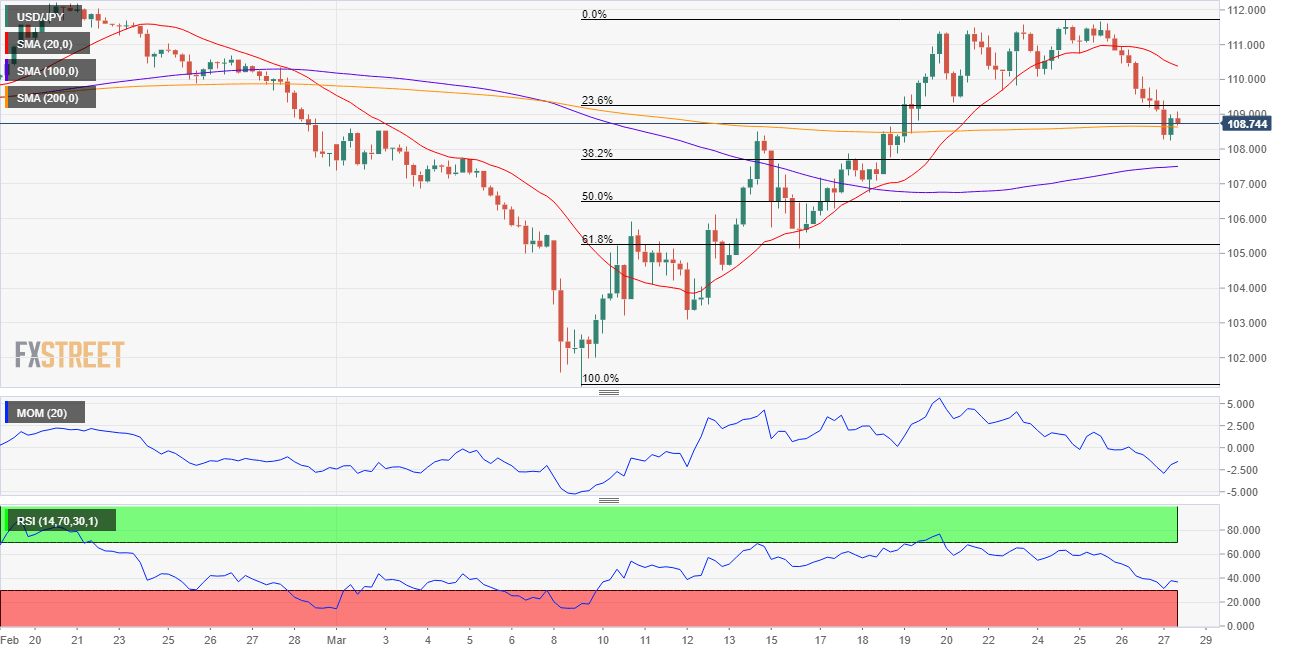
Markets continue to depend on speculation about how the global economic situation will be once the pandemic is controlled, something that we all ignore. The USD/JPY pair is trading at around 109.00, down for a second consecutive day, as the greenback remains out of the market’s favour.
Asian equities followed the lead of US ones, posting substantial gains, but European indexes are in the red. The sentiment is sour as the number of coronavirus cases in the US has surpassed those in China, while the spread in Europe gives no signs of easing. One-third of the world’s population is in quarantine, and the most optimistic view suggests that activity could resume mid-April.
On the data front, Japan published Tokyo March inflation, which resulted slightly below expected, at 0.4% YoY, although the core reading, excluding fresh food and energy prices, remained stable at 0.7% YoY. Later today, the US Personal Income and Spending figures for February are due, along with PCE inflation. Given that the numbers are from pre-crisis, they would likely have no impact on prices.
USD/JPY short-term technical outlook
The USD/JPY pair is trading just below the 23.6% retracement of its latest daily advance at 109.20. In the 4-hour chart, the 20 SMA keeps easing above the current level, while the price is hovering around a flat 200 SMA. Technical indicators are resuming their declines within negative levels, after a modest bullish correction. The pair bottomed at 108.23 today, while the 38.2% retracement of the mentioned rally stands at 107.75. The bearish case will become stronger on a break below the mentioned daily low.
Support levels: 108.20 107.75 107.30
Resistance levels: 109.25 109.60 110.00
Author

Valeria Bednarik
FXStreet
Valeria Bednarik was born and lives in Buenos Aires, Argentina. Her passion for math and numbers pushed her into studying economics in her younger years.