|

USD/JPY analysis: dollar recovers some poise at the end of the day

USD/JPY Current price: 112.74

  • USD/JPY nears 112.86, the two-month high set last week.
  • BOJ to publish its latest meeting's Minutes, Kuroda to offer a speech.
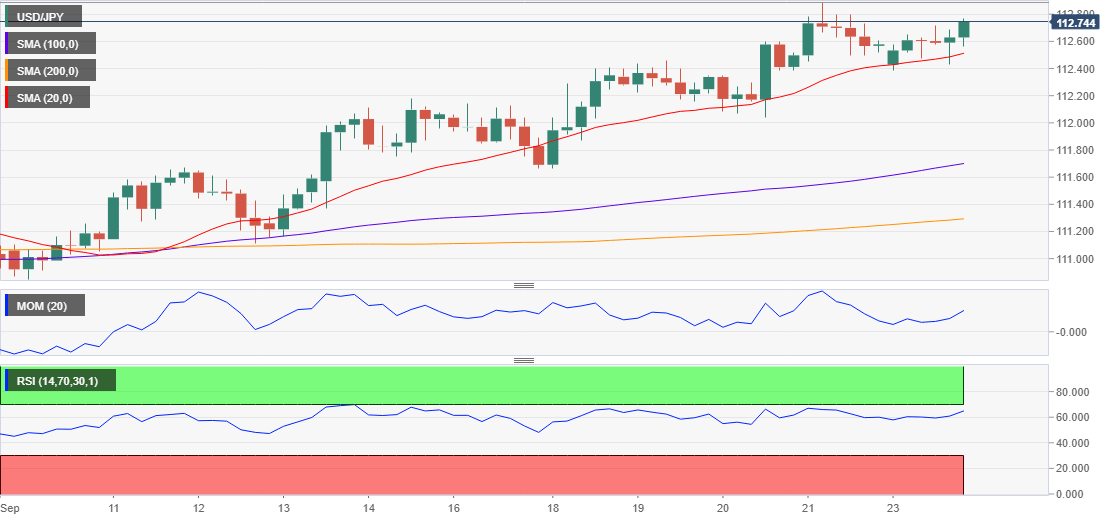
The USD/JPY pair is modestly up this Monday, around 112.70. Multiple holidays in major Asian economies kept the pair ranging at the beginning of the day, while risk-aversion was responsible for the lack of action during the last trading session of the day. US Treasury yields post modest intraday advances but remained below the 5-month highs posted last week, consolidating gains and just providing mild support to the pair, despite falling equities. Following a long weekend, the Japanese macroeconomic calendar will offer August Corporate Service Price Index, the latest BOJ's Meeting Minutes and revisions for July Leading and Coincident indexes.    

The pair heads into the Asian session at the upper end of its daily range, not far from 112.86, the two-month high set last week. In the 4 hours chart, the pair is well above bullish 100 and 200 SMA, while technical indicators remain within familiar levels, the Momentum heading lower and the RSI higher, both well above their midlines, favoring additional gains on a break above the mentioned 112.86, now the immediate resistance. The next one comes at 113.17, July monthly high. 112.45, on the other hand, is the immediate support ahead of 112.14, August monthly high.

Support levels: 112.45 112.15 111.80  

Resistance levels: 112.85 113.20 113.50

View Live Chart for the USD/JPY

Author

Valeria Bednarik

Valeria Bednarik was born and lives in Buenos Aires, Argentina. Her passion for math and numbers pushed her into studying economics in her younger years.


More from Valeria Bednarik
Share:

Editor's Picks

AUD/USD battles 0.7000 amid bullish USD

AUD/USD keeps its offered tone intact near 0.7000 at the start of a new week, trading near its lowest level since August 4 amid a bullish US Dollar. US yields hold near multi-year highs amid inflation risks from higher oil prices and rising bets on an October Fed rate hike. This, along with the US-Iran standoff, continues to underpin the safe-haven buck and weigh on the pair ahead of Tuesday's RBA policy announcements.

USD/JPY climbs back toward 158.00 after BoJ minutes amid firm USD

USD/JPY finds dip-buyers and reverses part of Friday's slide driven by speculation that authorities will step in again to prop up the Japanese Yen. However, the BoJ's dovish Minutes cap the JPY. Meanwhile, the US Dollar regains traction as the US-Iran standoff supports crude oil prices, fueling inflation fears and reaffirming bets for an October Fed rate hike. This further supports the pair, driving it back toward 158.00.

Gold slides to $4,200 on Fed hike bets and Iran risks

Gold falls hard at the start of a new week, sliding back closer to $4,200 and the lower boundary of the monthly range. Firming October Fed rate-hike bets, along with oil-driven inflation risks, keep US bond yields elevated near multi-year highs, helping the US Dollar regain positive traction amid persistent Iran risks. These factors weigh heavily on the bullion.

Week ahead: Rate hike bets face a crucial data week
Despite the solid drop from the mid-September high, oil prices remained in the driver’s seat for another week, setting the tone in financial markets. Six months have passed since the late-February start of the US-Iran conflict, and there is still no breakthrough in the stalled talks, despite pressure from regional leaders and the rest of the world.
After the Trump Xi summit, markets are trading three clocks
The summit delivered time, not a deal. Trade, oil and chips now each run to a date, and the macro backdrop matters more than the pageantry. Markets wanted a deal and got a calendar date instead. Xi Jinping left Washington on Friday after tea at the White House and a tour of the National Archives.
Fed vs BoJ: Both hiked. The market only believes one of them – and the chart shows which

The Fed and the BoJ have just done something remarkably similar. Both central banks raised interest rates by 25 bps last week, both are confronting inflation risks, and both signal that future decisions will depend on incoming economic data.