|

USD/JPY analysis: bulls lead but begin to hesitate

USD/JPY Current price: 114.06

  • US Treasury yield curve keeps narrowing.
  • Major resistance at 114.40 under pressure.
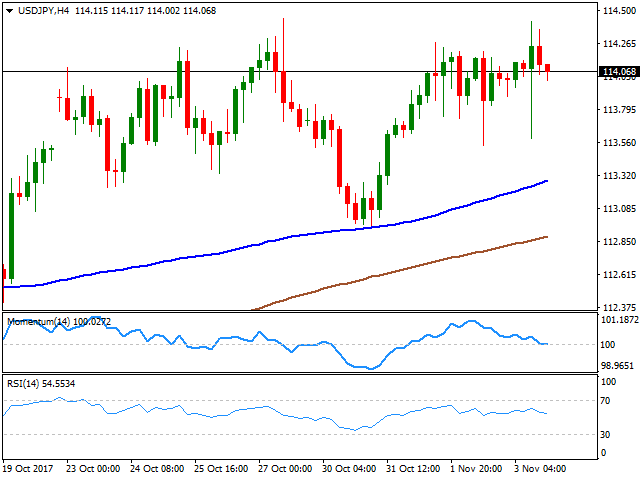
The USD/JPY pair closed the week modestly higher at 114.06, having failed to overcome the 114.40 region, despite multiple intraday attempts. The Bank of Japan had its monetary policy meeting last week, but as usual, the Central Bank maintained the status quo with a null effect on the Japanese currency. US Treasury yields came under pressure last week, something that usually leads to an appreciation of the JPY, but this time was just enough to prevent the pair from breaking above the major static resistance, somehow indicating that bulls are in the driver's seat. The 10-year note yield closed Friday at 2.34% while for the 2-year bond it settled at 1.61%, as a result of US President Trump nominating Jerome Powell as the next Fed's head. The spread between both narrowed to its lowest level since 2007 Friday, something that the market understands as a warning sign, as an inverted curve usually anticipates a recession period. Technically, the pair is neutral-to-bullish, but at the upper end of its last eight-month range, which increases the risk of a bullish extension. In the daily chart, the price is developing well above the 100 and 200 SMAs, both converging around 111.35, while technical indicators lost momentum, but remain above their mid-lines. In the 4 hours chart, the moving averages maintain their bullish slopes below the current level, but the Momentum diverges lower, currently pressuring its mid-line, while the RSI heads south around 54,  suggesting the pair may ease early Monday. Anyway, the upward potential won't be at risk unless the pair breaks below the 113.25 support.

Support levels: 113.60 113.25 112.80

Resistance levels: 114.40 114.85 115.10

View Live Chart for the USD/JPY

Author

Valeria Bednarik

Valeria Bednarik was born and lives in Buenos Aires, Argentina. Her passion for math and numbers pushed her into studying economics in her younger years.


More from Valeria Bednarik
Share:

Editor's Picks

GBP/USD remains offered; bears target 1.3600

GBP/USD now leaves behind part of its recent recovery and revisits the low 1.3600s at the beginning of the week. Indeed, Cable trades with a mild downward bias amid decent gains in the Greenback as investors remain wary of upcoming US data releases and the Jackson Hole event.

EUR/USD slips back to 1.1660, daily lows

EUR/USD remains slightly offered and drops toward the 1.1660 zone to hit daily troughs on Monday. The pair’s decline follows a decent advance in the US Dollar while investors continue to closely follow developments from the US money market.

Gold poised to extend its bullish run

Gold surrenders part of its initial advance, although it keeps its bullish pace well and sound above the $4,600 mark per troy ounce on Monday. The precious metal’s move higher comes despite slight gains in the US Dollar and a modest pullback in US Treasury yields across the curve.

Here's what I learned trading meme coins
I’ve been trading cryptocurrencies for the past seven years, with meme coins becoming one of the most exciting and implacable parts of my experience. I love them because they represent internet culture and community sentiment, and, let’s be honest, extreme speculation. Newly launched meme coins were especially tempting: get in early enough, I thought, and a small bet could turn into a huge return.
Bessent’s presser in focus
Preview: Busy week ahead, with Bessent kicking this off today, with things wrapping up with Warsh at Jackson Hole. For a month that should have been a temporary period of ‘quiet’, we had anything but last week, with the bond market and tariffs front and centre.
$20 billion offered, $2 billion taken: Why Treasury doubled its buyback cap

The US Treasury moved off its own calendar on Wednesday, and that is the part worth sitting with. At 12:32 GMT, the department said it would at least double the size of liquidity support buyback operations in the 10-year to 20-year and 20-year to 30-year sectors, lifting the maximum from $2 billion per operation to at least $4 billion, effective September 9 and running to November 4.















