|

USD/JPY analysis: 112.00 held but bearish case stronger

USD/JPY Current price: 112.20

  • USD/JPY recovered from a daily low of 111.94 as Wall Street trims part of its losses.
  • Government bond yields down on a run to safety back yen's gains.
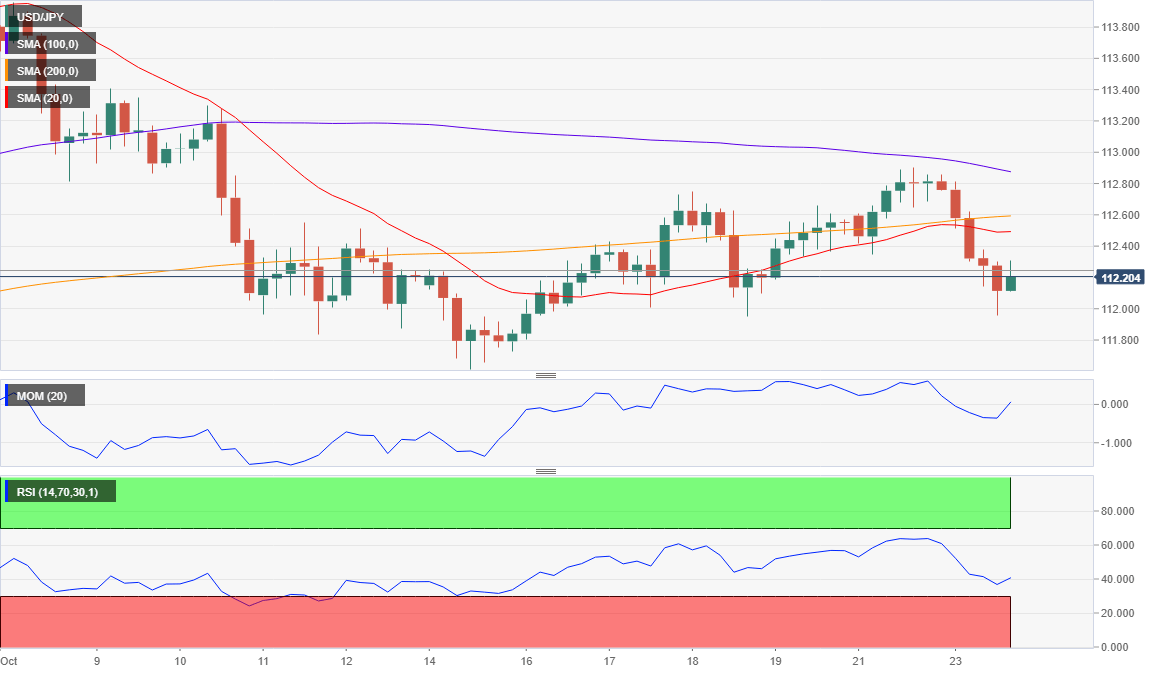
The Japanese yen was on demand for most of the day amid prevalent risk-averse mood, resulting in the USD/JPY pair bottoming at 111.94, its lowest for this week. The pair, however, bounced from the level alongside with US indexes, which anyway remained well into the red. US Treasury yields fell as demand for bonds surged, with the benchmark yield for the 10-year US Treasury note hitting a daily low of 3.11% from 3.19% Monday. Bank of Japan Governor Kuroda was said to have expressed concerns about "nervous" moves in global stocks, not something that can actually move the market, but a clear sign that volatility has become excessive. Japan will release its October preliminary Nikkei Manufacturing PMI, previous at 52.5, and the Leading and Coincident Indexes for August.

The pair recovered some ground in the US afternoon but still holds below the short-term ascendant channel coming from 111.62, with the trend-line that draws the base of the figure at around 112.40 for this Wednesday. In the 4 hours chart, the price is well below its 100 and 200 SMA, with the shortest gaining downward traction above the larger one, as technical indicators stabilize in negative levels, keeping the risk leaned to the downside. A break below 111.60, however, is still needed for the pair to accelerate its decline, with scope then to reach 110.37, September low.

Support levels: 112.60 112.20 111.90 

Resistance levels: 113.00 113.45 113.80

View Live Chart for the USD/JPY

Author

Valeria Bednarik

Valeria Bednarik was born and lives in Buenos Aires, Argentina. Her passion for math and numbers pushed her into studying economics in her younger years.


More from Valeria Bednarik
Share:

Editor's Picks

GBP/USD bounces off lows, back above 1.3200

After bottoming out near 1.3160, GBP/USD manages to regain a bit of shine and reclaim the 1.3200 mark and beyond at the end of the week. Stronger-than-expected UK Retail Sales data seem to be helping the British Pound limit its losses, while the chaotic UK political environment keeps the bulls at bay for now.

EUR/USD looks consolidative around 1.1460

EUR/USD stages a modest rebound after slipping to a three-month low below 1.1420 at the end of the week. That said, the pair now looks to consolidate humble gains just above 1.1460 despite growing uncertainty surrounding the next round of US-Iran negotiations, which keeps the US Dollar’s downside contained.

Gold slips back to six-day lows, targets $4,100

Gold retreats for the third consecutive day on Friday, eroding gains seen in the first half of the week and approaching the key $4,100 mark per troy ounce. Indeed, the precious metal continues to face headwinds from the Fed's hawkish stance and renewed uncertainty surrounding the next round of US-Iran negotiations.

Breaking: Iran closes the Strait of Hormuz amid ceasefire deal violation
Iran says it is closing the Strait of Hormuz after accusing the United States (US) and Israel of violating the ceasefire. According to Iran, the decision came over the continued Israeli strikes in Lebanon. The Iranian Revolutionary Guard Corps Navy issued a warning to all vessels: "Do not approach the Strait of Hormuz; otherwise, your security will be jeopardized."
The Iran war didn't break the US economy, but what happens next?

Nearly four months after the start of the Iran war, the US economy remains remarkably resilient. While the conflict initially triggered a severe disruption to global energy markets and a sharp rise in Oil prices, recent diplomatic progress between Washington and Tehran has eased concerns about a prolonged supply shock.

Regime change: Inside Kevin Warsh's first move to make the Fed unreadable on purpose

The rate did not move. That was the least interesting thing about Kevin Warsh's first meeting in charge of the Fed. The FOMC held its benchmark at 3.50%-3.75% for the fourth straight meeting, exactly as priced, and then the new chair used his first press conference to dismantle the machinery the market has leaned on for a decade.