USD/CAD Weekly Forecast: Can the Bank of Canada break the loonie free?
- Canadian dollar gains on lower Treasury yields and weaker US data.
- Lower oil prices for the week fail to boost USD/CAD.
- USD/CAD remains uncommitted with alternating rate hikes and range-bound WTI.
- FXStreet Forecast Poll forsees a reversion range trading.

Traders reversed their normal order of USD/CAD concerns for most of this week. Lower US Treasury rates and weak American data helped the Canadian dollar gain 1.0%, overriding the normal negative correlation of falling oil prices.
Treasury yields in the US have retreated from their mid-month highs with the benchmark 10-year closing at 3.136% on Friday, down 10 basis points on the week and 35 points from the June 14 top at 3.480%. The 2-year note shed 13 points from last Friday to finish at 3.063% and was off 23 points from its June 14 peak at 3.422%.
West Texas Intermediate (WTI) continued to descend from its June 8 high of $121.21, falling 4.8% from Monday to Thursday’s close at $103.33.
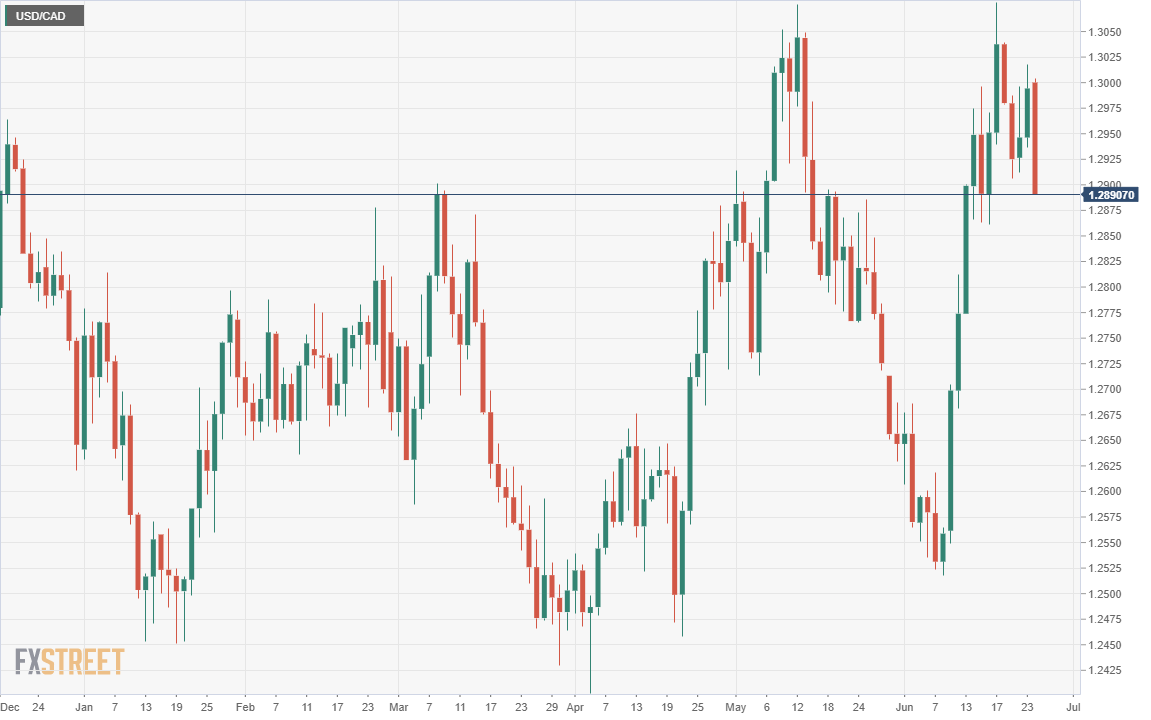
Friday’s slight increase in Treasury yields, the 10-year added 4 basis points, usually a USD/CAD positive, was overwhelmed by a 3.1% rebound in WTI to $106.57. The USD/CAD lost just over a figure on the day from 1.2994 to 1.2893.
On the week, the US 10-year yield lost 10 basis points, WTI dropped 1.8% and the USD/CAD slipped 1.1% from 1.3038 to the above 1.2893.
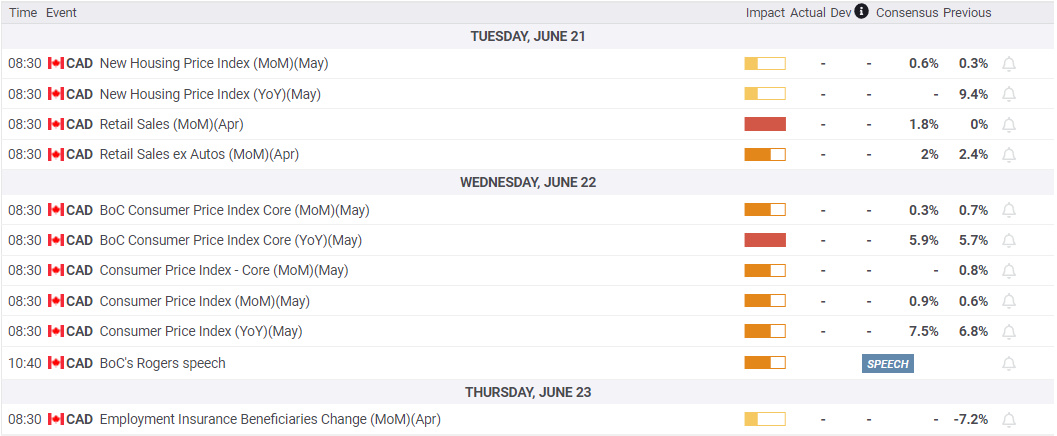
Canadian Retail Sales at 0.9% in April were marginally stronger than the 0.8% forecast but up substantially from March’s 0.2% gain. The increase was a bit surprising given accelerating inflation. The Consumer Price Index (CPI) jumped to 7.7% overall in May from 6.8% prior and the core rate rose to 6.1% from 5.7%.
Testifying before Congress, Federal Reserve Chair Jerome Powell said that the central bank needs to see clear proof that inflation is slowing before limiting rate increases. He admitted under questioning that higher rates could bring on a recession and may have limited effect on inflation, especially for food and energy prices.
Fed Governor Michelle Bowman suggested in an interview with Reuters that a 75 basis point increase in July followed by 50 points at later meetings was the appropriate scenario. “I am committed to a policy that will bring real federal funds rate back into positive territory.”
With the Core Personal Consumption Expenditures Price Index at 4.9% in April and forecast to be 4.7% in May, that would place the final base rate more than 100 basis points above the 3.4% projected by the central bank at the end of this year and 200 points above the current upper target of 1.75%.
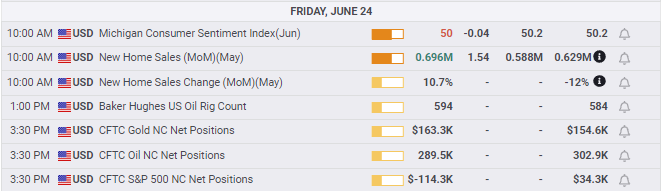
The US business outlook weakened in June with the S&P manufacturing PMI registering its lowest score since July 2020. Existing Home Sales, 90% of the US housing market, fell 3.4% in May bringing the decline since January to 16.6%. American consumer confidence slipped again in June as the Michigan Survey was revised to 50.
USD/CAD outlook
American and Canadian economic statistics reflect the same trends and tendencies and over the course of the lockdowns and recovery have offered no direction to the USD/CAD. Likewise, the alternating rate hikes of the Federal Reserve and the Bank of Canada (BoC) are nearly mirror images.
The next BoC meeting is on July 13 and a 75 basis point hike is possible given the surprise in May’s CPI.
Canadian statistics are sparse next week with only April GDP on tap.
Energy prices have been the sole variable providing the loonie with additional heft.
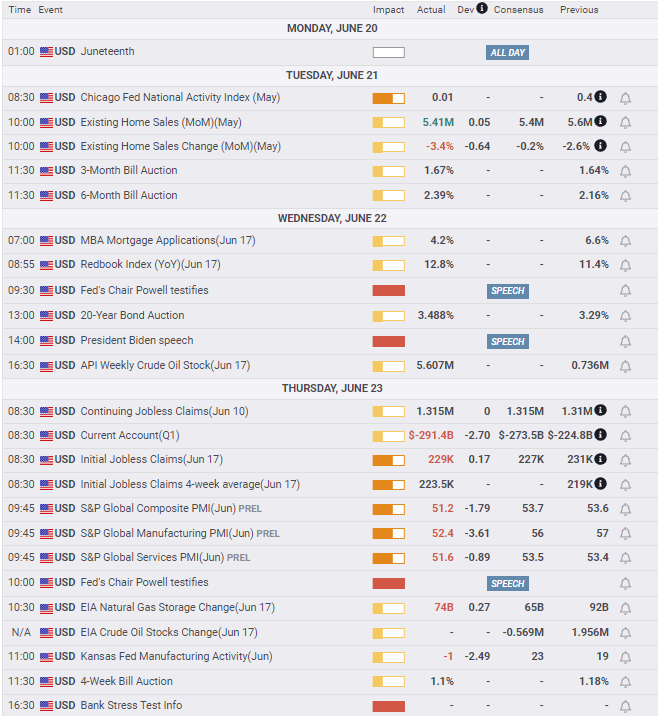
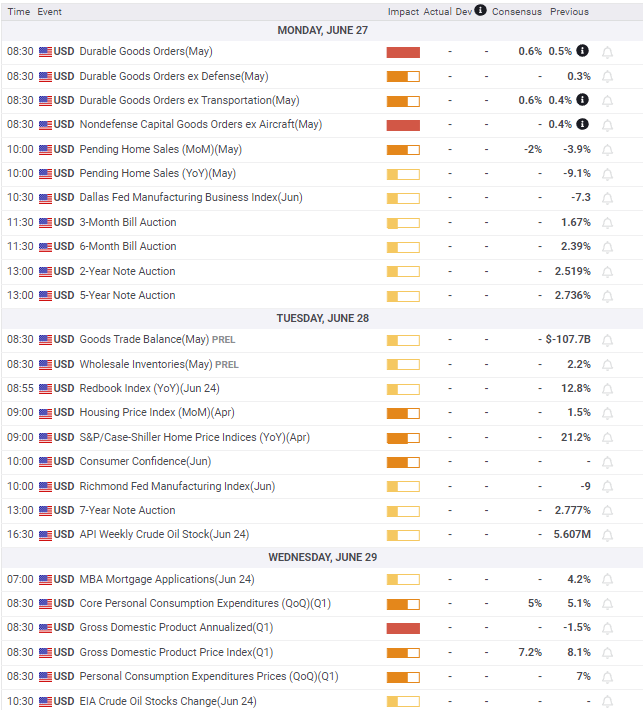
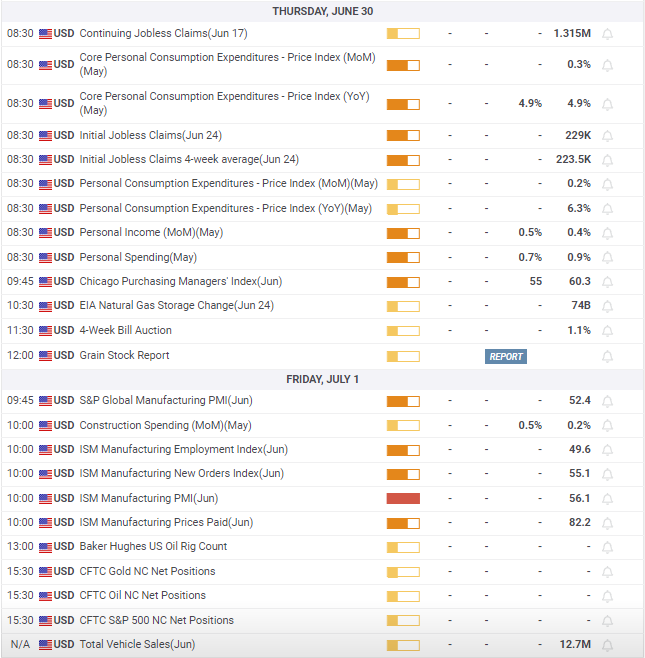
In the US, Durable Goods in the US will repeat the weakness of Retail Sales and Conference Board Consumer Confidence that of the Michigan survey. The final edition of first quarter GDP is expected to be unchanged at -1.5%. Personal Income and Spending and the accompanying PCE inflation gauges will be the week's highlight. Weakness in consumption and higher than forecast inflation will play into the recession scenario. Traders should note the Real Disposable Income and Spending figures from the Bureau of Economic Analysis (BEA) that are issued with the PCE data for an accurate reading of income and consumption.
Markets have become increasingly concerned that the combination of aggressive Fed and BoC monetary policies and inflation will bring on a recession. The possibility has grown as some forward-looking data has weakened but the likelihood is that a recession would strike the US and Canadian economies simultaneously.
Energy prices are the potential difference as their variation affects the Canadian economy more than its southern neighbor.
Germany is attempting to reduce its dependency on Russian energy, though it is unclear what effect that might have on the global energy market. Russia is pumping and selling as much oil and gas as before the Ukraine invasion, albeit for less income.
If Germany, or the EU abandoned all Russian energy imports it could squeeze prices higher for non-Russian sources. Or, and probably more likely, the essentially fungible commodity would keep prices from rising much higher.
The outlook for the USD/CAD is range-bound between 1.2700 and 1.3000 with two caveats. First for oil. As has been true since the Ukraine invasion, oil volatility has a pronounced USD/CAD response.
Second is for US Treasury rates. Fed officials have repeatedly said rates will rise to combat inflation, doubling in the bank’s projection by the end of the year. Credit markets, however, will lower Treasury yields if a recession seems imminent, taking the USD/CAD with them.
Canada statistics June 20–June 24
US statistics June 20–June 24
FXStreet
Canada statistics June 27–July 1

FXStreet
US statistics June 27–July 1
USD/CAD technical outlook
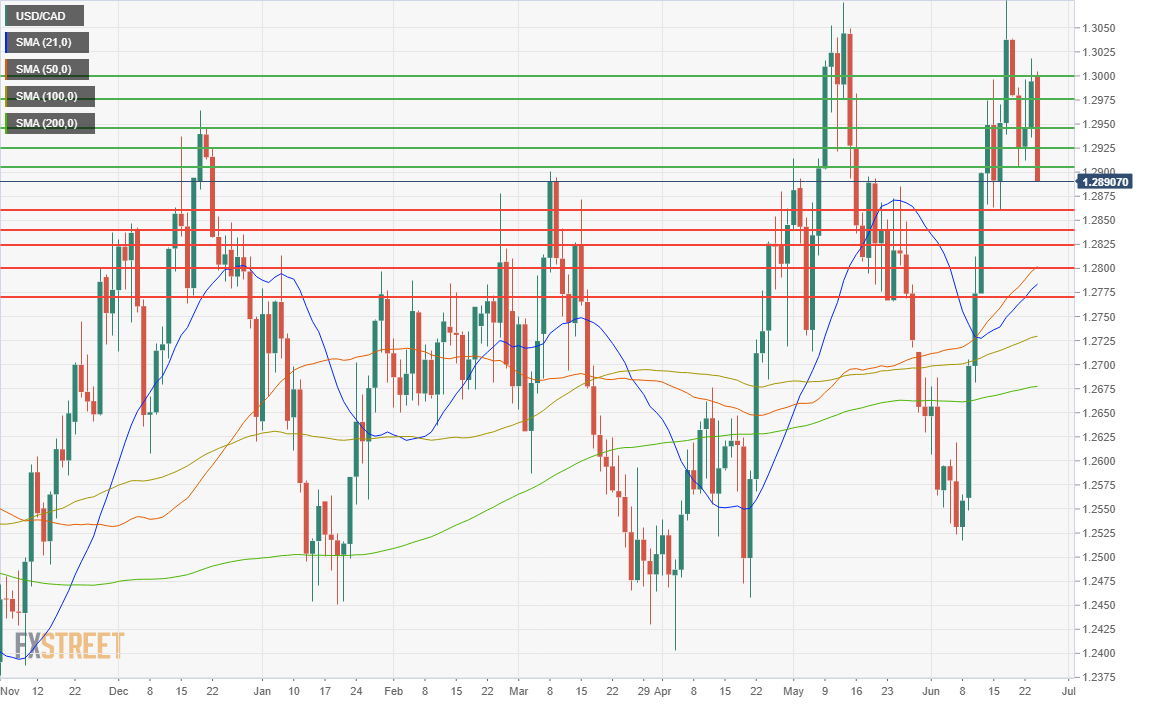
The turn in the MACD (Moving Average Convergence Divergence) on Thursday bought the price line closer to the signal line than at any time in the last two weeks. At best this is a neutral signal, it is not yet a sell point. The Relative Strength Index (RSI) has also shifted to neutral with the reversion back into the range of the last two months. Average True Range (ATR) is still relatively high but if the USD/CAD falls below 1.2850 volatility will decrease.
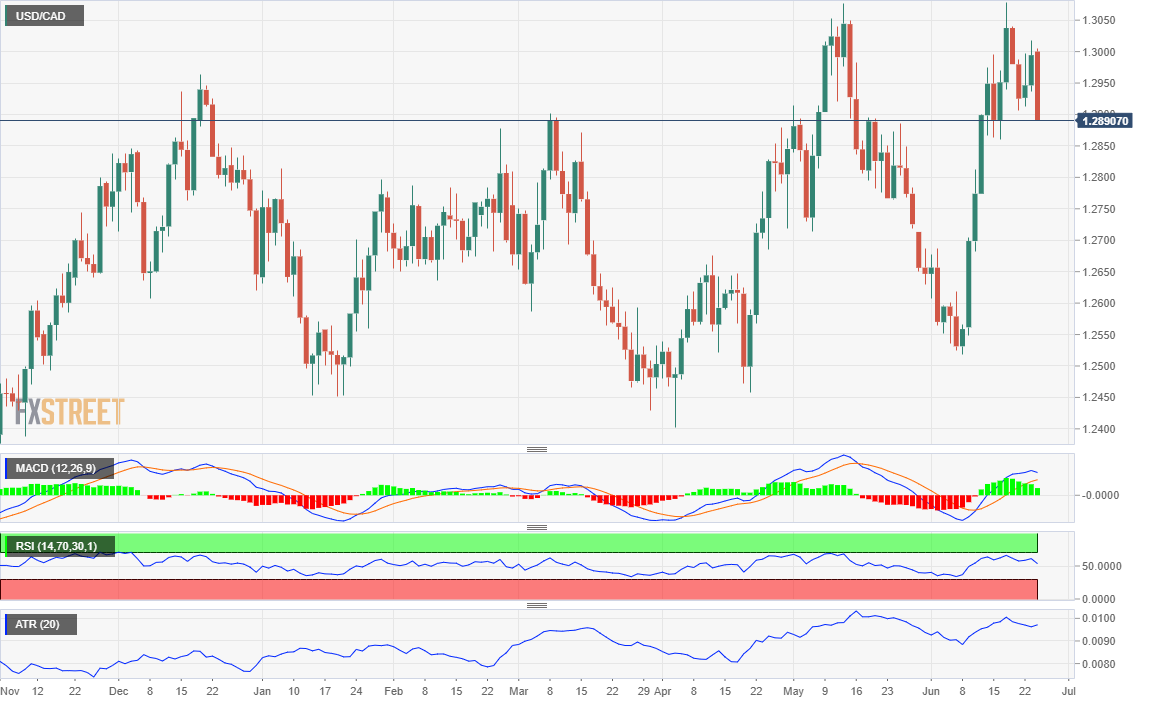
Moving Averages: 21-day 1.2784, 50-day 1.2802, 100-day 1.2730, 200-day 1.2677
Resistance: 1.2900, 1.2925, 1.2945, 1.2975, 1.2000
Support: 1.2860, 1.2840, 1.2825, 1.2800 (50-day moving average 1.2802), 1.2770
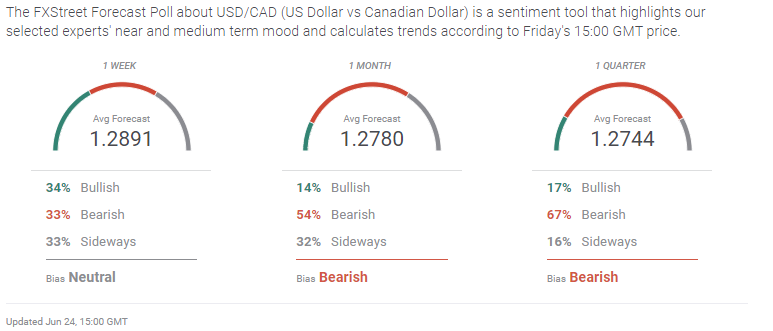
FXStreet Forecast Poll
The FXStreet Forecast Poll sees no catalyst to break the USD/CAD from its cage. Without a fundamental change in the forces playing on the pair, the USD/CAD will slip back into its familiar territory.
Author

Joseph Trevisani
FXStreet
Joseph Trevisani began his thirty-year career in the financial markets at Credit Suisse in New York and Singapore where he worked for 12 years as an interbank currency trader and trading desk manager.