USD and ISM manufacturing reaction


The U.S. dollar extended its rebound overnight, driven in large part by a surprisingly strong January ISM Manufacturing Index. After lingering below the 50 threshold for much of the past year — signalling contraction — the headline index jumped to 52.6, beating expectations and returning to expansion territory for the first time since August 2022.
What stood out in today’s release was not just the headline number, but breadth of improvement:
- Production rose sharply, suggesting factories are increasing output rather than simply stabilizing.
- New orders climbed back above 50, a critical early indicator of future activity.
- Even order backlogs moved into expansion, hinting that demand may be outpacing supply and spurring capacity utilization.
This suite of data paints a picture of the manufacturing sector shifting from contraction to measured expansion, which has implications well beyond the factory floor.
Why does this matter for markets and the Federal Reserve?
- Stronger manufacturing activity tends to support employment, capital spending, and services demand, reducing the need for the Fed to rush into rate cuts.
- Durable ISM data keeps the narrative of economic resilience alive at a time when many investors had been leaning on soft data to justify looser policy.
- With inflation still above target and activity proving more robust, today’s print may temper expectations for near-term rate cuts, reinforcing a “higher-for-longer” rate backdrop.
In this context, the dollar’s recent strength looks less like a technical rebound and more like a response to fundamental upticks in U.S. economic momentum.
Technical picture — DXY (US Dollar Index)
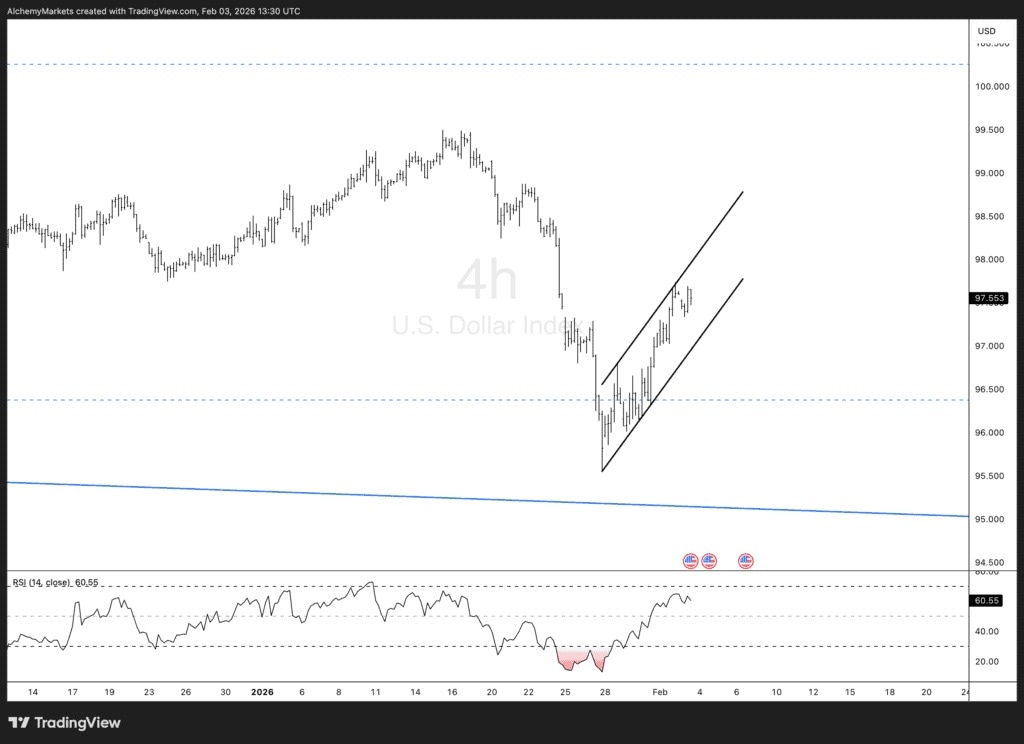
On the charts, the U.S. Dollar Index (DXY) has staged a sharp recovery from the late-January lows — roughly those seen around January 27. Since then, price action has been climbing inside a well-defined ascending channel on the 4-hour timeframe, consistent with typical corrective rallies.
A few key observations:
- The move off the lows has been steep and sustained, pushing the index back toward resistance levels near prior supply zones.
- Relative Strength (RSI) readings on the 4-hour chart have climbed into the upper range, suggesting short-term momentum is strong but perhaps becoming overextended.
- Structurally, the channel remains intact, meaning buyers are still in control — but overextensions within such patterns often precede pullbacks or sideways consolidation before another leg higher.
So where could the dollar go from here?
- In the near term, the steep slope of the rally leaves the DXY vulnerable to a technical correction, particularly if U.S. equities stabilize or yields pull back — catalysts that often weigh on safe-haven flows.
- A break below the channel’s lower boundary would shift focus toward the January lows as the next meaningful support zone.
- Conversely, if the dollar digests recent strength and finds buyers near the channel floor, it could resume its uptrend later in February — especially if macro data remain surprisingly firm.
What this means for markets and the Fed
Today’s strong ISM print reinforces market pricing that the U.S. economy is not deteriorating as quickly as some feared. For the Federal Reserve, that’s a signal that the labor market and core sectors still have room to operate without immediate policy easing.
From a trading perspective:
- Expect some profit-taking or corrective action in the dollar after a steep move off the lows.
- The medium-term trend may ultimately remain upward if economic data continue to surprise to the upside.
- Key levels on the DXY will be watched closely for breakouts or breakdowns as traders digest both macro momentum and technical exhaustion.
Author
Zorrays Junaid
Alchemy Markets
Zorrays Junaid has extensive combined experience in the financial markets as a portfolio manager and trading coach. More recently, he is an Analyst with Alchemy Markets, and has contributed to DailyFX and Elliott Wave Forecast in the past.